How to Create Generational Wealth: Strategies, Examples and Mistakes to Avoid
Generational wealth is not only about leaving a large inheritance. It is about building assets, knowledge, habits, and systems that give the next generation a stronger financial start than the last one had.
For some families, generational wealth may mean a paid-off home, a small business, or money invested for children’s education. For others, it may include rental properties, investment portfolios, trusts, insurance, family businesses, and a clear estate plan. The size matters less than the principle: assets should survive, grow, and be transferred wisely.
This guide explains how generational wealth works, why many families lose it, and how beginners can start building it step by step. The goal is not to promise overnight riches. The goal is to show practical, realistic strategies that can help a family move from financial stress to long-term financial stability.
1. Quick Answer: How Do You Create Generational Wealth?
You create generational wealth by consistently buying and protecting assets that can increase in value, produce income, or reduce future expenses, then transferring those assets with a clear plan. The process usually includes earning more, spending wisely, investing regularly, avoiding destructive debt, protecting the family with insurance and legal documents, and teaching financial skills to the next generation.
- Build a strong financial base: emergency savings, controlled debt, and positive cash flow.
- Buy assets: diversified investments, real estate, business ownership, education, and intellectual property where appropriate.
- Protect assets: insurance, legal structures, estate planning, and risk management.
- Transfer wisely: wills, beneficiary designations, trusts, family governance, and financial education.
- Repeat across generations: teach heirs how to manage, grow, and preserve what they receive.
| Generational wealth pillar | What it means | Beginner example |
|---|---|---|
| Cash-flow discipline | Spend less than you earn and direct the gap into assets. | Automate monthly investing after every payday. |
| Ownership | Own assets instead of only consuming income. | Buy index funds, a small rental, or equity in a business. |
| Protection | Prevent one crisis from destroying years of progress. | Use insurance, emergency funds, and legal documents. |
| Transfer planning | Make sure wealth reaches the right people efficiently. | Keep an updated will and beneficiaries. |
| Education and values | Teach heirs how to handle responsibility. | Discuss budgeting, investing, generosity, and family goals. |
2. What Is Generational Wealth?
Generational wealth is wealth that passes from one generation of a family to the next. It can include money, property, investments, businesses, education, professional networks, financial habits, and valuable knowledge.
A simple way to think about it is this: personal wealth helps one person or household. Generational wealth is designed to support future family members too. It gives children, grandchildren, or other heirs better choices, such as less student debt, a safer home, startup capital for a business, or a cushion during emergencies.
Generational wealth can be financial or non-financial. Financial wealth includes cash, real estate, retirement accounts, brokerage accounts, businesses, life insurance proceeds, and intellectual property. Non-financial wealth includes education, skills, family values, discipline, reputation, mentorship, and access to useful relationships.
3. Why Generational Wealth Matters
Generational wealth can reduce financial pressure and increase opportunity. A young adult who graduates without heavy debt, receives help with a home deposit, or inherits a well-managed investment account may have more freedom to choose meaningful work, start a business, or invest early.
It can also protect a family during difficult times. A family with assets may be better able to handle job loss, medical bills, economic downturns, or business setbacks. This does not remove all risk, but it gives the family more options.
However, generational wealth can also create problems if it is transferred without preparation. Money without financial education can encourage overspending, entitlement, family conflict, or poor investment choices. This is why building wealth and preparing heirs must happen together.
| Type of generational wealth | Examples | Main benefit | Main risk |
|---|---|---|---|
| Financial assets | Cash, investments, real estate, retirement accounts | Can grow and support future needs | Can be spent quickly or poorly managed |
| Business ownership | Family company, shares, partnership interests | Can produce income and jobs | Can fail or create family disputes |
| Education capital | Tuition help, skills training, professional credentials | Raises earning potential | May not pay off without planning |
| Social capital | Mentors, reputation, networks, business contacts | Creates opportunities | Can fade if relationships are not maintained |
| Values and habits | Discipline, saving, investing, stewardship | Helps wealth last | Hard to teach if adults do not model it |
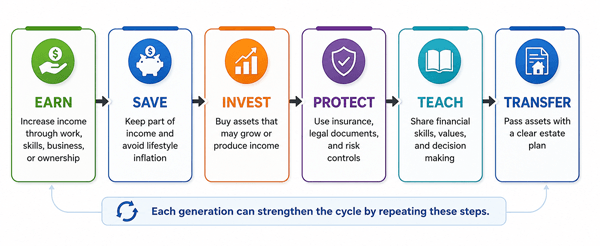
4. How Generational Wealth Works: A Simple Diagram
Generational wealth is a cycle. Each generation can either strengthen the cycle or weaken it.
Step 1: Build a Strong Financial Foundation First
Before a family can create wealth for future generations, it needs stability today. Trying to build generational wealth while ignoring high-interest debt, no emergency fund, or chaotic spending is like building a house on weak soil.
- Track income and expenses so you know where money is going.
- Build an emergency fund for unexpected costs.
- Pay down high-interest consumer debt before taking major investment risks.
- Create a basic budget that includes saving and investing as regular expenses.
- Keep important documents organized, including account details, policies, property records, and legal papers.
Practical example
A family earns $4,000 per month and saves $400 monthly. Instead of letting that money disappear into random spending, they automate $200 into long-term investments, $100 toward debt payoff, and $100 into emergency savings. This simple system can become the foundation for future assets.
Strategy 1: Invest Consistently in Diversified Assets
Investing is one of the most accessible ways to build long-term wealth. Beginners often think investing is only for rich people, but consistent investing can start small. The key is to invest regularly, stay diversified, and avoid gambling with money you cannot afford to lose.
Common options include broad stock market index funds, diversified mutual funds, exchange-traded funds, bonds, retirement accounts, and other regulated investment accounts available in your country. Diversification matters because it reduces the damage if one company, sector, or asset performs poorly.
A practical approach is to automate investing every month. This removes emotion and helps you benefit from long-term compounding. Compounding means your returns can begin earning returns of their own over time.
For accuracy, avoid promising a fixed return. Long-term markets can reward patience, but returns are never guaranteed and values can fall in the short term.
Strategy 2: Use Real Estate Carefully
Real estate has helped many families build generational wealth because it can provide shelter, appreciation, rental income, and a tangible asset that may be passed down. A paid-off family home can reduce housing costs for future generations. Rental property can produce income if managed well.
Real estate also carries risks. Property can be expensive to maintain, tenants may not pay, markets can decline, and debt can become stressful. Beginners should avoid buying property only because relatives or social media say it is always safe. Real estate works best when the numbers work even after repairs, vacancies, taxes, insurance, and financing costs.
Strategy 3: Build or Buy Ownership in a Business
Business ownership can create powerful generational wealth because a profitable business may produce income, increase in value, employ family members, and be sold or passed down. This could be a local service business, online business, franchise, professional practice, farm, manufacturing company, or shares in a private company.
The risk is that businesses can fail. A family business can also damage relationships if roles, ownership, pay, and succession are unclear. Good recordkeeping, written agreements, professional accounting, and clear leadership plans are essential.
Strategy 4: Invest in Education and Skills
Education can be a form of generational wealth when it improves earning power, decision-making, and independence. This does not always mean an expensive degree. It may include trade skills, professional certifications, apprenticeships, financial literacy, communication skills, technology skills, or entrepreneurship training.
The best education investment is one that has a realistic path to higher income, stronger skills, or better opportunities. Families should compare cost, expected earnings, debt levels, and career fit before spending heavily.
Strategy 5: Protect Wealth With Insurance and Risk Management
One accident, lawsuit, illness, death, or natural disaster can damage years of wealth-building. Insurance is not exciting, but it protects the wealth creation plan. Depending on the family situation, this may include health insurance, life insurance, disability insurance, property insurance, liability coverage, and business insurance.
The goal is not to buy every policy available. The goal is to identify risks that could seriously harm the family and transfer some of those risks to an insurer at a reasonable cost.
Strategy 6: Create an Estate Plan
Estate planning is the process of deciding what should happen to your assets, dependents, and responsibilities if you die or become unable to make decisions. A basic estate plan often includes a will, beneficiary designations, powers of attorney, healthcare directives, guardianship instructions for minor children, and sometimes trusts.
Many families delay estate planning because they think it is only for the wealthy. In reality, even modest estates need clear instructions. Without a plan, assets may be delayed, distributed according to default law, or become a source of family conflict.
Because estate laws differ by location, the safest approach is to use this section as a checklist and confirm the exact requirements with a qualified local professional.
Strategy 7: Teach Financial Literacy at Home
Money skills are part of the inheritance. If heirs receive assets but do not understand budgeting, investing, taxes, credit, debt, insurance, or business basics, the wealth may disappear quickly.
Start with age-appropriate lessons. Children can learn saving, spending, sharing, and delayed gratification. Teenagers can learn banking, compound growth, work ethic, and the cost of debt. Young adults can learn investing, taxes, insurance, estate documents, and career planning.
Strategy 8: Build Family Systems, Not Just Family Assets
Families that preserve wealth often create systems. These may include regular family money conversations, shared values, written goals, documentation, trusted advisors, and clear rules for helping relatives financially.
Systems reduce confusion. For example, instead of giving money whenever a family member asks, a family may create rules: help is available for education, emergencies, or business plans, but not for repeated lifestyle overspending. This protects both relationships and assets.
| Strategy | Best for | Pros | Cons or risks |
|---|---|---|---|
| Index fund investing | Beginners who want broad diversification | Simple, scalable, low maintenance | Market values rise and fall |
| Homeownership | Families seeking stability and long-term asset growth | Housing security, possible appreciation | Maintenance, taxes, concentration risk |
| Rental property | Families willing to manage property or hire managers | Income plus potential appreciation | Vacancy, repairs, tenant issues, leverage risk |
| Business ownership | Entrepreneurial families | High upside, income, legacy opportunities | Failure risk, stress, family conflict |
| Education funding | Children and young adults | Can increase lifetime earnings | Poor course choice or excessive debt can reduce benefit |
| Estate planning | Every family with assets or dependents | Clarity, protection, smoother transfer | Requires updates and professional help |
5. Real-World Examples of Generational Wealth
Example 1: The modest-income investing family
A couple with average income starts investing a small percentage of every paycheck in diversified funds. They also avoid high-interest debt and teach their children how investing works. After decades, the investment account helps fund education, a home deposit, and retirement. The next generation starts adulthood with less debt and better money habits.
Example 2: The paid-off family home
A family buys a home they can afford, maintains it, and eventually pays off the mortgage. Later, the home is passed to children or sold to fund education, caregiving, or retirement needs. The wealth is not only the property value; it is also decades of housing stability.
Example 3: The family business with a succession plan
Parents build a profitable local business. Instead of assuming children will automatically run it, they document roles, train successors, create fair compensation rules, and work with advisors on ownership transfer. The business becomes a productive asset rather than a source of confusion.
Example 4: The education-first family
Grandparents cannot leave a large estate, but they help grandchildren pay for practical education, certifications, and tools. The grandchildren avoid some debt and increase earning power. This is still generational wealth because it creates future opportunity.
6. Common Mistakes That Destroy Generational Wealth
Mistake 1: Building wealth but never teaching heirs how to manage it
Money without skills can disappear. Heirs need education, responsibility, and practice before receiving large assets.
Mistake 2: No written estate plan
Verbal promises can cause disputes. A written, legally valid plan makes wishes clearer and reduces confusion.
Mistake 3: Too much debt
Debt can help buy productive assets, but excessive consumer debt or overleveraged property can wipe out wealth during downturns.
Mistake 4: Lifestyle inflation
As income rises, spending often rises too. Families that spend every increase may look wealthy while building little lasting wealth.
Mistake 5: Concentrating all wealth in one asset
A family whose wealth is only one business, one property, or one stock is vulnerable if that asset declines.
Mistake 6: Ignoring taxes, legal rules, and documentation
Poor records, missed filings, and unclear ownership can reduce wealth and create conflict.
Mistake 7: Treating inheritance as a surprise event
Heirs should understand basic expectations, values, and responsibilities. Full details may not always be appropriate, but complete silence can create problems.
| Mistake | Why it hurts | Better approach |
|---|---|---|
| No estate plan | Assets may be delayed or disputed | Create and update wills, beneficiaries, and key documents |
| No financial education | Heirs may overspend or invest poorly | Teach budgeting, investing, debt, and stewardship |
| Overusing debt | Payments can crush cash flow | Use debt cautiously and avoid high-interest consumer debt |
| Poor communication | Family conflict can destroy value | Discuss values, roles, and expectations clearly |
| No diversification | One failure can damage everything | Spread risk across asset types where possible |
■ A Beginner-Friendly Plan to Start Creating Generational Wealth
- Calculate your net worth. List what you own, what you owe, and the difference between the two.
- Create positive monthly cash flow. Spend less than you earn and decide where the surplus goes before it disappears.
- Build emergency savings. This reduces the need to sell investments or borrow during a crisis.
- Eliminate destructive debt. Prioritize high-interest debt that does not help build assets.
- Start investing automatically. Even small monthly contributions can build discipline and long-term momentum.
- Increase earning power. Improve skills, negotiate income, start a side business, or build career capital.
- Protect the family. Review insurance, legal documents, and account beneficiaries.
- Document everything. Keep a secure record of accounts, policies, property, debts, advisors, and passwords.
- Talk about money wisely. Teach children and heirs how money works before they inherit it.
- Review the plan every year. Life changes, markets change, laws change, and family needs change.
Simple 12-month starter roadmap
Months 1-3: track spending, build a small emergency fund, and list assets and debts. Months 4-6: pay down high-interest debt and automate saving. Months 7-9: begin diversified investing and review insurance. Months 10-12: create or update estate documents and start family financial education conversations.
7. Tools That Help Transfer Wealth
The right transfer tools depend on your country, assets, family situation, and legal system. The following are common concepts to discuss with qualified professionals.
| Tool | What it does | Who may need it |
|---|---|---|
| Will | States how assets should be distributed and may name guardians for minor children. | Most adults, especially parents and asset owners |
| Beneficiary designations | Direct certain accounts or policies to named people. | People with retirement accounts, insurance, or payable-on-death accounts |
| Trust | Can hold and distribute assets under specific rules. | Families needing control, privacy, tax planning, or protection for minors |
| Power of attorney | Allows someone to handle financial matters if you cannot. | Adults who want continuity during incapacity |
| Healthcare directive | States medical decision preferences and decision-makers. | Adults who want healthcare wishes documented |
| Buy-sell agreement | Sets rules for transferring business ownership. | Business owners and family businesses |
8. Benefits and Limitations of Generational Wealth Planning
| Benefits | Limitations |
|---|---|
| Gives future generations more options and stability. | It takes time, discipline, and patience. |
| Can reduce debt burdens for children or heirs. | Assets can be lost through poor choices or market declines. |
| Can support education, homeownership, and entrepreneurship. | Family conflict can damage the plan. |
| Encourages long-term thinking and responsibility. | Legal and tax planning can be complex. |
| Creates a family culture of stewardship. | Inheritance alone does not guarantee happiness or success. |
9. Generational Wealth Checklist
- I know my current net worth and monthly cash flow.
- I have an emergency fund or a plan to build one.
- I am reducing high-interest consumer debt.
- I invest consistently in diversified assets.
- I understand the risks of real estate, business ownership, and leverage before using them.
- I have appropriate insurance for major risks.
- My will, beneficiaries, and key estate documents are current.
- My family knows where important documents are stored.
- I teach heirs practical money skills.
- I review the family wealth plan at least once a year.
■ FAQs About Creating Generational Wealth
1. Do you need to be rich to create generational wealth?
No. You need a plan, discipline, and time. A modest inheritance, debt-free education support, a paid-off home, or strong financial education can all improve the next generation’s future.
2. What is the best asset for generational wealth?
There is no single best asset for every family. Diversified investments, real estate, business ownership, and education can all play a role. The best mix depends on income, risk tolerance, goals, skills, and local laws.
3. How long does it take to build generational wealth?
It often takes decades. Some progress can happen in a few years, such as paying off debt or starting investments, but lasting wealth usually comes from consistent decisions over a long period.
4. Can life insurance create generational wealth?
Life insurance can protect dependents and may provide funds after death. It should be chosen based on family needs, affordability, and policy details rather than sold as a magic wealth-building tool.
5. Should parents tell children about inheritance?
Parents do not need to reveal every number, but children should learn the values, responsibilities, and basic financial skills needed to manage wealth. Age-appropriate communication is better than complete secrecy.
6. What is the biggest threat to generational wealth?
The biggest threats are usually poor financial education, family conflict, lack of planning, excessive debt, and concentrated risk. Wealth preservation requires both assets and good decision-making.
7. How can a low-income family start?
Start with what is controllable: budgeting, emergency savings, debt reduction, career skills, small automated investments, and teaching children money habits. Small steps can compound over time.
8. Is generational wealth only about inheritance?
No. It also includes education, habits, values, networks, and systems that help future generations make better financial decisions.
■ Final Thoughts: Build Assets, Skills, and Systems
Creating generational wealth is not about chasing quick money. It is about building assets, protecting those assets, and preparing the next generation to handle them wisely. The strongest family wealth plans combine practical investing, responsible debt use, estate planning, risk management, education, and honest communication.
Start with one step: calculate your net worth, automate a small investment, update your beneficiaries, or teach a child how saving works. Generational wealth is built through repeated decisions that help the family become more stable, capable, and prepared over time.
Reader Advice: This article is for educational and information purposes only and should not be taken as financial, legal, tax, or investment advice. Please check the latest information from official sources and qualified professionals, as rules, policies, and personal circumstances can change over time.