How to Build Wealth from Scratch: Beginner's Guide
Building wealth from scratch does not mean becoming rich overnight. It means creating a financial life where your money gives you more choices, more stability, and less stress over time. You may be starting with a low income, no savings, debt, or very little financial knowledge. That is normal. Many people begin there.
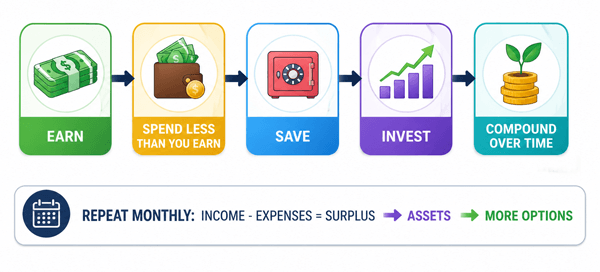
The good news is that wealth building is not based on luck alone. It is built through a repeatable pattern: earn money, spend less than you earn, protect yourself from emergencies, pay down harmful debt, buy assets, and give those assets time to grow. Small steps repeated consistently can create meaningful results.
This beginner's guide explains how to build wealth from scratch in a practical way. You will learn what wealth really means, how to start even with little money, what to prioritize first, how investing works, and which mistakes to avoid.
In simple terms, the best way to build wealth from scratch is to create a monthly surplus, protect it with savings, use it to remove expensive debt, and then invest consistently in suitable long-term assets.
1. What Does It Mean to Build Wealth from Scratch?
Building wealth from scratch means starting with little or no financial assets and gradually increasing your net worth. Net worth is the difference between what you own and what you owe.
Net worth formula: Assets - Liabilities = Net Worth
Assets are things you own that have value, such as cash, savings, investments, retirement accounts, property, or a business. Liabilities are debts you owe, such as credit cards, student loans, car loans, personal loans, or a mortgage.
| Example | Amount |
|---|---|
| Cash and savings | $1,000 |
| Investments | $500 |
| Car value | $6,000 |
| Total assets | $7,500 |
| Credit card debt | -$1,200 |
| Car loan | -$4,000 |
| Net worth | $2,300 |
A person with a modest income can build wealth if they consistently grow assets faster than debts. A high-income person can still struggle financially if they spend everything and carry expensive debt.
2. The Core Wealth-Building Formula
Wealth building can be simplified into one practical formula:
Increase income + control spending + invest the gap + stay consistent = wealth over time
The phrase 'invest the gap' is important. The gap is the difference between your income and expenses. If you earn $2,000 per month and spend $1,850, your gap is $150. If you can increase the gap to $400 by earning more or reducing wasteful spending, you have more money to save, invest, or use to pay off debt.
Quick answer for beginners: start by measuring your net worth, build a realistic budget, create a starter emergency fund, pay off high-interest debt, increase income, and invest only after you understand the risks and time horizon.
Wealth-Building Flow Diagram
Step 1: Know Your Starting Point
Before you can build wealth, you need a clear picture of your finances. Many beginners avoid this step because they feel embarrassed, confused, or anxious. But knowing your numbers gives you control.
Calculate Your Net Worth
- List everything you own that has financial value: cash, bank balances, investments, vehicles, property, business assets, and valuable items you would realistically sell.
- List everything you owe: credit cards, loans, unpaid bills, student loans, car loans, mortgages, or money borrowed from family.
- Subtract total debts from total assets.
Do not worry if your net worth is low or negative. The number is not a judgment. It is a starting line.
Track Your Monthly Cash Flow
Cash flow means how money moves in and out of your life each month. Write down your income and your regular expenses. Include rent, food, transport, utilities, insurance, debt payments, subscriptions, personal spending, and irregular costs.
| Category | Monthly Amount |
|---|---|
| Income | $2,500 |
| Rent and utilities | $950 |
| Food | $350 |
| Transport | $250 |
| Debt payments | $300 |
| Insurance and phone | $180 |
| Personal and entertainment | $250 |
| Remaining gap | $220 |
Step 2: Build a Simple Budget That You Can Actually Follow
A budget is not a punishment. It is a plan for where your money should go before it disappears. The best budget is the one you can repeat every month.
A Beginner-Friendly Budget Method
A simple starting method is the 50/30/20 framework. It is not perfect for every situation, but it helps beginners understand balance.
| Budget Area | Meaning | Example |
|---|---|---|
| Needs | Essential expenses such as housing, food, transport, utilities, basic insurance, minimum debt payments. | Around 50% of income if possible. |
| Wants | Lifestyle spending such as eating out, hobbies, subscriptions, shopping, entertainment. | Around 30% or less. |
| Savings and debt payoff | Emergency fund, investing, extra debt payments, future goals. | Around 20% or more. |
If your income is low or your living costs are high, you may not hit these percentages right away. Start with whatever is possible. Even saving 2% to 5% builds the habit. Then improve gradually.
Practical Budgeting Tips
- Automate savings as soon as income arrives, even if the amount is small.
- Separate bills, spending money, and savings into different accounts if possible.
- Review subscriptions and recurring charges every month.
- Use cash or a debit card for categories where you overspend.
- Plan for irregular expenses such as car repairs, school fees, gifts, and medical costs.
Step 3: Create a Starter Emergency Fund
An emergency fund is cash set aside for unexpected expenses. It protects your wealth-building plan from being destroyed by one surprise bill.
For beginners, a good first target is a small starter emergency fund, such as $500 to $1,000 or one month of essential expenses. After high-interest debt is under control, aim for three to six months of essential expenses.
| Emergency Fund Stage | Goal | Best For |
|---|---|---|
| Starter fund | $500 to $1,000 or a small local equivalent | People just beginning or paying high-interest debt. |
| Basic fund | One month of essential expenses | People with unstable income or tight budgets. |
| Full fund | Three to six months of essential expenses | Most households seeking stronger protection. |
Keep emergency money safe and easy to access. Do not invest it in risky assets, because emergencies often happen when markets are down or when you need cash quickly.
Step 4: Pay Off High-Interest Debt
Not all debt is equal. Some debt can help you build assets, such as a reasonable mortgage on a home or a business loan used wisely. But high-interest consumer debt, especially credit card debt and payday-style loans, can block wealth building because interest costs grow quickly.
Debt Snowball vs. Debt Avalanche
| Method | How It Works | Pros | Cons |
|---|---|---|---|
| Debt snowball | Pay the smallest debt first while making minimum payments on the rest. | Builds motivation quickly; simple to follow. | May cost more interest. |
| Debt avalanche | Pay the highest-interest debt first while making minimum payments on the rest. | Usually saves the most money. | May feel slower if the highest-rate debt is large. |
Choose the method you will actually follow. If motivation is your biggest problem, the snowball method may help. If you are disciplined and want the lowest interest cost, the avalanche method is usually better.
Step 5: Increase Your Income
Cutting expenses helps, but there is a limit to how much you can cut. Income growth can speed up wealth building because it increases the gap between what you earn and what you spend.
Ways Beginners Can Increase Income
- Ask for a raise after documenting your results and market value.
- Learn a practical skill that improves your earning power, such as sales, coding, bookkeeping, design, writing, data analysis, or a trade.
- Take on freelance or part-time work for a limited period to build savings or pay debt.
- Sell unused items and put the money toward your emergency fund or debt payoff.
- Start a small service business based on skills you already have.
The key is to avoid lifestyle inflation. If your income rises by $300 per month and your spending rises by $300, your wealth-building gap does not improve. Direct part of every raise, bonus, or side income toward savings, debt reduction, or investing.
Step 6: Start Investing Early, Even with Small Amounts
Saving protects you. Investing grows your money. Once you have a basic emergency fund and a plan for high-interest debt, investing becomes one of the most important wealth-building tools.
Investing means putting money into assets that may increase in value or produce income over time. Common examples include stock funds, bond funds, retirement accounts, real estate, and business ownership. Investments can lose value, especially in the short term, so they are best used for long-term goals.
Why Compounding Matters
Compounding happens when your investment earnings begin generating their own earnings. Time is the key ingredient. The earlier you start, the less pressure you put on yourself later.
| Monthly Investment | Years Invested | What Happens |
|---|---|---|
| $50 | 5 years | Builds the habit and creates a small investment base. |
| $100 | 10 years | Creates meaningful progress if invested consistently. |
| $300+ | 20+ years | Can become a major part of long-term wealth when paired with patience and diversification. |
The exact result depends on returns, fees, taxes, and market performance. There are no guaranteed investment returns, and past performance does not guarantee future results. Focus on consistency, diversification, low costs, and a long time horizon.
Common Investment Options for Beginners
Before choosing any investment account or product, check the current rules, fees, tax treatment, and withdrawal limits in your country. These details can change over time and can affect which option is suitable for you.
| Investment Option | What It Is | Potential Benefit | Main Risk |
|---|---|---|---|
| Savings account or money market account | Cash account for safe, accessible money. | Good for emergency funds and short-term goals. | May not keep up with inflation. |
| Index fund or ETF | A fund that tracks a broad market index. | Diversification and often lower costs. | Market value can fall. |
| Retirement account | Tax-advantaged account for long-term retirement savings. | Can support disciplined long-term investing. | Rules, taxes, fees, and withdrawal limits may apply. |
| Bonds or bond funds | Loans to governments or companies. | May add stability and income. | Interest rate and credit risk. |
| Real estate | Property used for living, renting, or appreciation. | Potential income and long-term value. | Requires capital, maintenance, and risk management. |
| Business ownership | Building or buying a business asset. | High upside and control. | Higher failure risk and time demands. |
Step 7: Protect Your Wealth
Wealth building is not only about making money. It is also about protecting what you build. A single uninsured accident, medical bill, legal problem, or job loss can set you back.
Protection Basics
- Keep an emergency fund for surprise costs.
- Use appropriate insurance for your situation, such as health, auto, renters, homeowners, disability, or life insurance.
- Avoid co-signing loans unless you are fully prepared to repay the debt yourself.
- Keep important documents organized, including IDs, insurance policies, account details, and debt records.
- Use strong passwords and two-factor authentication for financial accounts.
Step 8: Build Good Money Habits
Wealth is often the result of boring habits repeated for years. You do not need to be perfect. You need a system that helps you make good decisions most of the time.
| Habit | Why It Helps | Simple Action |
|---|---|---|
| Pay yourself first | Makes saving automatic instead of optional. | Transfer money to savings when income arrives. |
| Track net worth monthly | Shows whether you are moving in the right direction. | Update assets and debts once per month. |
| Avoid bad debt | Keeps interest from eating your future income. | Wait 24 hours before non-essential purchases. |
| Invest regularly | Uses consistency and time to grow assets. | Set a recurring monthly investment. |
| Learn continuously | Improves decisions and confidence. | Read one personal finance article or book chapter each week. |
A Practical 12-Month Wealth-Building Plan for Beginners
| Month | Main Focus | Action Step |
|---|---|---|
| 1 | Face the numbers | Calculate net worth and write down all income, expenses, and debts. |
| 2 | Create a budget | Choose a simple budget and identify three expenses to reduce. |
| 3 | Start emergency savings | Save your first $100 to $500 or local equivalent. |
| 4 | Debt plan | Choose snowball or avalanche and make extra payments. |
| 5 | Automate | Set automatic transfers for savings or debt payoff. |
| 6 | Increase income | Apply for better work, ask for a raise, or start a side income project. |
| 7 | Learn investing basics | Understand risk, diversification, fees, and time horizon. |
| 8 | Begin investing | Start small if appropriate and focus on long-term diversified investments. |
| 9 | Review insurance | Check whether one major event could damage your finances. |
| 10 | Improve skills | Invest time in a skill that can raise your income. |
| 11 | Review net worth | Compare your current net worth with month one. |
| 12 | Set next-year goals | Choose targets for savings rate, debt reduction, income, and investing. |
3. Real-World Example: Building Wealth on a Modest Income
Imagine Sara earns $2,200 per month after tax. She has $600 in savings, $3,000 in credit card debt, and no investments. At first, wealth building feels impossible. She starts by tracking expenses and finds $180 per month in avoidable spending: unused subscriptions, frequent food delivery, and impulse shopping.
Sara uses $80 per month to build a starter emergency fund and $100 per month for extra credit card payments. Three months later, she receives a small raise worth $150 per month. Instead of spending it, she adds it to debt payoff. After her high-interest debt is gone, she redirects the same monthly amount into investments and a full emergency fund.
Sara did not become wealthy overnight. But she changed the direction of her finances. Her debt fell, savings rose, and she built habits that can compound for years.
4. Common Mistakes That Stop Beginners from Building Wealth
For financial safety, avoid any opportunity that promises guaranteed high returns, pressures you to act immediately, or is unclear about fees, risks, ownership, or regulation.
| Mistake | Why It Hurts | Better Choice |
|---|---|---|
| Waiting to start until income is higher | Delays habit building and compounding. | Start with a small amount now. |
| Trying to look rich | Spending on status can prevent real wealth. | Prioritize assets over appearances. |
| Ignoring high-interest debt | Interest can grow faster than savings. | Create a focused debt payoff plan. |
| Investing without an emergency fund | You may sell investments at a bad time. | Keep short-term safety money in cash. |
| Chasing quick money | Scams and speculation can cause major losses. | Use simple, diversified, long-term strategies. |
| Not tracking progress | You cannot improve what you do not measure. | Review budget and net worth monthly. |
5. Myths and Misconceptions About Wealth Building
Myth 1: You Need a High Income to Build Wealth
A higher income helps, but it does not guarantee wealth. The important question is how much of your income becomes assets instead of disappearing into expenses and debt.
Myth 2: Investing Is Only for Rich People
Many investment platforms and retirement plans allow small regular contributions. Beginners should focus on education, risk management, and long-term consistency rather than trying to pick the perfect investment.
Myth 3: All Debt Is Bad
Debt can be harmful when it funds consumption at high interest. But some debt may support long-term value, such as education, business growth, or property, if the cost and risk are carefully managed.
Myth 4: Wealth Building Should Be Fast
Fast wealth promises are often risky or misleading. Real wealth usually comes from time, discipline, skill development, and ownership of assets.
6. Pros and Cons of Building Wealth from Scratch
| Pros | Cons or Challenges |
|---|---|
| Creates financial security and more life choices. | Progress can feel slow in the beginning. |
| Reduces stress from emergencies and debt. | Requires discipline and delayed gratification. |
| Improves confidence and decision-making. | Income limits can make saving difficult at first. |
| Builds long-term assets and future opportunities. | Investments involve risk and uncertainty. |
Best Practices for Long-Term Wealth Building
- Spend less than you earn and increase the gap over time.
- Keep emergency savings separate from daily spending money.
- Pay off high-interest debt before taking big investment risks.
- Invest regularly in diversified assets for long-term goals.
- Avoid lifestyle inflation when income increases.
- Track net worth monthly or quarterly.
- Improve your skills so your income can grow.
- Protect yourself with appropriate insurance and good financial records.
- Be patient. Wealth is built through years of consistent decisions.
Beginner Wealth-Building Checklist
- I know my current net worth.
- I know how much money comes in and goes out each month.
- I have a simple budget I can follow.
- I am building or maintaining an emergency fund.
- I have a plan for high-interest debt.
- I am working on increasing my income.
- I understand the basics of investing before risking money.
- I am investing for long-term goals when appropriate.
- I review progress regularly.
Frequently Asked Questions
1. How can I build wealth if I have no money?
Start by tracking your income and expenses, creating a small gap, and saving even a small amount. Then focus on paying high-interest debt, increasing income, and building skills. The first goal is not to become rich quickly. It is to create financial momentum.
2. What is the first step to building wealth?
The first step is knowing your current financial position. Calculate your net worth and monthly cash flow. Once you know your numbers, you can make a realistic plan.
3. Should I save or pay off debt first?
If you have no emergency fund, build a small starter fund first. Then focus on high-interest debt while still keeping some cash for emergencies. After expensive debt is under control, increase savings and investing.
4. How much should I save each month?
Save what you can consistently maintain. A common target is 10% to 20% of income, but beginners may start with less. The key is to increase the percentage over time.
5. Can I build wealth with a low income?
Yes, but it may take more planning. Focus on controlling expenses, avoiding high-interest debt, building emergency savings, and increasing income through skills, better work, or side income.
6. Is investing risky for beginners?
Investing always involves risk. Beginners can reduce risk by learning first, avoiding speculation, diversifying, keeping costs low, and investing for long-term goals rather than short-term needs.
7. How long does it take to build wealth?
It depends on income, savings rate, debt, investment returns, and consistency. Most real wealth building takes years, not weeks. The earlier you begin, the more time your habits and investments have to compound.
8. What should I avoid when trying to build wealth?
Avoid high-interest debt, get-rich-quick schemes, emotional investing, lifestyle inflation, ignoring insurance, and comparing your progress to others.
Final Thoughts: Start Small, Stay Consistent, Keep Learning
Building wealth from scratch is not about one perfect decision. It is about building a system that turns your income into assets over time. Start with your numbers. Create a small monthly gap. Protect yourself with emergency savings. Pay down expensive debt. Increase your income. Invest consistently when you are ready.
The beginning may feel slow, but the habits you build now can change your future. Wealth grows when you make repeated choices that move money away from short-term waste and toward long-term ownership, security, and freedom.
Reader Advice: This article is for educational and informational purposes only and should not be taken as personalized financial, tax, legal, or investment advice. Please check the latest information from official sources or a qualified professional, because rules, policies, fees, and tax details can change over time.