Negative Net Worth Explained: Meaning, Causes and How to Fix It
This guide answers the common questions readers search for: what negative net worth means, how to calculate it, whether it is bad, and the practical steps that can help move net worth back toward zero and then positive territory.
1. What Is Negative Net Worth?
Negative net worth means you owe more than you own. In simple terms, the total value of your debts is higher than the total value of your assets. It can happen to students, young professionals, families, business owners, and even high-income earners. It does not automatically mean you are irresponsible or that your situation is hopeless. It means your current financial balance sheet needs attention.
Your net worth is a snapshot of your financial position at a specific point in time. It is not the same as your income, your credit score, or your monthly budget. A person can earn a high salary and still have negative net worth if they carry large debts. Another person can earn a modest income and have positive net worth if they own assets and keep debt under control.
It is also different from your debt-to-income ratio. Debt-to-income compares monthly debt payments with monthly income, while net worth compares everything you own with everything you owe.
Negative Net Worth Formula
The basic formula is:
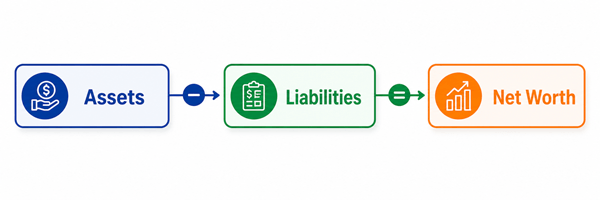
Image: Net worth is calculated by subtracting total liabilities from total assets.
| Assets | minus | Liabilities | equals | Net Worth |
|---|
If your liabilities are larger than your assets, your net worth is negative.
| Total Assets | Total Liabilities | Net Worth | Result |
|---|---|---|---|
| $20,000 | $35,000 | -$15,000 | Negative net worth |
| $75,000 | $75,000 | $0 | Break-even net worth |
| $120,000 | $80,000 | $40,000 | Positive net worth |
Short: Quick Answer: What Does Negative Net Worth Mean?
Negative net worth means your debts exceed your assets. For example, if you own $10,000 in cash, investments, and personal property but owe $25,000 in student loans and credit cards, your net worth is -$15,000. The goal is not to panic. The goal is to measure the gap, understand what caused it, and build a realistic plan to reduce liabilities while growing assets.
2. Examples of Negative Net Worth
Negative net worth can look different depending on your life stage and financial situation. Here are practical examples.
| Situation | Assets | Liabilities | Net Worth | What It Means |
|---|---|---|---|---|
| Recent graduate | $5,000 savings + $2,000 laptop/car value = $7,000 | $35,000 student loans | -$28,000 | Common early-career situation; focus on income growth and steady loan repayment. |
| Credit card debt | $3,000 cash + $4,000 car value = $7,000 | $18,000 credit cards | -$11,000 | High-interest debt is urgent because it grows quickly. |
| Upside-down car loan | $2,000 savings + $14,000 car value = $16,000 | $22,000 auto loan | -$6,000 | The car is worth less than the loan balance. |
| New business owner | $12,000 equipment + $5,000 cash = $17,000 | $30,000 business/personal debt | -$13,000 | May improve if the business becomes profitable, but needs cash-flow control. |
These examples show why context matters. A temporary negative net worth caused by education debt may be manageable if the degree leads to higher income. Negative net worth caused by high-interest consumer debt is usually more urgent because the balance can grow faster than you can repay it.
■ Common Causes of Negative Net Worth
1. Student Loans
Student loans are one of the most common reasons young adults start with negative net worth. Education can be an investment, but the debt still appears as a liability until it is repaid. The key question is whether your expected income can comfortably support the loan payments without blocking emergency savings and basic living costs.
2. Credit Card Debt
Credit card debt can quickly push net worth below zero because interest rates are often high. When you carry balances month after month, part of your future income is already committed to past spending. This makes it harder to save, invest, or handle emergencies. Paying only the minimum can keep balances outstanding for a long time, especially when new purchases are added.
3. Auto Loans That Exceed the Car Value
Cars usually lose value over time. If you finance a vehicle with a small down payment, a long loan term, or a high interest rate, you may owe more than the vehicle is worth. This is sometimes called being upside down or underwater on the loan.
4. Medical Bills or Emergency Expenses
A sudden medical bill, family emergency, job loss, or home repair can create debt even for someone who usually manages money well. Negative net worth caused by a crisis is not a character flaw. It is a signal that the recovery plan should include emergency savings and risk protection.
5. Low Savings and No Asset Base
Some people have negative net worth not because their debt is huge, but because they have very few assets. A small credit card balance, personal loan, or unpaid bill can create negative net worth when there is little cash, no investments, and no emergency fund.
6. Lifestyle Inflation
Lifestyle inflation happens when spending rises as income rises. Bigger rent, car payments, subscriptions, travel, dining out, and upgrades can keep a person financially stuck even with a good salary. If debt grows faster than assets, net worth can stay negative for years.
7. Business Losses or Personal Guarantees
Entrepreneurs sometimes use personal credit cards, personal loans, or guarantees to fund a business. If the business does not generate enough profit, personal net worth can become negative. Business debt should be tracked separately and carefully, especially when personal assets are at risk.
■ Is Negative Net Worth Bad?
Negative net worth is a warning sign, but it is not a life sentence. Whether it is serious depends on the amount, the type of debt, your income, your age, and whether the situation is improving or getting worse.
| Potentially Manageable | Needs Urgent Attention |
|---|---|
| Less concerning | More concerning |
| Debt is tied to education or a productive asset | Debt is mostly high-interest consumer debt |
| Payments are affordable and current | Payments are late or only minimum payments are possible |
| Income is stable or growing | Income is unstable or not enough for basic expenses |
| Net worth is improving over time | Net worth is becoming more negative each month |
| You have a written repayment plan | There is no plan and new debt keeps increasing |
The most important question is trend direction. A -$20,000 net worth that improves by $500 every month is healthier than a -$5,000 net worth that gets worse every month.
■ Risks and Limitations of Having Negative Net Worth
- Less financial flexibility: More income goes toward debt payments, leaving less room for saving and investing.
- Higher stress: Debt can affect sleep, relationships, and decision-making.
- Limited borrowing options: Lenders may view high debt levels as risky, especially when income is stretched.
- Delayed goals: Buying a home, starting a business, having children, or retiring comfortably may take longer.
- Greater emergency risk: Without savings, one unexpected expense can create more debt.
- Opportunity cost: Money used for interest cannot be used to build assets.
These risks are real, but they are also practical. That means they can often be improved through practical steps: better cash flow, lower interest, disciplined repayment, and steady asset building.
■ How to Calculate Your Net Worth Step by Step
- List your assets. Include cash, checking and savings accounts, investments, retirement accounts, real estate equity, vehicle value, business equity, and valuable personal property you could realistically sell.
- List your liabilities. Include credit cards, student loans, auto loans, personal loans, medical bills, mortgages, tax debt, business debt you personally owe, and money owed to family or friends.
- Use realistic values. Do not overestimate your car, home, business, or collectibles. Use conservative market values when possible.
- Subtract total liabilities from total assets. Assets minus liabilities equals net worth.
- Repeat monthly or quarterly. The trend matters more than one single number.
Optional but useful: keep a separate note of interest rates, minimum payments, due dates, and whether each debt is secured or unsecured. This makes the recovery plan clearer and reduces the chance of missing a payment.
What Counts as an Asset?
| Item | Count as Asset? | Practical Note |
|---|---|---|
| Cash and bank accounts | Yes | Use current balances. |
| Investments and retirement accounts | Yes | Use current market value before taxes unless doing a detailed plan. |
| Home | Yes | Use realistic market value, then list mortgage separately as a liability. |
| Car | Usually | Use resale value, not purchase price. |
| Furniture and electronics | Sometimes | Only include realistic resale value if meaningful. |
| Future salary | No | Income is not an asset until received and saved or invested. |
What Counts as a Liability?
| Item | Count as Liability? | Practical Note |
|---|---|---|
| Credit card balances | Yes | Use current balance, not just the minimum payment. |
| Student loans | Yes | Include principal and accrued interest. |
| Auto loans | Yes | Include full payoff balance. |
| Mortgage | Yes | List home value as an asset and mortgage as a liability. |
| Medical bills | Yes | Include unpaid balances and payment plans. |
| Monthly rent | No | Rent is an expense, not a debt, unless overdue. |
■ How to Fix Negative Net Worth: A Practical Step-by-Step Plan
Fixing negative net worth means closing the gap between what you owe and what you own. You can do that in two ways: reduce liabilities and increase assets. Most people need both.
Step 1: Stop the Net Worth From Getting Worse
Before you focus on big goals, stabilize the situation. You cannot repair net worth if new debt keeps appearing every month.
- Pause non-essential borrowing.
- Stop using credit cards for purchases you cannot pay off this month.
- Cancel or reduce expenses that are not helping your basic needs or goals.
- Build a small starter emergency fund, even if it is only $500 to $1,000.
- Make all required minimum payments to avoid fees, penalties, and credit damage.
Step 2: Build a Simple Survival Budget
A budget is not punishment. It is a cash-flow plan. Start with four categories: essentials, minimum debt payments, emergency savings, and everything else. If the first three categories do not fit your income, you need to reduce costs, increase income, negotiate payments, or seek professional help.
| Budget Area | Examples | Why It Matters |
|---|---|---|
| Essentials | Rent/mortgage, food, utilities, transport, insurance | Protect basic stability. |
| Debt minimums | Credit cards, loans, payment plans | Avoid late fees and defaults. |
| Starter savings | Small emergency fund | Reduce the need for new debt. |
| Flexible spending | Dining, shopping, entertainment, subscriptions | Cut here first when cash is tight. |
Step 3: Choose a Debt Repayment Strategy
Two popular methods are the debt snowball and debt avalanche. Both can work. The best method is the one you can follow consistently.
| Method | How It Works | Best For | Main Limitation |
|---|---|---|---|
| Debt snowball | Pay extra toward the smallest balance first while making minimums on the rest. | Quick wins and motivation. | May cost more interest than avalanche. |
| Debt avalanche | Pay extra toward the highest interest rate first while making minimums on the rest. | Usually saves the most interest. | Progress may feel slower if the highest-rate debt has a large balance. |
Step 4: Lower Interest Where Possible
Lower interest can make debt repayment easier because more of each payment reduces the principal balance. Options may include negotiating with creditors, using a balance transfer carefully, refinancing, consolidating, or asking about hardship programs. These options are not always available and may include fees or risks, so compare the total cost before choosing one.
Step 5: Increase Income and Direct the Extra Money
Cutting expenses helps, but income growth can speed up recovery. The key is to assign extra income before it disappears into everyday spending.
- Ask for overtime, a raise, or a higher-paying role if realistic.
- Use freelance work, part-time work, or selling unused items to make targeted debt payments.
- Put bonuses, tax refunds, and cash gifts toward priority debt or emergency savings.
- Avoid upgrading your lifestyle until your net worth trend is clearly improving.
Step 6: Build Assets While Paying Down Debt
Some people focus only on debt and ignore savings. Others invest while carrying expensive debt. A balanced approach usually works better. Build a small emergency fund first, attack high-interest debt, and then gradually increase savings and investing as the pressure decreases.
| Asset-Building Move | How It Helps | Practical Tip |
|---|---|---|
| Emergency fund | Prevents new debt when surprises happen. | Start small, then build toward 3 to 6 months of essential expenses. |
| Retirement contributions | Builds long-term assets. | Consider enough to capture any employer match if available. |
| Debt repayment | Improves net worth by reducing liabilities. | Prioritize high-interest debt first when possible. |
| Skill building | Can increase earning power. | Choose affordable training with realistic income potential. |
Step 7: Track Progress Monthly
A monthly net worth check keeps you honest and motivated. You do not need a complicated spreadsheet. Record total assets, total liabilities, net worth, and the change from last month. If your net worth is becoming less negative, you are moving in the right direction.
The chart below shows a simple example of someone moving from -$15,000 to positive net worth through debt repayment, emergency savings, and steady income improvement.
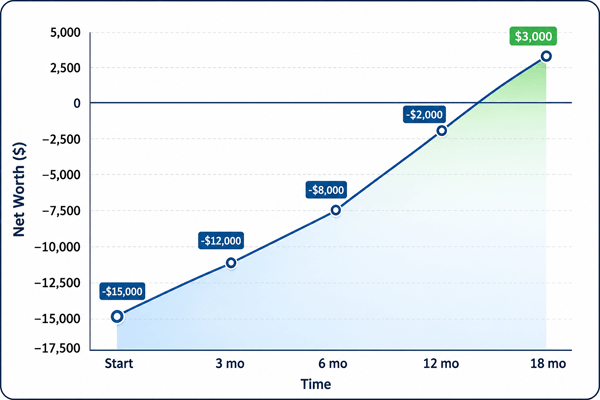
Chart: Example recovery path from negative net worth to positive net worth.
■ A 90-Day Action Plan for Negative Net Worth
| Time Period | Main Actions | Goal |
|---|---|---|
| Days 1-7 | Calculate net worth, list all debts, check due dates, stop new unnecessary debt. | You know the size of the problem and avoid making it worse. |
| Days 8-30 | Create a basic budget, build a small cash buffer, make all minimum payments, choose snowball or avalanche. | Your cash flow becomes more controlled. |
| Days 31-60 | Cut one or two major expenses, negotiate bills, sell unused items, direct extra money to priority debt. | Your first visible progress appears. |
| Days 61-90 | Review progress, adjust the plan, explore income growth, automate payments and savings. | Your recovery becomes a repeatable system. |
■ Detailed Example: Fixing a Negative Net Worth
Assume Maya has $4,000 in assets and $19,000 in liabilities. Her net worth is -$15,000.
| Item | Amount |
|---|---|
| Checking and savings | $2,500 |
| Car resale value | $1,500 |
| Total assets | $4,000 |
| Credit cards | $7,000 |
| Student loan | $9,000 |
| Medical bill | $3,000 |
| Total liabilities | $19,000 |
| Net worth | -$15,000 |
Maya decides to make minimum payments on all debts, build a $1,000 starter emergency fund, and put every extra dollar toward her highest-interest credit card. She also picks up freelance work that adds $300 per month. If she improves her net worth by about $600 per month through debt reduction and savings, she could move from -$15,000 to around -$7,800 in one year before considering interest, fees, taxes, or unexpected changes. The exact timeline depends on interest rates, income, expenses, and consistency.
■ Mistakes to Avoid When You Have Negative Net Worth
- Ignoring the number because it feels stressful. Avoidance usually makes debt more expensive.
- Only looking at monthly payments instead of total balances and interest rates.
- Borrowing more to maintain a lifestyle that income cannot support.
- Using a consolidation loan without changing spending habits.
- Emptying all savings to pay debt and then using credit cards again for emergencies.
- Selling important assets without considering transportation, job, tax, or family needs.
- Comparing yourself with others instead of tracking your own progress.
- Assuming bankruptcy, settlement, or hardship programs are simple fixes. They may help in some cases, but they can carry serious costs and should be understood carefully.
■ Common Misconceptions About Negative Net Worth
| Misconception | Reality |
|---|---|
| “Negative net worth means I am broke forever.” | False. It is a current snapshot, not a permanent identity. |
| “Income automatically fixes negative net worth.” | False. Higher income helps only if debt growth slows and assets increase. |
| “All debt is bad.” | Not always. Debt used for education, a home, or a business may be productive if affordable and well managed. |
| “I should invest before paying any debt.” | It depends. High-interest debt often deserves priority, while emergency savings and employer retirement matches may also matter. |
| “My net worth should include everything I own at purchase price.” | No. Use realistic current values, especially for cars, electronics, and personal items. |
■ When to Get Professional Help
Consider speaking with a reputable nonprofit credit counselor, financial planner, attorney, or tax professional if you are missing payments, facing collection calls, considering bankruptcy, dealing with tax debt, using payday loans, or unable to afford essentials. Professional help is especially important when your debt involves legal action, foreclosure, repossession, wage garnishment, or business guarantees.
Be cautious with companies that promise quick debt forgiveness, pressure you to stop paying creditors without explaining the risks, charge large upfront fees, or make guarantees that sound too good to be true.
A trustworthy helper should explain fees, risks, alternatives, and the likely impact on your credit, taxes, assets, and legal position before you agree to any plan.
■ Frequently Asked Questions
1. What is negative net worth in simple words?
Negative net worth means you owe more money than the value of what you own. If your assets are $8,000 and your debts are $20,000, your net worth is -$12,000.
2. Is it normal to have negative net worth?
It can be common at certain life stages, especially after taking student loans, starting a business, buying a car with financing, or going through a financial emergency. Common does not mean harmless. It should still be measured and improved.
3. How do I get out of negative net worth?
Start by stopping new unnecessary debt, building a small emergency fund, paying at least the minimum on every debt, targeting high-interest balances, increasing income where possible, and tracking net worth monthly.
4. Should I pay debt or save first?
Many people need both. A small emergency fund can prevent new debt, while extra payments reduce liabilities. High-interest debt usually deserves priority after basic stability is protected.
5. Does negative net worth affect my credit score?
Net worth itself is not a credit score factor. However, the debts that cause negative net worth may affect credit if balances are high, payments are late, or accounts go to collections. Reducing revolving balances may also improve available credit use over time, but credit results vary by profile and scoring model.
6. Can I have negative net worth but good credit?
Yes. You may have negative net worth and still have good credit if you make payments on time and manage accounts responsibly. Credit score and net worth measure different things.
7. How often should I calculate my net worth?
Monthly is helpful when you are trying to recover from negative net worth. Quarterly may be enough once your finances are stable.
8. Is a mortgage negative net worth?
A mortgage is a liability, but the home is an asset. You have negative net worth only if your total liabilities exceed your total assets after counting both the home value and the mortgage balance.
9. What is the fastest way to improve net worth?
The fastest practical approach is usually a mix of reducing high-interest debt, increasing income, controlling spending, and saving consistently. Avoid risky shortcuts that can create bigger losses.
10. Can bankruptcy fix negative net worth?
Bankruptcy may help some people with overwhelming debt, but it has legal, credit, cost, and eligibility consequences. It should be discussed with a qualified professional before making decisions.
■ Final Thoughts: Negative Net Worth Can Be Repaired
Negative net worth means your debts are currently larger than your assets. It may feel discouraging, but it is also measurable. Once you know your number, you can begin improving it through steady actions: stop unnecessary borrowing, control cash flow, pay down debt, lower interest where possible, increase income, build emergency savings, and track progress over time.
The goal is not perfection. The goal is direction. If your net worth becomes less negative month by month, you are already rebuilding your financial foundation.
Reader Advice: This article is for educational and informational purposes only, not financial, legal, tax, or credit advice. Please check official sources or a qualified professional because rules and policies change over time.