Net Worth Explained: Meaning, Formula and Examples
Net worth is one of the simplest ways to measure your financial position. It shows the difference between what you own and what you owe. A person can have a high income and still have a low or negative net worth if they carry too much debt. Another person may have an average income but strong net worth because they save, invest, and avoid unnecessary borrowing.
This guide explains net worth in plain English. You will learn the formula, what counts as an asset, what counts as a liability, how to calculate your own number, and how to use it wisely without turning it into a source of stress.
1. What Is Net Worth?
Net worth is the value of everything you own minus the value of everything you owe. In personal finance, it gives you a snapshot of your financial health at a specific point in time.
| Term | Simple Meaning | Example |
|---|---|---|
| Assets | Things you own that have financial value | Cash, savings, home equity, investments, car |
| Liabilities | Debts or financial obligations you owe | Credit card balances, loans, mortgage, unpaid bills |
| Net Worth | Assets minus liabilities | A person with $100,000 in assets and $40,000 in debts has $60,000 net worth |
Net worth is not the same as income. Income is money you earn. Net worth is what remains after adding up your owned assets and subtracting your debts.
Net Worth Formula
The basic net worth formula is:
Net Worth = Total Assets - Total Liabilities
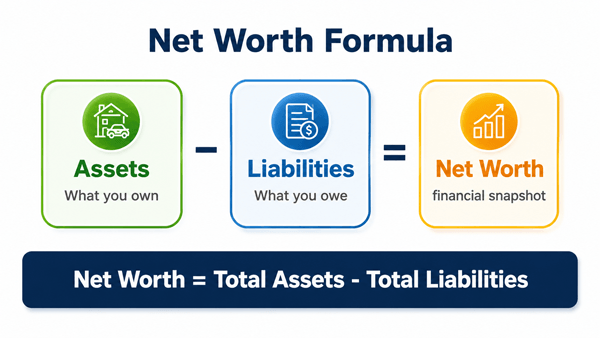
Image: Your net worth is calculated by subtracting what you owe from what you own. Use current asset values and current debt balances for the most realistic result.
2. How Net Worth Works in Real Life
Net worth changes whenever your assets or liabilities change. It can rise when you save money, pay down debt, invest, or your assets increase in value. It can fall when you borrow more, spend savings, or assets lose value.
| Action | Effect on Net Worth | Why |
|---|---|---|
| Saving $500 | Increases net worth | Cash assets rise by $500 |
| Paying $500 toward credit card debt | Increases net worth | Liabilities fall by $500 |
| Buying a $20,000 car with a $20,000 loan | Usually little immediate change | You gain an asset but also add debt; the car may depreciate |
| Taking a $5,000 personal loan and spending it | Decreases net worth over time | Debt remains, but the cash is gone |
| Investment account grows by $2,000 | Increases net worth | Asset value rises |
3. What Counts as Assets?
Assets are things you own that have economic value. For a personal net worth calculation, include assets that can reasonably be valued or converted into money.
| Asset Type | What to Include | Valuation Tip |
|---|---|---|
| Cash and bank accounts | Checking, savings, emergency fund | Use current account balances |
| Investments | Retirement accounts, brokerage accounts, mutual funds, ETFs, stocks, bonds | Use current market value |
| Real estate | Home, rental property, land | Use a realistic market estimate, not a wish price |
| Vehicles | Car, motorcycle, boat | Use resale value, not original purchase price |
| Business ownership | Your share of a business or side business | Use a conservative estimated value |
| Valuable personal property | Jewelry, collectibles, equipment | Include only if realistically sellable and meaningful in value |
4. What Counts as Liabilities?
Liabilities are debts and financial obligations you owe. Include the current outstanding balance, not the original loan amount.
| Liability Type | Examples | What Balance to Use |
|---|---|---|
| Credit card debt | Unpaid card balances | Current total balance |
| Student loans | Federal or private education loans | Remaining loan balance |
| Mortgage | Home loan | Current payoff balance |
| Auto loan | Car financing | Remaining loan balance |
| Personal loans | Bank loans, family loans, high-cost short-term loans | Amount still owed |
| Medical or tax debt | Unpaid bills, tax balances | Amount due, including known penalties or interest |
■ How to Calculate Your Net Worth Step by Step
- List all your assets. Include bank balances, investments, property value, vehicle value, and any meaningful valuables.
- Estimate each asset realistically. Use current balances and market values instead of emotional or inflated estimates.
- List all your liabilities. Include credit cards, loans, mortgage balances, unpaid bills, and other debts.
- Add up total assets. This is the total value of what you own.
- Add up total liabilities. This is the total amount you owe.
- Subtract liabilities from assets. The result is your net worth.
- Save the calculation and update it regularly, such as monthly, quarterly, or annually.
■ Simple Net Worth Example
| Assets | Value |
|---|---|
| Checking account | $2,000 |
| Savings account | $8,000 |
| Retirement account | $25,000 |
| Car resale value | $12,000 |
| Total Assets | $47,000 |
| Liabilities | Balance |
|---|---|
| Credit card debt | $3,000 |
| Student loan | $18,000 |
| Auto loan | $7,000 |
| Total Liabilities | $28,000 |
Net worth = $47,000 - $28,000 = $19,000. This person has a positive net worth of $19,000.
■ Example: Positive, Zero, and Negative Net Worth
| Scenario | Assets | Liabilities | Net Worth | What It Means |
|---|---|---|---|---|
| Positive net worth | $150,000 | $60,000 | $90,000 | Assets are higher than debts |
| Zero net worth | $40,000 | $40,000 | $0 | Assets and debts are equal |
| Negative net worth | $25,000 | $45,000 | -$20,000 | Debts are higher than assets |
A negative net worth does not mean a person is a failure. It often happens early in adult life, after student loans, during a business setback, or after major medical or family expenses. The goal is to understand the number and create a plan to improve it.
5. Net Worth vs Income: What Is the Difference?
| Factor | Net Worth | Income |
|---|---|---|
| Meaning | What you own minus what you owe | Money you earn over a period |
| Timing | A snapshot at one date | Usually weekly, monthly, or yearly |
| Example | Assets of $80,000 minus debts of $30,000 = $50,000 net worth | $5,000 monthly salary |
| Why it matters | Shows financial position and progress | Shows cash flow and earning power |
| Can be misleading? | Yes, if assets are overvalued | Yes, if spending and debt are high |
6. Why Net Worth Matters
- It gives you a clear financial snapshot instead of guessing.
- It helps you track progress over time, even if month-to-month income changes.
- It shows whether debt is helping you build assets or holding you back.
- It can guide major decisions, such as buying a home, investing, retiring, or starting a business.
- It encourages better financial habits, such as saving, debt repayment, and realistic spending.
7. What Is a Good Net Worth?
A “good” net worth depends on age, income, family responsibilities, location, debt level, career stage, and goals. There is no single number that applies to everyone. A better question is: Is your net worth improving in a healthy direction over time?
| Life Stage | Common Situation | Helpful Goal |
|---|---|---|
| 20s | Starting work, paying student loans, building savings | Build an emergency fund and avoid high-interest debt |
| 30s | Career growth, family expenses, home decisions | Increase savings rate and invest consistently |
| 40s | Peak responsibility years, mortgage, children, aging parents | Grow retirement assets and reduce costly debt |
| 50s | Retirement planning becomes more urgent | Maximize savings and review retirement readiness |
| 60s and beyond | Retirement income and asset protection matter more | Manage withdrawals, healthcare costs, and estate planning |
8. Liquid Net Worth vs Total Net Worth
Total net worth includes all assets. Liquid net worth focuses on assets that can quickly become cash without a major loss in value. Both numbers are useful.
| Type | Includes | Excludes or Reduces | Best Use |
|---|---|---|---|
| Total net worth | Home equity, retirement accounts, investments, cash, vehicles | Nothing if it has realistic value | Long-term financial picture |
| Liquid net worth | Cash, savings, taxable investments | Home equity, vehicles, hard-to-sell items; retirement accounts may be adjusted for taxes/penalties | Emergency planning and short-term flexibility |
9. Common Mistakes When Calculating Net Worth
- Using the purchase price of a car instead of its current resale value.
- Overestimating home value and ignoring selling costs.
- Forgetting credit card balances, personal loans, or unpaid taxes.
- Counting future income as an asset. Expected salary is not net worth until it is earned and saved.
- Ignoring taxes on some accounts when estimating spendable wealth.
- Comparing your net worth to strangers online without knowing their full situation.
- Checking too often and becoming discouraged by normal market changes.
10. How to Improve Your Net Worth
Improving net worth usually comes from two sides: increasing assets and reducing liabilities. The best approach depends on your starting point.
| Strategy | How It Helps | Practical Example |
|---|---|---|
| Build an emergency fund | Prevents new debt during surprises | Save one month of expenses, then gradually build more |
| Pay down high-interest debt | Reduces liabilities and interest costs | Target credit card balances before low-interest debts |
| Save automatically | Grows assets without relying on willpower | Set automatic transfers after each paycheck |
| Invest for long-term goals | Gives money a chance to grow over time | Use retirement accounts or diversified investments where suitable |
| Increase income wisely | Creates more room to save and repay debt | Negotiate pay, freelance, upgrade skills, or change jobs |
| Avoid lifestyle inflation | Keeps expenses from rising as income grows | Save part of every raise before increasing spending |
| Protect your assets | Prevents setbacks from wiping out progress | Use appropriate insurance and estate documents |
11. Practical Net Worth Checklist
- Update your asset balances at least once every quarter or year.
- Use conservative estimates for property, vehicles, and valuables.
- Track both total net worth and liquid net worth if possible.
- Separate productive debt from harmful debt. Productive debt may help build assets; harmful debt often funds consumption at high interest.
- Focus on your trend over time, not one month of market movement.
- Review your plan after major life changes such as marriage, divorce, job change, home purchase, birth of a child, or retirement.
12. Net Worth Worksheet Template
| Category | Amount |
|---|---|
| Cash and bank accounts | |
| Investments | |
| Retirement accounts | |
| Home or real estate value | |
| Vehicle resale value | |
| Other meaningful assets | |
| Total Assets | |
| Credit card debt | |
| Student loans | |
| Mortgage balance | |
| Auto loans | |
| Personal loans | |
| Other debts | |
| Total Liabilities | |
| Net Worth = Total Assets - Total Liabilities |
13. Pros and Cons of Using Net Worth as a Financial Metric
| Pros | Cons or Limitations |
|---|---|
| Simple and easy to calculate | Does not show monthly cash flow |
| Shows overall financial position | Asset values can change quickly |
| Helps track long-term progress | Can feel discouraging if used for comparison |
| Encourages debt reduction and asset building | Does not measure happiness, skills, relationships, or quality of life |
| Useful for planning retirement and major goals | Some assets are hard to sell or value accurately |
14. When Should You Review Your Net Worth?
For most people, reviewing net worth monthly, quarterly, or annually is enough. Monthly tracking can help if you are paying off debt or aggressively saving. Quarterly or annual tracking may be better if frequent market swings make you anxious.
- Review monthly if you are fixing debt, building savings, or starting a new plan.
- Review quarterly if you want a balanced routine without obsessing.
- Review annually if your finances are stable and you mainly want a big-picture update.
15. Beginner Example: A Net Worth Improvement Plan
Imagine Sara has $20,000 in assets and $32,000 in liabilities. Her net worth is -$12,000. She wants to improve it over the next year.
| Step | Action | Expected Impact |
|---|---|---|
| 1 | Build a small emergency fund of $1,000 | Reduces reliance on credit cards |
| 2 | Pay $400 per month toward credit card debt | Cuts liabilities by about $4,800 in one year, before interest effects |
| 3 | Save $150 per month automatically | Adds about $1,800 to assets in one year |
| 4 | Avoid taking new consumer debt | Prevents the plan from moving backward |
| 5 | Review net worth every quarter | Keeps progress visible and realistic |
Even without a huge income increase, Sara could improve her net worth by thousands of dollars by combining saving, debt repayment, and better spending habits.
■ Frequently Asked Questions About Net Worth
1. What does net worth mean in simple words?
Net worth means what you own minus what you owe. If your assets are worth more than your debts, you have positive net worth. If your debts are higher than your assets, you have negative net worth.
2. Is net worth the same as wealth?
Net worth is a common way to measure financial wealth, but it is not the full meaning of a good life. It does not measure health, relationships, knowledge, career satisfaction, or personal values.
3. Should I include my house in net worth?
Yes, you can include your home as an asset, but use a realistic market value and subtract the remaining mortgage. Many people also track liquid net worth separately because home equity is not quickly spendable cash.
4. Should I include my car in net worth?
You can include your car at its current resale value, but avoid using the original purchase price. Cars usually lose value over time, so be conservative.
5. Can net worth be negative?
Yes. Negative net worth means liabilities are greater than assets. This can happen because of student loans, credit card debt, medical bills, business losses, or early-career borrowing. It can improve with a clear plan.
6. How often should I calculate net worth?
Monthly, quarterly, or annually can all work. Choose a schedule that helps you stay informed without creating stress.
7. What is the fastest way to increase net worth?
The fastest sustainable ways are usually paying down high-interest debt, increasing savings, earning more, investing for long-term goals, and avoiding new unnecessary debt.
8. Why did my net worth go down even though I saved money?
Investment values, property values, or vehicle values may have fallen. A short-term drop is not always a problem if your long-term habits are strong.
9. Does retirement savings count in net worth?
Yes, retirement savings count as assets. However, for liquid net worth, you may treat retirement funds differently because withdrawals may involve taxes, penalties, or age restrictions.
10. Is a high income enough to build net worth?
No. Income helps, but net worth depends on what you keep and build after spending and debt. High earners can have low net worth if they overspend or borrow heavily.
■ Final Thoughts: Use Net Worth as a Progress Tool, Not a Judgment
Net worth is a useful personal finance number because it turns scattered financial details into one clear snapshot. The formula is simple: assets minus liabilities. But the real value comes from using the number to make better decisions.
Do not use net worth to shame yourself or compete with others. Use it to understand where you are, choose your next step, and measure progress over time. A healthy financial plan is not built in one day. It grows through consistent saving, careful borrowing, smart investing, and regular review.
Reader Advice: This article is for educational and information purposes only and should not be taken as personal financial, legal, tax, or investment advice. Please check the latest information from official sources or a qualified professional, as rules, information, and policies can change over time.