Wealth Building Strategies That Actually Work
Building wealth is not about getting rich overnight. For most people, it is the steady process of earning money, spending less than you earn, protecting yourself from financial shocks, and investing consistently over time. The strategies that actually work are usually simple, repeatable, and sometimes boring - but they are powerful when you apply them for years.
This guide explains wealth building from a beginner’s perspective. You will learn what wealth building means, why it matters, which strategies are most effective, which mistakes to avoid, and how to create a practical plan you can start using today.
1. What Does Wealth Building Mean?
Wealth building means increasing your net worth over time. Net worth is the value of what you own minus what you owe.
Net worth formula: Assets - Liabilities = Net Worth
Assets include cash, investments, retirement accounts, real estate, business ownership, and other valuable property. Liabilities include credit card balances, student loans, car loans, personal loans, mortgages, and other debts.
A person with a high income may still have low wealth if they spend everything or carry expensive debt. A person with a moderate income can build meaningful wealth by saving consistently, investing wisely, and avoiding major financial mistakes.
2. Why Wealth Building Matters
Wealth gives you options. It can help you handle emergencies, reduce stress, retire with dignity, support your family, start a business, change careers, buy a home, or give to causes you care about.
Wealth also protects your future self. Life is unpredictable. Job loss, medical bills, market downturns, inflation, and family responsibilities can affect anyone. A strong financial foundation gives you more control when life does not go according to plan.
3. The Wealth Building Formula
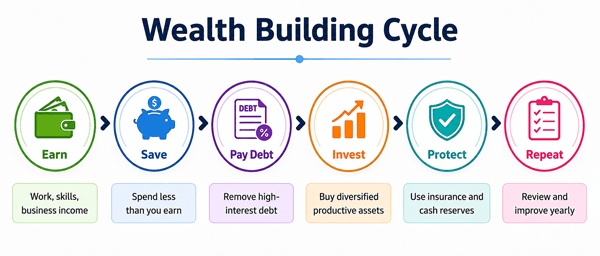
Wealth is built through a few connected habits. You earn money, keep part of it, use it to reduce bad debt, invest it in productive assets, and protect what you build.
| Step | What It Means | Practical Example |
|---|---|---|
| Earn | Create income through work, business, or assets | Salary, freelance income, rental income, dividends |
| Save | Keep part of what you earn instead of spending it all | Save 10% to 20% of income when possible |
| Invest | Put money into assets that may grow over time | Retirement funds, index funds, real estate, business equity |
| Protect | Reduce risks that can destroy wealth | Insurance, emergency fund, diversification, estate planning |
| Repeat | Make the process automatic and consistent | Monthly investing and yearly financial review |
Strategy 1: Start With a Clear Financial Picture
You cannot improve what you do not measure. Before choosing investments or side hustles, understand where you stand today.
Create a Simple Net Worth Statement
List your assets on one side and your debts on the other. Then subtract debts from assets. This gives you your starting point.
| Assets | Estimated Value | Debts | Balance |
|---|---|---|---|
| Checking and savings | $3,000 | Credit card debt | $2,500 |
| Retirement account | $8,000 | Student loan | $12,000 |
| Car value | $9,000 | Car loan | $6,000 |
| Total assets | $20,000 | Total debts | $20,500 |
| Net worth | -$500 |
This example shows a slightly negative net worth. That is not a failure. It is a starting point. The goal is to make progress over time.
Track Cash Flow
Cash flow is the money coming in and going out each month. Wealth building becomes much easier when you know where your money is going.
- Income: salary, business income, freelance work, bonuses, rental income.
- Fixed expenses: rent or mortgage, insurance, loan payments, utilities.
- Variable expenses: groceries, fuel, shopping, subscriptions, dining out.
- Savings and investments: emergency fund, retirement account, brokerage account.
Strategy 2: Spend Less Than You Earn
This is the foundation of wealth building. If you consistently spend more than you earn, debt grows. If you consistently spend less than you earn, you create money that can be saved, invested, and used to build assets.
Use a Practical Budget, Not a Perfect One
A budget is not a punishment. It is a plan for your money. The best budget is one you can actually follow.
| Budget Method | How It Works | Best For |
|---|---|---|
| 50/30/20 budget | Needs, wants, savings/debt repayment | Beginners who want a simple framework |
| Zero-based budget | Every dollar gets a job before the month starts | People who want more control |
| Pay-yourself-first budget | Savings and investing happen before spending | People who struggle to save after spending |
| Envelope method | Set spending limits by category | People who overspend in specific areas |
Best Practical Spending Moves
- Automate savings on payday so wealth building happens before discretionary spending.
- Review subscriptions every 3 months and cancel what you no longer use.
- Delay large nonessential purchases for 24 to 72 hours.
- Compare insurance, phone, internet, and banking fees at least once a year.
- Avoid lifestyle inflation when income rises. Increase saving and investing first.
Strategy 3: Build an Emergency Fund
An emergency fund is cash set aside for unexpected expenses or income interruptions. The Consumer Financial Protection Bureau describes an emergency fund as a cash reserve specifically set aside for unplanned expenses or financial emergencies such as car repairs, home repairs, medical bills, or loss of income. [1]
How Much Should You Save?
A common target is 3 to 6 months of essential expenses. However, beginners can start smaller. A first goal of $500 to $1,000 can prevent many small emergencies from turning into credit card debt.
| Stage | Emergency Fund Target | Who It Helps |
|---|---|---|
| Starter fund | $500 to $1,000 | People starting from zero or paying off debt |
| Basic fund | 1 month of essential expenses | People with stable income and low debt |
| Strong fund | 3 to 6 months of essential expenses | Most households |
| Extra cushion | 6 to 12 months of expenses | Self-employed workers, single-income households, unstable income |
Where to Keep Emergency Savings
Keep emergency money safe and easy to access. A savings account or money market deposit account is usually better than the stock market for this purpose. In the United States, FDIC deposit insurance generally covers up to $250,000 per depositor, per FDIC-insured bank, for each ownership category. [2]
Strategy 4: Pay Off High-Interest Debt
High-interest debt can destroy wealth because interest works against you. Credit cards and payday loans are common examples. If your debt interest rate is much higher than what you can reasonably expect from investing, paying it down is often one of the strongest financial moves you can make.
Debt Snowball vs Debt Avalanche
| Method | How It Works | Main Benefit | Main Limitation |
|---|---|---|---|
| Debt snowball | Pay smallest balance first while making minimums on others | Builds motivation quickly | May cost more interest |
| Debt avalanche | Pay highest interest rate first while making minimums on others | Usually saves the most money | May feel slower at first |
The best method is the one you will follow. If motivation is your biggest challenge, the snowball method may help. If minimizing total interest is your priority, the avalanche method is usually better.
Debt Payoff Example
Suppose you have a $3,000 credit card balance at 24% interest and a $10,000 student loan at 6% interest. Paying extra toward the credit card first usually makes sense because the interest rate is much higher. After the card is paid off, redirect that payment toward the student loan or investments.
Strategy 5: Invest Consistently for the Long Term
Saving protects you. Investing helps your money grow. The SEC’s Investor.gov provides a compound interest calculator to show how money can grow over time when returns are reinvested. [3]
Why Compound Growth Matters
Compound growth means your money can earn returns, and then those returns can earn returns too. Time is one of the most important ingredients in wealth building.
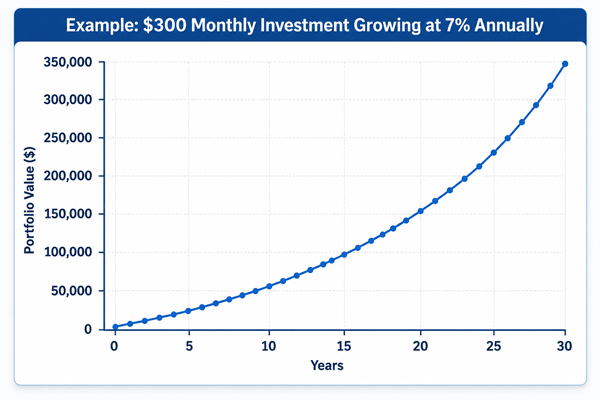
Chart note: This is a simplified example using a steady 7% annual return and $300 monthly contributions. Real investment returns are not guaranteed and will rise and fall over time.
Beginner-Friendly Investment Principles
- Start early, even with small amounts.
- Invest regularly instead of waiting for the perfect time.
- Diversify across many investments instead of betting everything on one stock.
- Keep fees low because high fees reduce long-term returns.
- Use tax-advantaged retirement accounts when appropriate.
- Stay invested through normal market ups and downs if your time horizon is long.
Common Investment Options
| Investment | Potential Role | Main Risk |
|---|---|---|
| High-yield savings or CDs | Short-term savings and emergency funds | May not keep up with inflation after taxes |
| Broad stock index funds | Long-term growth | Market value can fall in the short term |
| Bond funds | Income and stability | Interest rate and inflation risk |
| Retirement accounts | Tax-advantaged long-term investing | Rules, contribution limits, and withdrawal restrictions |
| Real estate | Income, appreciation, diversification | Large costs, vacancies, maintenance, market risk |
| Business ownership | Potential high upside and control | High failure risk and uneven income |
Strategy 6: Use Tax-Advantaged Accounts When Available
Taxes matter because money lost to taxes cannot compound for you. Tax-advantaged accounts can help you keep more of your investment growth, depending on your country and situation.
For U.S. readers, the IRS announced that the 2026 employee contribution limit for 401(k), 403(b), most 457 plans, and the federal Thrift Savings Plan is $24,500, while the IRA contribution limit is $7,500. [4] Rules can change, so always confirm the current limits before contributing.
Traditional vs Roth: Simple Explanation
| Account Type | Tax Treatment | May Fit People Who... |
|---|---|---|
| Traditional retirement account | Contributions may reduce taxable income now; withdrawals are taxed later | Expect a lower tax rate in retirement or want a current tax deduction |
| Roth retirement account | Contributions are made after tax; qualified withdrawals may be tax-free | Expect a higher tax rate later or value tax-free retirement income |
Tax strategy should not be based on guesses alone. If your situation is complex, consider speaking with a qualified tax professional.
Strategy 7: Increase Your Income
Cutting expenses helps, but there is a limit to how much you can cut. Income growth can accelerate wealth building because it gives you more money to save, invest, and use strategically.
Practical Ways to Grow Income
- Build high-value skills in your field, such as leadership, sales, data analysis, coding, design, operations, or communication.
- Negotiate salary using market research and documented results.
- Change jobs when it offers better pay, benefits, or growth potential.
- Start a side income stream that fits your skills and schedule.
- Create scalable income over time, such as digital products, a small business, or rental assets, if the risks fit your situation.
Important Warning About Side Hustles
Not every side hustle is worth it. Consider startup costs, time, taxes, burnout risk, and whether it distracts from your main career. A side hustle that earns $200 per month but takes 40 stressful hours may not be as useful as improving your main career skills.
Strategy 8: Own Productive Assets
Wealth grows faster when you own assets that can increase in value or produce income. Productive assets are things that may generate cash flow, appreciation, or both.
| Productive Asset | How It Builds Wealth | Beginner Consideration |
|---|---|---|
| Stocks and funds | Business growth, dividends, long-term appreciation | Use diversification; avoid stock picking as a beginner strategy |
| Real estate | Rental income and potential appreciation | Understand financing, repairs, taxes, vacancies, and local market risks |
| Business equity | Profit and potential sale value | High effort and higher risk than passive investing |
| Education and skills | Higher earning power | Choose skills with real market demand |
| Intellectual property | Royalties or licensing income | Usually requires upfront work and audience/market fit |
The key is not to chase every opportunity. Choose assets you understand and can afford to hold through difficult periods.
Strategy 9: Protect Your Wealth
Building wealth is only half the job. You also need to protect it from avoidable losses.
Use Insurance Wisely
Insurance protects against risks that could financially devastate you. Common examples include health insurance, auto insurance, homeowners or renters insurance, disability insurance, life insurance for people with dependents, and business insurance for entrepreneurs.
Avoid Concentration Risk
Concentration risk means too much of your money depends on one thing: one employer, one stock, one property, one client, or one business. Diversification does not eliminate risk, but it can reduce the damage caused by one bad outcome.
Protect Against Fraud and Bad Advice
- Be cautious of guaranteed high returns.
- Do not invest in something you cannot explain in simple words.
- Check the background of financial professionals before working with them.
- Avoid pressure tactics, secret opportunities, and “act now” investment pitches.
- Keep your financial accounts secure with strong passwords and two-factor authentication.
Strategy 10: Automate Good Financial Decisions
Automation helps because it removes the need to rely on motivation every month. When saving and investing happen automatically, wealth building becomes part of your system.
What to Automate
- Emergency fund transfers on payday.
- Retirement contributions through payroll when available.
- Monthly brokerage or investment contributions.
- Debt payments above the minimum amount.
- Bill payments to avoid late fees, while still reviewing statements for errors.
Automation should not mean ignoring your money. Review your accounts regularly to make sure transfers, fees, and investment allocations still fit your goals.
Strategy 11: Keep Investing Simple
Many beginners think wealth requires complex strategies. In reality, complexity often creates confusion, fees, and mistakes. A simple, diversified, low-cost plan is often more effective than constantly chasing the next hot investment.
Simple Portfolio Idea for Beginners
A beginner might start with a broad stock market index fund and a bond fund or target-date fund inside a retirement account. The exact mix depends on age, goals, risk tolerance, and time horizon. The point is to avoid overcomplicating your first steps.
What About Cryptocurrency, Options, and Speculative Assets?
Speculative assets can rise quickly, but they can also lose value quickly. They should not replace emergency savings, debt payoff, retirement contributions, or basic diversified investing. If you choose to speculate, consider limiting it to money you can afford to lose without damaging your financial plan.
Strategy 12: Review Your Progress Regularly
A wealth building plan should be reviewed, not obsessed over. Monthly or quarterly check-ins are usually enough for most beginners.
Monthly Review Checklist
- Did your net worth increase, decrease, or stay about the same?
- Did you save or invest as planned?
- Did any spending category surprise you?
- Are you carrying any high-interest debt?
- Do you need to adjust your emergency fund?
- Are your goals still realistic?
Annual Review Checklist
- Update your net worth statement.
- Review insurance coverage.
- Increase retirement contributions if possible.
- Rebalance investments if your allocation has drifted.
- Review tax planning opportunities.
- Update beneficiaries and important documents.
A Practical Wealth Building Plan for Beginners
Here is a simple step-by-step plan that works for many beginners. Adjust it based on your income, debt, family needs, and local rules.
- Calculate your net worth so you know your starting point.
- Track spending for 30 days to find leaks and opportunities.
- Build a starter emergency fund of $500 to $1,000.
- Pay off high-interest debt aggressively.
- Contribute enough to get any employer retirement match if available.
- Grow your emergency fund toward 3 to 6 months of essential expenses.
- Invest consistently in a diversified long-term portfolio.
- Increase income through skills, career growth, or carefully chosen side income.
- Protect your wealth with insurance, diversification, and fraud awareness.
- Review your plan monthly and improve it annually.
Real-World Examples
Example 1: Beginner With Credit Card Debt
Aisha earns $3,200 per month and has $4,000 in credit card debt at a high interest rate. She starts by saving a $1,000 emergency fund, then pays an extra $500 per month toward the card. After the card is paid off, she redirects the same $500 into her emergency fund and retirement account. Her wealth building starts with debt control, not risky investing.
Example 2: Middle-Income Worker Building Long-Term Wealth
Omar earns $55,000 per year and contributes 10% of income to a retirement account. He also invests $200 per month in a diversified fund and avoids upgrading his car when he receives a raise. Over time, his consistent investing and controlled lifestyle help his net worth grow steadily.
Example 3: Business Owner Managing Uneven Income
Sara runs a small business with irregular income. She keeps a larger emergency fund, separates business and personal accounts, pays estimated taxes, and invests only after business cash needs are covered. For her, wealth building depends on cash flow management and risk control as much as investing.
Common Wealth Building Mistakes to Avoid
| Mistake | Why It Hurts | Better Choice |
|---|---|---|
| Trying to get rich quickly | Often leads to scams, leverage, and emotional decisions | Build wealth through consistent habits and informed risk-taking |
| Ignoring high-interest debt | Interest can grow faster than investments | Pay down expensive debt before aggressive investing |
| No emergency fund | Small emergencies become new debt | Keep cash reserves for unexpected expenses |
| Investing without understanding risk | Panic selling or concentrated losses can damage progress | Diversify and match investments to your time horizon |
| Lifestyle inflation | Higher income disappears into higher spending | Increase savings rate when income rises |
| Waiting too long to start | Lost time reduces compounding potential | Start small and improve gradually |
| Following social media advice blindly | Advice may be biased, incomplete, or unsuitable | Verify information and consider your own goals |
Pros and Cons of Wealth Building Strategies
| Strategy | Pros | Cons or Limits |
|---|---|---|
| Budgeting | Creates control and reveals waste | Requires consistency and honest tracking |
| Emergency fund | Reduces financial stress and debt risk | Cash returns may be lower than investments |
| Debt payoff | Guaranteed improvement equal to avoided interest | May feel slow and less exciting than investing |
| Long-term investing | Can build wealth through compounding | Market losses can happen, especially short term |
| Income growth | Can speed up all financial goals | May require time, education, risk, or negotiation |
| Real estate/business | Potential income and appreciation | Can be complex, expensive, and risky |
Misconceptions About Building Wealth
Misconception 1: You Need a High Income to Build Wealth
A higher income helps, but it does not guarantee wealth. Spending habits, debt, investing behavior, and time matter too.
Misconception 2: Investing Is Only for Rich People
Many platforms and retirement plans allow small regular contributions. The important part is starting responsibly and learning as you go.
Misconception 3: All Debt Is Bad
Debt can be harmful or useful depending on cost, purpose, and risk. High-interest consumer debt is usually destructive. A reasonable mortgage, business loan, or education loan may be useful if it supports long-term value and remains affordable.
Misconception 4: Wealth Building Is Mostly About Picking the Best Stock
For most beginners, consistent saving, diversified investing, and avoiding major mistakes matter more than finding one winning investment.
Best Practices for Long-Term Wealth Building
- Keep your financial plan simple enough to follow.
- Focus on savings rate, debt control, and time in the market.
- Use diversified investments instead of single bets.
- Increase contributions whenever your income rises.
- Protect yourself with insurance and emergency savings.
- Learn basic tax rules in your country or work with a qualified professional.
- Avoid comparing your progress to others. Compare your current self to your past self.
Wealth Building Diagram
The wealth building process is a cycle, not a one-time event:
Frequently Asked Questions
1. What is the best wealth building strategy for beginners?
The best starting strategy is to spend less than you earn, build a small emergency fund, pay off high-interest debt, and start investing consistently in a diversified way. These basics create the foundation for everything else.
2. How much money do I need to start building wealth?
You can start with any amount. Even small amounts matter because they build the habit. The goal is to increase the amount over time as your income improves and debt decreases.
3. Should I save or invest first?
Start with a small emergency fund first. Then pay down high-interest debt. After that, invest for long-term goals while continuing to keep enough cash for emergencies.
4. Is buying a house the best way to build wealth?
A home can build wealth, but it is not automatically the best choice for everyone. Consider affordability, maintenance, location, interest rates, taxes, time horizon, and whether renting gives you more flexibility.
5. How long does it take to build wealth?
Wealth building usually takes years, not weeks. The timeline depends on income, savings rate, debt, investment returns, family responsibilities, and major life events. The earlier you start and the more consistent you are, the better your odds of success.
6. What is the biggest enemy of wealth building?
The biggest enemies are high-interest debt, overspending, lack of emergency savings, emotional investing, and chasing quick returns without understanding the risks.
7. Can I build wealth on a low income?
Yes, but it may require more patience and careful choices. Focus first on stability: control expenses, avoid expensive debt, build skills, look for income growth opportunities, and save small amounts consistently.
Final Thoughts
Wealth building is not about one perfect investment or one lucky break. It is the result of practical habits repeated over time: earn, save, pay off expensive debt, invest, protect, and review. The strategies that actually work are not always exciting, but they are reliable because they focus on behavior, risk control, and long-term growth.
Start where you are. Measure your net worth, choose one improvement, and take the next step. Small actions repeated consistently can become life-changing over time.
References
[1] Consumer Financial Protection Bureau, “An essential guide to building an emergency fund,” consumerfinance.gov.
[2] Federal Deposit Insurance Corporation, “Understanding Deposit Insurance,” fdic.gov.
[3] U.S. Securities and Exchange Commission, Investor.gov Compound Interest Calculator, investor.gov.
[4] Internal Revenue Service, “401(k) limit increases to $24,500 for 2026; IRA limit increases to $7,500,” irs.gov.
Reader Advice: This article is for educational and information purposes only and should not be taken as personal financial, tax, investment, or legal advice. Rules, limits, policies, and market conditions can change, so please check the latest information from official sources and consider speaking with a qualified professional before making important decisions.