Net Worth Tracking Guide: How to Track Assets, Debt and Wealth
1. What Is Net Worth Tracking?
Net worth tracking is the habit of measuring your overall financial position at regular intervals. Instead of looking only at your paycheck, bank balance, credit card debt, or investment account separately, net worth tracking combines the big picture into one simple number.
Your net worth is the difference between what you own and what you owe. What you own is called assets. What you owe is called liabilities or debts. The result can be positive, negative, or close to zero. A negative net worth does not mean you have failed; it simply means your debts are currently higher than your assets. Many people begin there, especially after student loans, starting a business, buying a home, or dealing with medical or family expenses.
Helpful note: For the most accurate result, use current account balances, recent debt payoff balances, and conservative resale values. This makes the tracker more trustworthy and useful for real decisions.
Quick answer: Net worth tracking means listing everything you own, subtracting everything you owe, and reviewing the result regularly. The basic formula is: Net Worth = Total Assets - Total Liabilities. Tracking it helps you see whether your financial position is improving over time, even when income, spending, investments, and debt balances change.
2. Why Tracking Net Worth Matters
Tracking your net worth is useful because it shows whether your financial life is moving in the right direction. A high income does not automatically create wealth if spending and debt rise at the same time. A modest income can still build wealth if savings, investments, and debt repayment are consistent.
- It gives you a clear financial starting point.
- It helps you see progress that may not be obvious month to month.
- It encourages better decisions about saving, investing, borrowing, and spending.
- It can reveal hidden problems, such as rising credit card debt or too much money sitting in low-return assets.
- It helps you set realistic goals for debt payoff, emergency savings, home ownership, retirement, or financial independence.
3. The Net Worth Formula
The formula is simple:
Net Worth = Total Assets - Total Liabilities
Example: If you own assets worth $85,000 and owe $42,000, your net worth is $43,000. If you own $15,000 and owe $28,000, your net worth is -$13,000. The number itself is less important than the trend over time.
Important distinction: Net worth is not the same as income or cash flow. Income shows what comes in during a period, cash flow shows what comes in and goes out, and net worth shows what remains after assets and debts are measured at one point in time.
4. What to Include as Assets
Assets are things you own that have financial value. For net worth tracking, focus on assets that can reasonably be valued and could help your financial position. Do not inflate values to feel better; realistic numbers make the tracker useful.
Do not overcount: Future salary, expected inheritances, emotional value, and the original purchase price of used items should not be counted as current assets unless they have a realistic market value today.
| Asset Category | Examples | How to Value It | Tracking Tip |
|---|---|---|---|
| Cash and bank accounts | Checking, savings, money market accounts | Use the current account balance | Update monthly or at statement date |
| Emergency fund | Cash reserved for unexpected expenses | Use current balance | Keep separate from everyday spending money |
| Investments | Stocks, mutual funds, ETFs, retirement accounts | Use current market value | Expect values to move up and down |
| Home equity asset value | Primary home or rental property | Use a conservative market estimate | Do not confuse home value with home equity |
| Vehicles | Car, motorcycle, boat | Use estimated resale value | Be conservative because vehicles often lose value |
| Business ownership | Small business, side business equity | Use a realistic estimate or professional valuation | Avoid guessing too high |
| Valuable personal property | Jewelry, collectibles, equipment | Use resale value, not purchase price | Include only meaningful items |
5. What to Include as Debt and Liabilities
Liabilities are amounts you owe. Include every debt, even if the payment feels manageable. Net worth tracking is not about judging the debt; it is about seeing the complete picture.
Also consider: Unpaid taxes, medical bills, family loans, overdrafts, late fees, and business debts you personally guarantee can affect your true financial position and should be listed when applicable.
| Debt Category | Examples | Balance to Use | Tracking Tip |
|---|---|---|---|
| Credit cards | Revolving card balances | Current balance owed | Track even if you plan to pay in full |
| Student loans | Federal or private education loans | Principal plus accrued interest if shown | Separate each loan if rates differ |
| Auto loans | Car or vehicle financing | Remaining payoff balance | Compare loan balance with vehicle value |
| Mortgage | Home loan | Remaining principal balance | Home equity equals home value minus mortgage |
| Personal loans | Installment loans, debt consolidation | Current payoff balance | Watch total interest cost |
| Buy now, pay later | Installment purchase plans | Remaining unpaid amount | Small balances can add up |
| Business debt | Business loans, credit lines | Outstanding balance you are responsible for | Separate personal and business where possible |
■ How to Track Net Worth Step by Step
- Choose a tracking method: Use a spreadsheet, budgeting app, personal finance software, or notebook. A spreadsheet is usually best for beginners because it is simple, flexible, and transparent.
- Pick a tracking date: Choose one day each month, such as the last day of the month. Using the same date makes comparisons more meaningful.
- List all assets: Write down each bank account, investment account, property, vehicle, business interest, and other meaningful asset. Use conservative values.
- List all debts: Write down every loan, credit card, mortgage, installment plan, and unpaid balance.
- Calculate totals: Add all assets. Add all liabilities. Subtract liabilities from assets.
- Record the result: Save the date, total assets, total liabilities, and net worth in a tracking table.
- Review the trend: Compare this month with last month, last quarter, and last year. Look for direction, not perfection.
- Choose one next action: Use the information to decide whether to pay down debt, build cash savings, invest more, reduce spending, or rebalance your finances.
Accuracy tip: Use the same currency, the same tracking date, and the same valuation method each month. Consistency makes month-to-month and year-to-year comparisons more meaningful.
■ Net Worth Tracking Template
A simple tracker does not need to be complicated. The goal is to capture the same information consistently. Here is a practical beginner template:
| Date | Total Assets | Total Debt | Net Worth | Notes / Main Change |
|---|---|---|---|---|
| Jan 31 | $50,000 | $28,000 | $22,000 | Started tracking |
| Feb 28 | $51,500 | $27,400 | $24,100 | Paid extra toward credit card |
| Mar 31 | $52,600 | $26,800 | $25,800 | Investment account rose |
| Apr 30 | $54,500 | $26,200 | $28,300 | Added tax refund to savings |
Useful extra columns include cash, investments, home value, mortgage balance, credit card debt, student loans, and month-over-month change. Keep the tracker simple at first. Add detail only when it improves decisions.
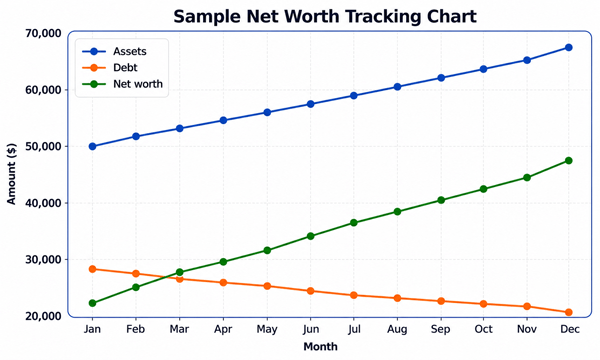
Sample Chart: Assets, Debt and Net Worth Over Time
A chart can make your progress easier to understand. The example below shows assets rising, debt falling, and net worth improving over a year. Your real chart may not be this smooth, especially if you invest in markets that fluctuate.
Simple Net Worth Tracking Diagram
List Assets -> List Debts -> Subtract Debts -> Record Net Worth -> Review Trend -> Take Action
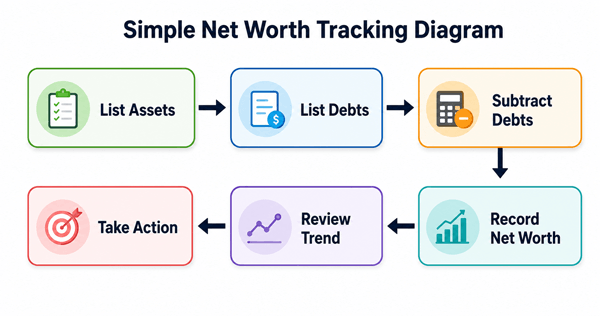
Visual summary: repeat this process monthly so your net worth trend becomes easier to understand and act on.
6. How Often Should You Update Your Net Worth?
For most beginners, monthly tracking is enough. Weekly tracking can create unnecessary stress because account balances and investment prices move often. Annual tracking may be too slow because you might miss problems for many months.
| Frequency | Best For | Pros | Cons |
|---|---|---|---|
| Monthly | Most people | Balanced, easy to maintain, shows trends | Small changes may feel slow |
| Quarterly | People with stable finances | Less time-consuming | May miss fast-growing debt |
| Annually | Long-term review | Good for big-picture planning | Too infrequent for active debt payoff |
| Weekly | Highly active trackers | Quick feedback | Can cause stress and overreaction |
7. Spreadsheet vs App vs Notebook: Which Method Is Best?
| Method | Best For | Advantages | Limitations | Beginner Rating |
|---|---|---|---|---|
| Spreadsheet | People who want control | Flexible, transparent, low cost | Requires manual updates | Excellent |
| Finance app | People who want automation | Can sync accounts, saves time | Privacy concerns, subscription fees, sync errors | Good |
| Notebook | People who prefer pen and paper | Simple and private | Harder to chart trends or calculate totals | Okay |
| Bank dashboard | Quick account views | Convenient for linked accounts | May not include all assets and debts | Limited |
8. How to Read Your Net Worth Trend
A single net worth number is only a snapshot. The trend tells the story. Your net worth can rise because assets increase, debt falls, or both. It can fall because assets decline, debt rises, or you make a major purchase. Some changes are healthy even if the short-term number looks worse.
- Good sign: Net worth rises because you save more, invest consistently, or reduce high-interest debt.
- Good sign: Debt falls each month even if investments are temporarily down.
- Warning sign: Income rises but net worth stays flat because spending rises at the same pace.
- Warning sign: Assets rise only because you borrow more, such as using debt to buy items that lose value.
- Neutral sign: Net worth drops after a planned large expense, such as education, relocation, or starting a business, if the decision fits your long-term plan.
10. Practical Example: Two People With the Same Income
Imagine two people each earn $4,000 per month after tax. Person A saves $500 per month, invests regularly, and pays down debt. Person B spends nearly all income and adds credit card balances for vacations and shopping. Their income is the same, but their net worth paths are very different. This is why net worth tracking is more useful than income alone.
| Person | Monthly Income | Monthly Behavior | Likely Net Worth Trend |
|---|---|---|---|
| Person A | $4,000 | Saves, invests, reduces debt | Improves over time |
| Person B | $4,000 | Spends most income, adds consumer debt | Stays flat or declines |
11. Common Net Worth Tracking Mistakes to Avoid
- Using purchase price instead of current value: A car bought for $30,000 may be worth much less today. Use realistic resale value.
- Ignoring small debts: Buy now, pay later balances, store cards, and unpaid bills can quietly grow.
- Counting income as wealth: Income is money coming in. Net worth is what remains after assets and debts are measured.
- Overvaluing personal items: Furniture, clothes, and electronics usually have low resale value. Include only meaningful assets.
- Checking too often: Daily investment movements can distract you from long-term progress.
- Comparing yourself unfairly: Age, family responsibilities, location, career stage, health, and starting point all matter.
- Tracking without action: The tracker is useful only if it helps you make better decisions.
12. Best Practices for Accurate Net Worth Tracking
- Use the same tracking date each month.
- Keep asset values conservative and debt balances exact.
- Separate liquid assets from illiquid assets so you know what cash is actually available.
- Track both total net worth and categories such as cash, investments, home equity, and consumer debt.
- Write one short note each month explaining major changes.
- Review your progress quarterly instead of reacting emotionally to every monthly movement.
- Protect your spreadsheet or app with strong passwords and two-factor authentication where available.
Privacy reminder: Avoid sharing full account numbers, passwords, or screenshots that reveal sensitive financial details. If you use an app, review its privacy and security settings before connecting accounts.
- Use net worth tracking as a decision tool, not as a measure of personal value.
13. Net Worth Tracking for Different Life Stages
| Life Stage | Main Focus | What to Watch | Useful Goal |
|---|---|---|---|
| 20s | Build habits and avoid bad debt | Student loans, credit cards, emergency fund | Create positive monthly progress |
| 30s | Grow savings and investments | Lifestyle inflation, family costs, home debt | Increase savings rate |
| 40s | Balance growth and protection | Retirement gap, insurance, mortgage, education costs | Accelerate investments and reduce high-interest debt |
| 50s | Prepare for retirement | Debt levels, healthcare costs, asset allocation | Strengthen retirement readiness |
| 60s and beyond | Preserve wealth and manage withdrawals | Cash flow, taxes, estate planning | Make assets support lifestyle safely |
14. How Net Worth Tracking Helps You Build Wealth
Tracking alone does not build wealth, but it makes wealth-building behavior easier to see and repeat. The main levers are increasing assets, reducing liabilities, and avoiding decisions that create long-term financial drag.
- Increase assets by saving regularly, investing according to your risk tolerance, improving income, and building emergency reserves.
- Reduce liabilities by paying down high-interest debt, avoiding unnecessary borrowing, and refinancing carefully when it truly lowers total cost.
- Protect progress with insurance, emergency savings, estate planning documents, and careful account security.
- Make better trade-offs by seeing how each major purchase, loan, or investment affects the full picture.
15. When Your Net Worth Goes Down: What It Means
A falling net worth is not always a disaster. Investment markets can decline. Property values can change. A planned expense can reduce cash. A temporary drop matters less than the reason behind it and whether your long-term plan still works.
Ask three questions: Did debt increase? Did assets fall because of normal market movement? Did I make a planned decision that should benefit me later? If debt is rising because of everyday overspending, take action quickly. If investments are down because markets are down, avoid panic decisions and review your plan calmly.
■ Monthly Net Worth Review Checklist
- Update bank and cash balances.
- Update investment and retirement account values.
- Update home, vehicle, or business estimates only when needed.
- Record all debt balances.
- Calculate total assets, total debt, and net worth.
- Compare with last month and last year.
- Write a short note explaining the biggest change.
- Choose one action for the next month.
■ Frequently Asked Questions
1. What is the best way to track net worth?
The best way for most beginners is a simple spreadsheet updated once per month. It is flexible, low cost, and makes the formula easy to understand.
2. Should I include my home in net worth?
Yes, you can include your home as an asset, but also include the mortgage as a liability. For a conservative view, use a realistic home value rather than an optimistic selling price.
3. Should I include my car?
You may include your car if it has meaningful resale value, but use a conservative current value. Remember that vehicles often decline in value over time.
4. Should retirement accounts count as assets?
Yes. Retirement accounts are part of your wealth. You may also track them separately because access rules, taxes, and penalties can differ from regular cash or brokerage accounts.
5. Is negative net worth bad?
Negative net worth means debts are higher than assets. It is common for people with student loans, new mortgages, or early-career finances. The key is improving the trend over time.
6. How often should I check net worth?
Monthly is usually enough. It provides regular feedback without encouraging daily stress over normal account fluctuations.
7. What is a good net worth?
A good net worth depends on age, income, location, family responsibilities, goals, and starting point. A better question is whether your net worth is improving in a sustainable way.
8. Can my net worth increase while I still have debt?
Yes. Your net worth can rise if assets increase faster than debt, or if you pay debt down while maintaining or growing assets.
9. Is net worth the same as cash flow?
No. Cash flow is money coming in and going out during a period. Net worth is the value of what you own minus what you owe at a point in time.
10. What should I do after calculating net worth?
Look for the biggest opportunity: build emergency savings, pay down high-interest debt, invest consistently, reduce unnecessary spending, or protect your finances with insurance and planning.
■ Final Thoughts
Net worth tracking is one of the simplest ways to understand your financial progress. You do not need advanced finance knowledge, a large income, or expensive software. You only need a clear list of assets, a complete list of debts, and a regular habit of reviewing the numbers honestly.
Start with one monthly tracker. Keep your numbers realistic. Focus on the trend. Over time, small improvements in saving, investing, debt repayment, and spending decisions can turn a simple spreadsheet into a powerful wealth-building tool.
Reader Advice: This article is for educational and information purposes only and should not be taken as financial, legal, tax, or investment advice. Please check the latest details from official sources and qualified professionals, as rules, information, and policies may change over time.