How to Increase Your Net Worth Over Time
Quick answer: To increase your net worth over time, calculate your current assets and liabilities, spend less than you earn, build emergency savings, pay down high-interest debt, invest consistently for long-term goals, increase income, and protect your money from avoidable risks.
You increase your net worth by growing what you own and reducing what you owe. In simple terms, net worth equals assets minus liabilities. Assets include cash, investments, retirement savings, property, and valuable items you could sell. Liabilities include credit card balances, loans, mortgages, unpaid bills, and other debts.
For the most accurate result, use current account balances and realistic resale values rather than original purchase prices. Review your numbers after major life changes such as a new job, marriage, relocation, buying a home, or taking on new debt.
The practical formula is simple:
Increase assets + reduce liabilities + avoid unnecessary financial leaks = higher net worth over time.
The challenge is not understanding the formula. The challenge is building habits that work month after month: spending less than you earn, saving regularly, paying down expensive debt, investing wisely, and protecting your money from avoidable risks.
1. What Is Net Worth?
Net worth is a snapshot of your financial position at a specific point in time. It shows the difference between your total assets and total liabilities. A person with many possessions can still have a low or negative net worth if they also have large debts. A person with a modest lifestyle can have a high net worth if they own valuable assets and keep debt under control.
| Category | Examples | Effect on Net Worth |
|---|---|---|
| Assets | Cash, savings, investments, retirement accounts, property, business equity | Increase net worth |
| Liabilities | Credit card debt, personal loans, student loans, car loans, mortgage debt | Decrease net worth |
| Net Worth | Total assets minus total liabilities | Shows overall financial position |
Example: If you own assets worth $80,000 and owe $35,000, your net worth is $45,000. If your assets rise to $95,000 and your debts fall to $25,000, your net worth becomes $70,000.
Why Increasing Net Worth Matters
A growing net worth gives you more choices. It can help you handle emergencies, qualify for better financial opportunities, reduce stress, retire more comfortably, support family goals, or start a business. Net worth is not about showing off. It is about building financial strength.
- It helps you measure real progress, not just income.
- It shows whether your financial decisions are moving you forward or backward.
- It can reveal hidden problems, such as rising lifestyle costs or debt growing faster than savings.
- It encourages long-term thinking instead of short-term spending decisions.
Step 1: Calculate Your Current Net Worth
Before you can increase your net worth, you need to know your starting point. This does not need to be perfect. Use reasonable estimates and improve the accuracy over time.
How to calculate it
- List everything you own that has financial value.
- List everything you owe.
- Subtract total liabilities from total assets.
- Record the date so you can compare progress later.
| Item | Amount |
|---|---|
| Cash and savings | $4,000 |
| Investments | $8,000 |
| Retirement account | $12,000 |
| Car resale value | $9,000 |
| Total assets | $33,000 |
| Credit card debt | $2,500 |
| Car loan | $7,000 |
| Student loan | $11,000 |
| Total liabilities | $20,500 |
| Net worth | $12,500 |
Do not feel discouraged if your first number is low or even negative. Many people start with student loans, credit card debt, or limited savings. The goal is to create a clear baseline and improve it steadily.
Step 2: Track Your Net Worth Regularly
Tracking net worth helps you see whether your overall financial life is improving. Monthly tracking is useful for beginners because it creates awareness, but quarterly tracking is enough for many people once their habits are stable.
| Tracking Frequency | Best For | Pros | Limitations |
|---|---|---|---|
| Monthly | Beginners, debt payoff, active budgeting | Keeps you aware and motivated | Can feel discouraging when markets move down |
| Quarterly | Long-term investors and stable budgets | Reduces noise and still shows trends | Less immediate feedback |
| Yearly | Simple financial checkups | Good for big-picture review | Too slow for correcting bad habits |
Focus on the trend, not one month. Investments can fall temporarily. Property values can change. A single month does not define success. What matters is whether your net worth is generally moving upward over time.
Step 3: Spend Less Than You Earn
A higher net worth usually starts with positive cash flow. Positive cash flow means money is left after your bills and basic needs are paid. That leftover money can be used to build savings, pay down debt, or invest.
Practical ways to create positive cash flow
- Track spending for 30 days to see where your money actually goes.
- Separate needs, wants, and wasteful expenses.
- Cancel subscriptions you rarely use.
- Plan meals and shopping lists to reduce impulse buying.
- Set spending limits for flexible categories like eating out, entertainment, and shopping.
- Use automatic transfers so saving happens before casual spending.
A useful beginner goal is to save or invest at least 10% of income, then increase the percentage over time. If that is not possible right now, start with a smaller amount. The habit matters first; the amount can grow later.
Step 4: Build an Emergency Fund
An emergency fund protects your net worth from unexpected expenses. Without cash reserves, a car repair, medical bill, job loss, or family emergency can push you into high-interest debt.
A common target is three to six months of essential expenses. If that feels too large, start with a starter emergency fund, such as $500 to $1,000, then build from there.
| Emergency Fund Stage | Goal | Purpose |
|---|---|---|
| Starter fund | $500 to $1,000 | Covers small emergencies without using credit cards |
| Basic fund | 1 month of essential expenses | Creates short-term breathing room |
| Stronger fund | 3 to 6 months of essential expenses | Protects against larger setbacks |
| Larger fund | 6 to 12 months, when appropriate | Useful for variable income, dependents, or unstable work |
Keep emergency money in a safe, accessible account. It should not be invested in risky assets because you may need it quickly.
Step 5: Pay Down High-Interest Debt
High-interest debt is one of the biggest obstacles to increasing net worth. Credit card balances and expensive personal loans can grow quickly because interest works against you. Paying off this debt gives you a strong, low-risk financial return because you avoid future interest costs.
Always keep making minimum payments on all debts while targeting extra payments to one balance. Missing payments can create fees, damage credit, and slow your net worth progress.
Debt snowball vs debt avalanche
| Method | How It Works | Best For | Main Advantage |
|---|---|---|---|
| Debt snowball | Pay the smallest debt first while making minimum payments on others | People who need motivation | Quick wins build confidence |
| Debt avalanche | Pay the highest-interest debt first while making minimum payments on others | People focused on saving the most money | Usually reduces total interest paid |
Both methods can work. The best method is the one you will actually follow. For many beginners, a hybrid approach works well: pay off one small balance for motivation, then focus on the highest-interest debts.
Step 6: Invest Consistently for Long-Term Growth
Saving money is important, but investing is often what helps net worth grow faster over long periods. Investments can rise and fall, but over time, diversified investments have historically helped people build wealth more effectively than cash savings alone.
Beginners should focus on simple principles: diversify, keep costs reasonable, invest regularly, avoid panic selling, and match investments to time horizon and risk tolerance.
Also consider fees, taxes, inflation, and your local rules before choosing an account or investment. A low-cost, diversified option may be suitable for many beginners, but the right choice depends on your time horizon, risk tolerance, and personal circumstances.
Common investment options for beginners
| Investment Type | Potential Benefit | Main Risk or Limitation | Best Use |
|---|---|---|---|
| Retirement account | Tax advantages and long-term growth | Rules may limit early withdrawals | Retirement planning |
| Broad stock index fund or ETF | Diversification and growth potential | Market values can fall | Long-term investing |
| Bond fund or fixed-income investment | More stability than stocks | Lower growth potential | Balance and risk control |
| High-yield savings or money market account | Safety and easy access | May not beat inflation over long periods | Emergency funds and short-term goals |
| Real estate | Potential appreciation and income | Requires capital, maintenance, and risk management | Long-term asset building |
Do not invest money you may need soon. Money for rent, bills, taxes, or emergencies should stay safe and accessible. Investing works best when you can leave the money alone for years.
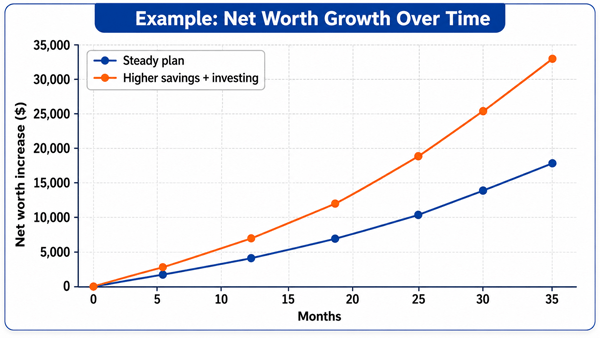
Chart: A simple illustration of how consistent savings, debt reduction, and investing can increase net worth over several years. Actual results vary based on income, expenses, debt, market returns, and personal choices.
Step 7: Increase Your Income
Cutting expenses has limits, but increasing income can create much more room to build net worth. Extra income is most powerful when you do not immediately raise your lifestyle to match it.
Ways to increase income over time
- Ask for a raise after documenting measurable results at work.
- Build skills that improve your earning power, such as sales, data analysis, project management, coding, design, communication, or leadership.
- Change jobs when a better opportunity offers fair compensation and growth.
- Start a side business or freelance service if it fits your skills and schedule.
- Turn unused assets into income, such as renting a room, selling unused items, or monetizing a practical skill.
A key rule: save or invest part of every raise, bonus, or side-income payment before increasing spending. This prevents lifestyle inflation from swallowing your progress.
Step 8: Buy Assets, Not Just Things That Lose Value
Not every purchase improves your financial position. Some purchases may be useful but lose value quickly. Others can help build wealth or reduce future costs. The goal is not to avoid all enjoyable spending, but to understand the difference between consumption and asset building.
| Purchase | Likely Net Worth Effect | Why |
|---|---|---|
| Low-cost index investment | Positive over long periods, though not guaranteed | Can grow in value and compound |
| Education or skill training with strong career value | Potentially positive | Can increase future income |
| Reliable used car bought within budget | Neutral or practical | May lose value but supports work and life needs |
| Luxury car financed with a large loan | Often negative | Depreciation plus interest costs |
| Frequent impulse shopping | Negative | Money leaves without creating lasting value |
A useful question before a large purchase is: Will this increase my income, reduce future costs, grow in value, or improve my life enough to justify the cost?
Step 9: Protect Your Net Worth
Building wealth is only half the job. You also need to protect it. One major financial setback can erase years of progress if you are not prepared.
Protection strategies
- Maintain appropriate insurance, such as health, auto, home or renters, disability, and life insurance when needed.
- Keep emergency savings separate from everyday spending money.
- Avoid co-signing loans unless you are fully prepared to pay the debt yourself.
- Use strong passwords and two-factor authentication for financial accounts.
- Review beneficiaries on retirement accounts and insurance policies.
- Create basic estate planning documents when your situation requires them.
Insurance and planning may feel boring, but they help prevent a temporary problem from becoming a long-term financial disaster.
Step 10: Avoid Lifestyle Inflation
Lifestyle inflation happens when your spending rises every time your income rises. This is one reason some high-income people still struggle to build net worth. A larger paycheck helps only if part of it is used to build assets or reduce debt.
A practical rule is to split raises and bonuses. For example, you might invest 50%, use 30% for goals, and enjoy 20%. The exact percentages can vary, but the principle is important: do not spend every increase.
Step 11: Use Automation to Stay Consistent
Financial progress often comes from systems, not willpower. Automation makes good decisions happen before you have a chance to forget or overspend.
- Set automatic transfers to savings after every paycheck.
- Automate retirement contributions or investment deposits where appropriate.
- Schedule automatic debt payments above the minimum if your budget allows.
- Use calendar reminders for quarterly net worth reviews.
- Create separate accounts for emergency savings, short-term goals, and everyday spending.
Automation does not replace awareness. Review your accounts regularly to make sure transfers, fees, subscriptions, and balances still make sense.
■ Example: How One Person Increases Net Worth in 12 Months
Consider a beginner named Sara. She starts with $5,000 in savings, $3,000 in investments, a $7,000 car, $4,000 of credit card debt, and a $9,000 car loan. Her starting net worth is $2,000.
| Action Over 12 Months | Result |
|---|---|
| Builds emergency fund from $5,000 to $7,000 | Assets increase by $2,000 |
| Invests $250 per month | Assets increase by $3,000 before market changes |
| Pays off $4,000 credit card balance | Liabilities decrease by $4,000 |
| Pays car loan down from $9,000 to $6,500 | Liabilities decrease by $2,500 |
| Avoids taking on new consumer debt | Progress is protected |
| Approximate net worth improvement | $11,500 before changes in car value or investment returns |
This example shows an important point: net worth can rise from both sides of the equation. Sara increased assets and reduced liabilities at the same time.
■ Best Practices for Increasing Net Worth Over Time
Use this checklist as a simple review routine. It supports the main goal of building assets, lowering liabilities, and keeping your financial plan realistic.
- Know your number: calculate net worth at least once per quarter.
- Prioritize high-interest debt before low-return investments.
- Build emergency savings before taking large investment risks.
- Invest consistently instead of trying to perfectly time the market.
- Keep housing, transportation, and debt payments affordable.
- Increase income and direct part of every increase toward wealth building.
- Avoid comparing your progress with others; compare your current situation with your past situation.
- Review your plan after major life changes, such as marriage, a new child, job loss, relocation, or buying a home.
■ Common Mistakes That Slow Net Worth Growth
| Mistake | Why It Hurts | Better Approach |
|---|---|---|
| Only focusing on income | High income can disappear through high spending | Track saving rate and net worth |
| Carrying credit card debt | Interest reduces your ability to save and invest | Pay high-interest debt aggressively |
| Investing without emergency savings | You may sell investments at a bad time during emergencies | Build cash reserves first |
| Trying to get rich quickly | Speculation can cause large losses | Use steady, diversified investing |
| Ignoring small leaks | Subscriptions, fees, and impulse buys add up | Review spending monthly |
| Taking too much lifestyle debt | Payments reduce future flexibility | Borrow carefully and keep fixed costs manageable |
■ How Long Does It Take to Increase Net Worth?
It depends on income, expenses, debt, savings rate, investment returns, and life circumstances. Some people see progress within a few months by paying off debt or building savings. Larger wealth-building goals usually take years.
The first stage often feels slow because you are building habits, paying down old debt, and creating a safety net. Over time, progress can speed up as debt payments disappear, investments grow, and income rises.
■ Simple Net Worth Growth Plan for Beginners
- Calculate your current net worth this week.
- Track spending for one month.
- Build a starter emergency fund.
- Pay off high-interest debt using the snowball, avalanche, or hybrid method.
- Automate savings and retirement contributions.
- Invest for long-term goals using diversified, low-cost options when appropriate.
- Look for ways to increase income without increasing lifestyle costs at the same pace.
- Review your net worth every month or quarter and adjust your plan.
■ Beginner-Friendly Net Worth Diagram
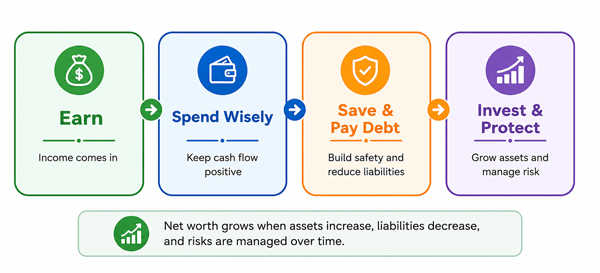
Diagram: A beginner-friendly flow showing how income decisions can support net worth growth when money is saved, debt is reduced, investments are built, and risks are managed.
| Money Decision | Short-Term Effect | Long-Term Net Worth Impact |
|---|---|---|
| Earn income | Money comes in | Creates opportunity to save, invest, or repay debt |
| Spend wisely | Money goes to needs and planned wants | Keeps cash flow positive |
| Save cash | Builds safety net | Prevents emergencies from becoming debt |
| Pay debt | Reduces liabilities | Raises net worth and improves flexibility |
| Invest | Buys growth-oriented assets | Can compound wealth over time |
| Protect wealth | Uses insurance and planning | Reduces risk of major setbacks |
■ Frequently Asked Questions
1. What is the fastest way to increase net worth?
The fastest reliable way is usually a combination of increasing income, reducing unnecessary expenses, paying off high-interest debt, and investing consistently. Trying to get rich quickly through speculation can backfire and reduce net worth instead of increasing it.
2. Should I save money or pay off debt first?
Start with a small emergency fund so you do not rely on credit for every surprise expense. After that, focus heavily on high-interest debt. Once expensive debt is under control, increase savings and investing for long-term goals.
3. Does buying a house increase net worth?
A home can increase net worth if it is affordable, maintained well, and builds equity over time. However, a home also comes with mortgage interest, taxes, insurance, repairs, and transaction costs. Buying too much house can weaken your finances.
4. Can my net worth be negative?
Yes. Negative net worth means your liabilities are larger than your assets. This is common for people with student loans, medical debt, business debt, or credit card balances. It can improve with a clear debt repayment and savings plan.
5. How often should I check my net worth?
Monthly or quarterly is usually enough. Checking too often can be stressful, especially if you invest in assets that change value daily. Focus on long-term direction instead of short-term changes.
6. Is income the same as net worth?
No. Income is money you earn over a period of time. Net worth is what you own minus what you owe at a specific point in time. A person can have high income and low net worth if they spend or borrow too much.
7. What net worth should I have by my age?
There is no perfect number because people start from different incomes, countries, family situations, education costs, and life events. A more useful goal is to improve your own net worth consistently and build a financial plan that matches your needs.
8. Can small savings really make a difference?
Yes. Small savings build the habit of paying yourself first. Over time, larger income, lower debt, and investment growth can make those habits much more powerful.
9. What is a good first step if I feel overwhelmed?
Start with one small action: calculate your current net worth or build a small emergency fund. One clear step can create momentum, and momentum is often more important than trying to fix everything at once.
■ Final Thoughts
Increasing your net worth over time is not about one perfect decision. It is about a series of practical decisions repeated consistently: spend less than you earn, keep emergency savings, reduce high-interest debt, invest for the long term, increase income, and protect what you build.
Start with your current number, choose one improvement to make this month, and keep going. Progress may feel slow at first, but steady action can create meaningful financial strength over time.
Reader Advice: This article is for educational and informational purposes only and should not be taken as personalized financial, investment, tax, or legal advice. Please check the latest information from official sources or a qualified professional, as rules, policies, rates, and financial conditions can change over time.