How to Build Wealth on a Low Income
Building wealth on a low income is possible, but it usually does not happen through one dramatic decision. It happens through small, repeated actions that protect your money, reduce financial leaks, and slowly turn your income into assets. When money is tight, the goal is not to pretend that saving is easy. The goal is to build a system that works with a small margin and improves as your income grows.
This guide explains how to build wealth on a low income from the ground up. You will learn how to stabilize your cash flow, create a realistic budget, save small amounts, pay down expensive debt, start investing, increase income, avoid common traps, and measure progress even when your paycheck feels limited.
It is also written for readers who search for practical phrases such as how to save money on a low income, how to build assets with a small paycheck, how to get out of debt on a low income, and how to start investing with little money. The steps below focus on realistic actions, not quick-money promises.
1. Quick Answer: How Do You Build Wealth on a Low Income?
To build wealth on a low income, start by controlling cash flow, saving a small emergency fund, paying off high-interest debt, automating even small savings, using tax-advantaged or low-cost investment accounts where available, increasing income over time, and protecting yourself from setbacks. The key is consistency, not perfection. A person who saves and invests a small amount every month while avoiding expensive debt can often make more progress than someone with a higher income but poor money habits.
For most readers, the safest order is stability first, expensive debt second, long-term investing third, and income growth throughout the process. This order helps reduce the chance that an emergency forces you back into costly borrowing.
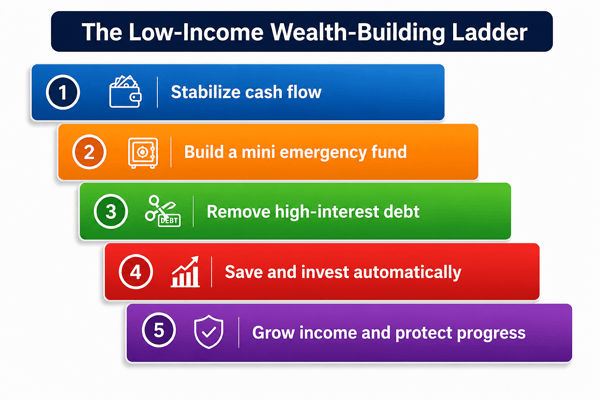
Figure: A practical wealth-building sequence for people starting with limited income.
2. What Building Wealth Really Means
Wealth is not just having a high salary. Wealth means owning resources that give you security, options, and future income. These resources may include cash savings, retirement accounts, investments, a paid-off car, education or skills that raise earning power, a small business, or a home if it is affordable and fits your life.
Low income makes wealth building harder because there is less room for mistakes. However, the basic formula is still the same: spend less than you earn when possible, avoid debt that drains your future income, save for emergencies, buy or build assets, and keep repeating the process.
Step 1: Know Where Your Money Is Going
Before you can build wealth, you need a clear picture of your cash flow. Cash flow means the money coming in and the money going out. Many people on a low income feel they have nothing left because their expenses are scattered across rent, food, transport, bills, debt payments, subscriptions, family support, and small unplanned purchases.
Track every expense for at least 30 days. Use a notebook, spreadsheet, budgeting app, or your bank statement. The method matters less than honesty. Do not judge yourself during this step. The purpose is to find patterns and identify where small changes can create breathing room.
A Simple Low-Income Budget Framework
A common budgeting mistake is using a perfect-looking template that does not match real life. On a low income, start with a survival-first budget. Pay for essentials first, protect a small emergency fund, then choose one or two priority goals.
| Category | What It Includes | Practical Target |
|---|---|---|
| Needs | Rent, utilities, groceries, transport, basic insurance, minimum debt payments | Keep as low and stable as possible |
| Emergency savings | Small automatic deposits into a separate savings account | Start with $5, $10, or 1% of income if needed |
| Debt payoff | Extra payments toward high-interest debt after minimums | Focus on one debt at a time |
| Future money | Retirement, investing, education, business tools | Start small and increase when income rises |
| Personal spending | Simple fun, clothing, gifts, small treats | Plan a modest amount to avoid burnout |
Step 2: Build a Starter Emergency Fund
An emergency fund is money set aside for real unexpected costs, such as a medical bill, job loss, urgent travel, a car repair, or a broken phone needed for work. It is not a luxury. It is a financial shock absorber.
If your income is low, do not pressure yourself to save three to six months of expenses immediately. Start with a mini emergency fund. A first target of $100, $250, $500, or one week of expenses can prevent small problems from turning into expensive debt. After that, gradually build toward one month of basic expenses, then three months if possible.
Keep emergency money separate from daily spending. A savings account, separate wallet, or mobile banking pocket can help. The account should be safe and easy to access, not invested in risky assets.
If your income does not cover basic needs, also check official support programs, local charities, employer benefits, food assistance, housing support, tax credits, or hardship options. Using legitimate support while you stabilize is not a failure; it can be part of a responsible wealth-building plan.
Step 3: Attack High-Interest Debt First
High-interest debt is one of the biggest barriers to building wealth on a low income. Credit cards, payday loans, buy-now-pay-later balances, overdrafts, and informal loans with penalties can eat the money that could have gone to savings or investing.
List each debt with its balance, minimum payment, interest rate, and due date. Keep paying all minimums to avoid late fees. Then use any extra money on the debt that hurts you most.
| Debt Strategy | How It Works | Best For | Possible Downside |
|---|---|---|---|
| Debt avalanche | Pay extra toward the highest-interest debt first | Saving the most money on interest | May feel slow if the highest-rate debt has a big balance |
| Debt snowball | Pay extra toward the smallest balance first | Building motivation through quick wins | Can cost more interest if high-rate debt waits |
| Debt consolidation | Combine debts into one lower-rate payment | People who qualify for a truly lower rate | Can backfire if you keep borrowing |
| Creditor negotiation | Ask for hardship plans, lower rates, or fee waivers | Temporary income problems | Not every creditor will agree |
If you are facing payday loans, repeated overdrafts, or debt collectors, consider getting help from a reputable nonprofit credit counselor or local financial counseling organization. Avoid debt relief companies that demand large upfront fees or promise guaranteed results.
Also protect your credit history where credit reporting applies. Paying on time, keeping balances low, checking reports for errors, and avoiding unnecessary applications can make future borrowing cheaper for housing, transport, education, or business needs.
Step 4: Save Small Amounts Automatically
When income is low, saving what is left at the end of the month often fails because there is rarely anything left. A better method is to save first, even if the amount is tiny. Automation removes the need to make a new decision every payday.
Examples of small automatic savings:
- $5 every payday into emergency savings.
- 1% of each paycheck into a retirement or investment account.
- Rounding up purchases and moving the difference to savings.
- Saving part of overtime, bonuses, tax refunds, gifts, or side income before spending the rest.
Small amounts matter because they build the habit and create proof that progress is possible. Once your income increases or a debt is paid off, raise the amount.
Step 5: Reduce Expenses Without Making Life Miserable
Cutting expenses can help, but it has limits. You cannot budget your way out of every income problem. Still, many people can find small leaks that add up over time. The goal is not extreme deprivation. The goal is to redirect money from low-value spending to financial security.
| Expense Area | Low-Stress Action | Why It Helps |
|---|---|---|
| Food | Plan 3 to 5 simple meals, use leftovers, compare unit prices | Food waste quietly drains money |
| Housing | Share housing, negotiate rent, move only if savings exceed moving costs | Housing is usually the largest expense |
| Transport | Use public transport, carpool, maintain your vehicle, avoid unnecessary car debt | Transport costs often include hidden repairs, fuel, and insurance |
| Utilities | Fix leaks, reduce standby power, review phone and internet plans | Recurring bills create monthly savings |
| Subscriptions | Cancel unused apps, streaming, memberships, and auto-renewals | Small recurring charges reduce cash flow |
| Bank fees | Use low-fee accounts and avoid overdrafts when possible | Fees provide no long-term value |
Be careful with advice that says you only need to stop buying coffee or small treats. Small spending matters, but the biggest gains usually come from housing, transport, food planning, debt costs, and income growth.
Step 6: Start Investing Only After the Basics Are Stable
Investing helps wealth grow because your money has the chance to earn returns over time. But investing should not come before food, housing, urgent bills, or high-interest debt. If you invest while relying on payday loans or credit cards for emergencies, you may be taking risk in one place while paying very expensive interest in another.
A beginner-friendly path is:
- Build a small emergency fund.
- Pay down high-interest debt.
- Contribute enough to get any employer retirement match if available.
- Use low-cost, diversified investments rather than trying to pick hot stocks.
- Increase contributions slowly when income rises or debts disappear.
Diversification means spreading money across many investments instead of relying on one company, one asset, or one prediction. Low-cost index funds or diversified retirement funds are common options in countries where they are available. Always check fees, risk, account rules, and local regulations before investing.
Avoid using rent money, bill money, or emergency savings for speculative assets. If an investment promises guaranteed high returns, pressures you to act immediately, or is difficult to explain in plain language, treat it as a warning sign.
Saving vs. Investing: Which Comes First?
| Goal | Best Tool | Why |
|---|---|---|
| Bills due this month | Checking account or cash | Needs to be safe and immediately available |
| Emergency fund | Savings account or safe cash account | Should be accessible and not exposed to market losses |
| Debt payoff | Extra payments to high-interest debt | A paid-off high-rate debt gives a reliable return by avoiding interest |
| Retirement or long-term wealth | Retirement account, diversified funds, or other regulated investment account | Long time horizon can help manage market ups and downs |
| Education or business tools | Savings plus targeted investment in skills or equipment | Can increase earning power |
For U.S. readers, contribution limits and tax rules change over time. For 2026, the IRS announced that the general employee contribution limit for 401(k), 403(b), most 457 plans, and the Thrift Savings Plan increased to $24,500, and the IRA limit increased to $7,500. Eligibility, deductions, Roth rules, employer matches, and tax treatment still depend on account type, income, and plan rules. Readers outside the U.S. should use the equivalent local retirement or investment accounts available in their country and verify current rules through official sources.
Step 7: Increase Income Strategically
Expense cutting has a floor, but income growth has more room. Building wealth on a low income becomes much easier when you create even a small income increase and save part of it before lifestyle costs expand.
Practical income-growth ideas include:
- Ask for more hours, overtime, shift differentials, or a raise if your workplace offers them.
- Move to a similar job with better pay, benefits, schedule, or transport costs.
- Learn a skill that employers actually pay for, such as bookkeeping, sales, caregiving credentials, coding basics, trade skills, language skills, driving, design, or repair work.
- Use side work carefully: tutoring, delivery, freelancing, repairs, reselling, childcare, virtual assistance, or weekend services can help, but only if the profit is worth the time, taxes, transport, and fatigue.
- Turn one-time windfalls into progress: use part of refunds, bonuses, gifts, or seasonal income for debt payoff, emergency savings, or skill-building.
The best side hustle is not always the trendiest one. It is the one that fits your schedule, has low startup cost, does not damage your health, and produces real net profit after expenses.
Before starting side work, estimate take-home profit after platform fees, fuel, transport, tools, childcare, taxes, and time. A lower-paying but steady option may be better than a trendy hustle that creates debt or burnout.
Step 8: Protect the Wealth You Build
When you are starting with a low income, one setback can erase months of progress. Protection is part of wealth building. Depending on your situation and location, this may include health coverage, renter or homeowner insurance, basic life insurance if others depend on your income, safe banking, fraud protection, and important documents.
Protection also means avoiding decisions that create hidden risk: co-signing loans you cannot afford, lending money without a plan, joining get-rich-quick schemes, investing in things you do not understand, or using debt for lifestyle purchases.
■ A Realistic Example: Building Wealth With a Small Monthly Surplus
Imagine someone earns a low income and can free up only $40 per month at first. That amount may feel too small to matter, but it can still start a system.
| Month | Action | Result |
|---|---|---|
| 1 to 3 | Track spending and save $40/month | $120 starter cushion |
| 4 to 8 | Keep saving and sell unused items for $150 | Emergency fund reaches about $470 |
| 9 to 14 | Use $40/month toward a small high-interest debt after emergency fund is stable | Debt balance starts falling faster |
| 15 onward | Debt payment is redirected to savings or investing after payoff | Monthly wealth-building amount increases without needing a raise |
The important lesson is that the first small habit creates the next opportunity. Once a debt is gone, a raise arrives, or a bill is reduced, the freed-up money should be captured quickly before it disappears into everyday spending.
3. Common Mistakes to Avoid
- Waiting until you earn more before starting any money habit. Start small now and increase later.
- Investing before building a basic safety cushion or dealing with high-interest debt.
- Using credit cards, overdrafts, or loans to maintain a lifestyle that income cannot support.
- Ignoring small fees, late charges, subscriptions, and penalties because each one looks minor alone.
- Chasing quick returns, trading tips, crypto hype, or investment schemes you do not understand.
- Not tracking progress. Without tracking, it is easy to feel stuck even when you are improving.
4. Best Practices for Building Wealth on a Low Income
- Use a simple budget that matches your real life, not an ideal life.
- Keep your first savings goal small enough that you can actually reach it.
- Pay every bill on time when possible to avoid late fees and credit damage.
- Treat high-interest debt like an emergency because it drains future income.
- Automate savings, even if the amount is very small.
- Increase savings whenever income rises, before new spending becomes normal.
- Use trusted financial institutions and regulated investment platforms.
- Protect your health, documents, tools, and transportation because they affect your ability to earn.
- Review your plan monthly, not daily. Daily checking can cause stress; monthly reviewing supports action.
■ 30-Day Low-Income Wealth-Building Checklist
| Day Range | Task | Done? |
|---|---|---|
| Days 1 to 3 | List all income, bills, debts, and due dates | |
| Days 4 to 10 | Track every expense and identify 3 spending leaks | |
| Days 11 to 15 | Open or separate a small emergency savings space | |
| Days 16 to 20 | Set one automatic savings transfer, even a tiny one | |
| Days 21 to 24 | List debts by interest rate and choose a payoff strategy | |
| Days 25 to 27 | Cancel or reduce one recurring cost | |
| Days 28 to 30 | Choose one income-improvement action for the next 60 days |
■ Frequently Asked Questions
1. Can you really build wealth on a low income?
Yes, but the path is usually slower and requires a stronger focus on stability, debt reduction, and income growth. The first goal is not to become rich quickly. It is to stop going backward, create a small cushion, and turn any available surplus into assets.
2. How much should I save if I barely have money left?
Start with an amount that is small enough to repeat. That might be $1 a day, $5 per payday, or 1% of income. The habit matters first. You can increase the amount after a debt is paid off, a bill is reduced, or income rises.
3. Should I save or pay off debt first?
Usually, build a small emergency fund first so you do not need to borrow for every surprise. Then focus extra money on high-interest debt while keeping the emergency fund in place. Low-interest debt may not need to be rushed if you have more urgent goals.
4. Is investing safe for low-income earners?
Investing always has risk. Low-income earners should avoid money they need soon being placed in risky investments. Long-term investing through diversified, low-cost, regulated options can be useful after basic stability is in place.
5. What is the fastest way to build wealth on a low income?
The fastest realistic path is a combination of cutting major waste, eliminating high-interest debt, increasing income, and automatically saving part of every raise or windfall. Get-rich-quick promises are usually dangerous.
6. What if my income is too low to cover basic needs?
If income does not cover essentials, budgeting alone is not enough. Focus on immediate support: benefits, community resources, food assistance, housing help, debt hardship programs, job changes, skill training, or additional income. Wealth building begins after basic stability is possible.
7. Do I need a financial advisor?
Not always. Many beginners can start with budgeting, debt payoff, emergency savings, and basic education. An advisor may help with complex investing, taxes, insurance, or major decisions, but choose someone qualified, transparent about fees, and legally required to act in your best interest where such standards apply.
8. What assets can I build if I have little money?
Start with assets that improve stability and earning power: emergency savings, debt-free cash flow, job skills, basic tools for work, regulated retirement accounts, diversified long-term investments, and reliable transportation if it helps you earn more. Not every asset has to be large at the beginning.
■ Final Thoughts
Building wealth on a low income is not about pretending money problems are simple. It is about creating a practical path from limited cash flow to greater security. Start with awareness, protect a small emergency fund, reduce expensive debt, save automatically, grow income, and invest carefully when the foundation is ready.
The most powerful step is the one you can repeat. A small monthly habit, protected from debt and strengthened by income growth, can become the foundation for long-term financial stability.
Sources and Notes
This article is educational and general in nature. Financial rules, taxes, account limits, and investment options vary by country and change over time. Readers should verify details with local regulators, tax authorities, qualified financial professionals, or official account providers before making decisions.
- FDIC Money Smart financial education program: https://www.fdic.gov/consumer-resource-center/money-smart
- FDIC Money Smart for Adults - spending, saving, and prioritizing when money is short: https://www.fdic.gov/consumer-resource-center/money-smart-adults
- U.S. Securities and Exchange Commission investor education resources: https://www.sec.gov/
- IRS 2026 retirement plan and IRA contribution limit announcement: https://www.irs.gov/newsroom/401k-limit-increases-to-24500-for-2026-ira-limit-increases-to-7500
- IRS retirement topics - IRA contribution limits: https://www.irs.gov/retirement-plans/plan-participant-employee/retirement-topics-ira-contribution-limits
Reader Advice: This article is for educational and information purposes only and should not be taken as personal financial, tax, legal, or investment advice. Please check the latest details from official sources or a qualified professional, because rules, account limits, policies, and local programs can change over time.