Financial Freedom vs Wealth: What's the Difference?
Many people use the words financial freedom and wealth as if they mean the same thing. They are related, but they are not identical. Wealth usually describes how many assets and resources you own. Financial freedom describes how much control you have over your time, choices, and lifestyle because your money situation is stable enough to support you.
A person can look wealthy but feel trapped by debt, high expenses, and constant pressure to earn more. Another person may not be rich by society's standards, but may have low living costs, steady income, savings, and enough flexibility to choose work they enjoy. That second person may be closer to financial freedom than the first.
This guide explains the difference in simple terms, shows practical examples, and helps you understand how to pursue both without falling into common money traps.
Last reviewed: July 2026. Figures and examples are simplified for education, not personal financial advice.
1. What Is Wealth?
Wealth is the total financial value of your assets after subtracting your liabilities. In personal finance, wealth is often measured by net worth.
Simple formula: Net Worth = Assets - Liabilities
Assets are things you own that have value. Liabilities are debts or obligations you owe.
| Assets | Liabilities |
|---|---|
| Cash and savings | Credit card balances |
| Investments such as stocks, funds, or retirement accounts | Student loans |
| Real estate equity | Car loans |
| Business ownership | Mortgage debt |
| Valuable personal property | Personal loans |
Example of Wealth
Imagine Priya owns a home worth $350,000, has $80,000 in investments, $20,000 in cash, and owes $220,000 on her mortgage and $10,000 on a car loan.
| Item | Amount |
|---|---|
| Total assets | $450,000 |
| Total liabilities | $230,000 |
| Net worth | $220,000 |
| What it means | Priya has built wealth because her assets exceed her debts. |
This does not automatically mean Priya is financially free. If her monthly expenses are high and she depends entirely on one paycheck, she may still feel financially stressed.
2. What Is Financial Freedom?
Financial freedom means having enough financial stability, income, savings, and flexibility to make life choices without being controlled by money stress. It does not always mean never working again. For many people, it means work becomes a choice rather than a survival requirement.
In practical terms, financial freedom is usually built from several layers: emergency savings, manageable debt, steady cash flow, suitable insurance, and long-term assets. The exact mix depends on your location, family responsibilities, health costs, taxes, and goals.
A financially free person may be able to:
- pay essential bills without panic
- handle emergencies without going into high-interest debt
- choose a job based on values, growth, or purpose rather than only survival
- take time off when needed
- retire, semi-retire, or work fewer hours
- support family goals without constant money anxiety
Example of Financial Freedom
Omar earns a moderate income, but he has no credit card debt, six months of emergency savings, affordable housing, a simple lifestyle, and investments that cover part of his expenses. He still works, but he could leave a bad job, handle an emergency, or take a lower-paying role without immediate financial crisis.
Omar may not be extremely wealthy, but he has meaningful financial freedom because his money supports his choices.
3. Financial Freedom vs Wealth: Key Differences
| Category | Wealth | Financial Freedom |
|---|---|---|
| Main meaning | How much value you own after debt | How much choice and independence your money gives you |
| Measured by | Net worth, assets, investment balances | Expense coverage, passive income, cash flow, savings, flexibility |
| Focus | Accumulation of assets | Control over time and lifestyle |
| Can exist without the other? | Yes. You can be wealthy but still financially trapped. | Yes. You can be financially free with modest wealth if expenses are low and income is stable. |
| Big risk | Lifestyle inflation, overconfidence, poor asset protection | Under-saving, ignoring long-term wealth building |
| Best use | Build long-term security, opportunity, and legacy | Create peace, flexibility, and independence |
4. Simple Diagram: How Wealth Can Support Financial Freedom
The relationship is easier to understand like this:
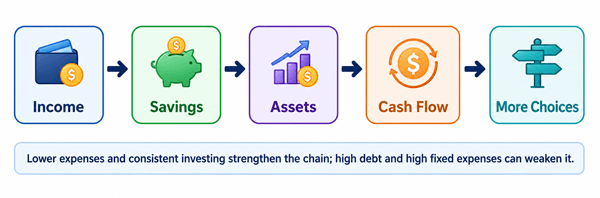
Flowchart showing income turning into savings, assets, cash flow, and more financial choices.
Income -> Savings -> Assets -> Cash Flow -> More Choices
Higher debt and higher expenses can break the chain.
Lower expenses and consistent investing can strengthen the chain.
5. Why Wealth Does Not Always Mean Financial Freedom
Wealth can create freedom, but only when it is managed well. A high net worth can still feel fragile if most of the wealth is locked inside illiquid assets, tied to a risky business, or supported by expensive habits.
Common reasons wealthy people may not feel financially free include:
This is why liquidity, after-tax cash flow, inflation, and risk management matter. A large asset value can look impressive, but freedom depends on whether money is available when needed and whether the plan can survive real-life changes.
- high fixed expenses such as large mortgages, private school fees, luxury cars, and staff costs
- debt used to maintain an image of success
- assets that are valuable on paper but do not produce usable cash flow
- dependence on one business, employer, or market cycle
- lack of emergency funds or insurance
- family pressure, poor boundaries, or unclear estate planning
6. Why Financial Freedom Does Not Always Mean Being Rich
Financial freedom is personal because it depends heavily on lifestyle costs. Someone who needs $3,000 per month to live comfortably requires less income and fewer assets than someone who needs $15,000 per month.
This is why two people with the same income can have very different levels of freedom. The person with lower debt, controlled expenses, and steady investing may become free earlier than the person with a higher salary but expensive habits.
7. The Role of Income, Expenses, Assets and Debt
Financial freedom and wealth are built from the same basic ingredients, but they use them differently.
| Money factor | How it affects wealth | How it affects financial freedom |
|---|---|---|
| Income | Provides money to save and invest | Creates breathing room if expenses stay controlled |
| Expenses | Lower expenses leave more money for assets | Lower expenses reduce how much income you need to be free |
| Assets | Increase net worth and may grow over time | Can produce income or be sold to support life choices |
| Debt | Reduces net worth and can slow progress | High payments reduce flexibility and increase pressure |
| Cash flow | Helps fund investing and debt payoff | Determines whether your lifestyle is sustainable |
8. Real-World Scenarios
Scenario 1: High Income, Low Freedom
Daniel earns $250,000 per year but spends nearly all of it. He has two car loans, credit card debt, a large mortgage, and no emergency fund. He looks successful, but he cannot miss two paychecks without stress. Daniel has income, but not much freedom.
Scenario 2: Moderate Income, Growing Freedom
Sara earns $70,000 per year, lives below her means, has no high-interest debt, invests every month, and keeps a strong emergency fund. She is not rich yet, but she is building both wealth and freedom.
Scenario 3: High Net Worth, Low Cash Flow
A business owner may have a company valued at $2 million, but if the business does not produce reliable cash and cannot easily be sold, that wealth may not feel like freedom. Net worth matters, but liquidity and cash flow matter too.
9. Which Should You Focus on First?
For most beginners, the best path is to build financial stability first, then financial freedom, then larger wealth. Trying to build wealth while ignoring debt, emergency savings, and spending habits can create stress and risk.
| Stage | Main goal | Practical actions |
|---|---|---|
| 1. Stability | Stop money emergencies from controlling you | Track spending, create a starter emergency fund, pay bills on time, reduce high-interest debt |
| 2. Security | Make your finances resilient | Build 3-6 months of essential expenses, get suitable insurance, improve income skills |
| 3. Freedom | Create more options | Invest consistently, lower fixed expenses, build flexible income streams |
| 4. Wealth | Grow and protect assets | Diversify investments, plan taxes and estate matters, avoid lifestyle inflation |
■ How to Build Financial Freedom and Wealth Together
1. Define what financial freedom means for your life
Write down what freedom would look like for you. It may mean paying bills without stress, leaving a toxic job, retiring early, working part-time, starting a business, or having time with family. The clearer the goal, the easier it is to plan.
2. Calculate your monthly freedom number
Add up your essential expenses and your desired lifestyle expenses. A simple beginner formula is: Monthly freedom number = housing + food + utilities + transportation + insurance + debt payments + health costs + family needs + basic lifestyle costs.
3. Know your net worth
List all assets, list all debts, and subtract debts from assets. Update this every month or quarter. Net worth shows whether your wealth is moving in the right direction.
4. Build an emergency fund
An emergency fund protects your freedom because it gives you time to think before making desperate decisions. Start small, then build toward several months of essential expenses.
5. Pay off high-interest debt
High-interest debt works against both wealth and freedom. It reduces cash flow, increases stress, and makes it harder to invest.
6. Invest consistently
Investing helps turn income into assets. Beginners often start with diversified funds, retirement accounts, or other long-term investment vehicles suitable for their country, risk tolerance, and goals.
7. Keep lifestyle inflation under control
When income rises, increase saving and investing before increasing spending. Lifestyle inflation is one of the biggest reasons high earners struggle to feel free.
8. Build income resilience
Financial freedom is stronger when you are not dependent on one income source. This can include career skills, side income, a business, rental income, dividends, or other cash-flow assets.
9. Protect what you build
Insurance, legal planning, estate planning, tax planning, and good recordkeeping help protect wealth. The right protection depends on your family, assets, country, and risk exposure.
10. Review your plan regularly
Your goals, family needs, income, and markets can change. Review your plan at least once or twice per year and adjust as needed.
■ Common Mistakes to Avoid
| Mistake | Why it matters |
|---|---|
| Confusing income with wealth | A high salary is useful, but wealth comes from what you keep and invest. |
| Buying status instead of assets | Luxury purchases may feel rewarding, but they can delay freedom if they create debt or high ongoing costs. |
| Ignoring cash flow | Net worth matters, but monthly cash flow determines day-to-day freedom. |
| Keeping too much bad debt | Debt with high interest can quietly consume future wealth. |
| Investing without a safety cushion | Emergency savings reduce the need to sell investments at a bad time. |
| Waiting too long to start | Small, consistent actions are often more powerful than waiting for the perfect moment. |
| Copying someone else’s lifestyle | Freedom is personal. A plan that works for one person may not fit your income, family, values, or risk tolerance. |
10. Pros and Cons of Pursuing Financial Freedom First
| Pros | Cons or limits |
|---|---|
| Reduces stress and dependence on every paycheck | May require lifestyle changes and patience |
| Gives more career and family flexibility | Can feel slow if income is low |
| Encourages healthier money habits | Too much focus on safety can make some people avoid reasonable investing risk |
11. Pros and Cons of Pursuing Wealth First
| Pros | Cons or limits |
|---|---|
| Can create long-term security and opportunity | May lead to overwork if freedom is not defined |
| Can support family, business, and legacy goals | Can encourage comparison and lifestyle inflation |
| Can eventually fund freedom through assets and income | Wealth on paper may not provide immediate cash flow |
12. Practical Checklist: Are You Moving Toward Freedom or Just Looking Wealthy?
- You spend less than you earn most months.
- You have emergency savings.
- You understand your net worth.
- Your debt payments are manageable.
- You invest regularly for long-term goals.
- You can handle a surprise expense without panic.
- You are not increasing your lifestyle every time your income rises.
- Your money decisions match your values, not just social pressure.
■ Frequently Asked Questions
1. Is financial freedom the same as being rich?
No. Being rich usually means having a high income or large assets. Financial freedom means having enough stability and flexibility to live with less money pressure. A rich person may lack freedom if expenses and debt are too high.
2. Can you be financially free without being wealthy?
Yes, depending on your lifestyle costs. A person with modest assets, low expenses, no high-interest debt, and reliable income may have more freedom than a high earner with large debts.
3. Can you be wealthy but not financially free?
Yes. If your wealth is illiquid, your expenses are very high, or your lifestyle depends on constant work, you may have wealth without much freedom.
4. What is the first step toward financial freedom?
Start by understanding your spending, debt, income, and emergency savings. You cannot improve what you do not measure.
5. How much money do I need for financial freedom?
It depends on your monthly expenses, family needs, location, health costs, risk tolerance, and desired lifestyle. The lower your required expenses, the less income or investment wealth you need.
6. Is passive income required for financial freedom?
Not always, but it helps. Freedom can also come from savings, low expenses, flexible work, strong skills, and reliable income. Passive income becomes more important if your goal is to stop working entirely.
7. Should I pay off debt or invest first?
It depends on the type of debt, interest rate, emergency savings, and employer benefits. Many beginners prioritize minimum payments, emergency savings, high-interest debt payoff, and then consistent investing.
8. What is better: wealth or financial freedom?
Neither is automatically better. Wealth is a resource. Financial freedom is a result. The healthiest goal is to build wealth in a way that increases your freedom, security, and quality of life.
■ Final Takeaway
Financial freedom and wealth are connected, but they are not the same. Wealth is about what you own. Financial freedom is about what your money allows you to do. The best financial plan does not chase a number only for status. It builds assets, protects cash flow, reduces unnecessary pressure, and gives you more control over your life.
For beginners, the practical path is simple: spend less than you earn, avoid high-interest debt, save for emergencies, invest consistently, protect your assets, and define what enough means for your life. When wealth supports freedom, money becomes a tool instead of a source of constant stress.
Reader Advice: This article is for educational and information purposes only and should not be taken as personal financial, tax, legal, or investment advice. Please check the latest information from official sources and consider speaking with a qualified professional, as rules, information, and policies can change over time.