How to Build Multiple Income Streams: Beginner's Guide
Building multiple income streams means earning money from more than one source instead of depending on a single paycheck, client, business, or investment. For beginners, the goal is not to chase every opportunity at once. The goal is to create a safer, more flexible financial life by adding income sources in a smart order.
A second or third income stream can help you pay off debt faster, save more consistently, handle job loss with less stress, and work toward long-term goals such as buying a home, starting a business, or retiring with more confidence. However, extra income also brings trade-offs: time pressure, taxes, upfront costs, learning curves, and sometimes financial risk.
This guide explains what multiple income streams are, the main types, how they work, how to choose the right one, and how to build them step by step without burning out or falling for unrealistic “passive income” promises.
Because extra income can affect taxes, contracts, benefits, insurance, and financial risk, use this guide as a practical starting point and confirm important details with qualified professionals or official sources in your location.
Quick Answer
To build multiple income streams, first stabilize your main income and emergency savings. Then choose one simple extra income idea that fits your skills, time, budget, and risk tolerance. Start small, track profit after expenses and taxes, improve one stream until it is reliable, and only then add another stream. Beginners usually do best with skill-based side work, overtime, freelancing, tutoring, resale, rental of unused assets, or low-cost digital products before moving into complex businesses or investments.
What This Beginner Guide Covers:
- What multiple income streams mean and why they matter
- The difference between active, passive, portfolio, digital, and business income
- A step-by-step plan to build extra income safely
- Beginner-friendly income stream ideas with pros, cons, costs, and risks
- Common mistakes, tax considerations, and practical examples
- FAQs that answer the questions most beginners ask
1. What Are Multiple Income Streams?
Multiple income streams are different ways you earn money. For example, one person may earn a salary from a job, freelance income on weekends, dividends from investments, and occasional income from selling digital templates. Another person may run a small repair business, rent out equipment, and invest part of the profit each month.
The important point is that each stream should have a clear source, cost, purpose, and level of effort. A real income stream is not just an idea. It is something that either earns money now or has a practical plan to earn money within a reasonable time.
2. Why Building Multiple Income Streams Can Improve Financial Stability
Relying on one income source can be risky because life changes. Jobs can end, clients can leave, businesses can slow down, health issues can interrupt work, and inflation can make the same paycheck feel smaller. Extra income does not remove all risk, but it can reduce dependence on one source.
The main benefits include more financial flexibility, faster progress toward savings goals, better debt repayment capacity, more career options, and a stronger sense of control. But the benefits are only real when the income is profitable and sustainable, not when it creates more stress or debt.
| Benefit | How it helps | Beginner example |
|---|---|---|
| More security | You are less dependent on one paycheck. | A teacher also tutors two evenings a week. |
| Faster savings | Extra money can be directed to an emergency fund or goals. | A worker saves all weekend delivery income. |
| Debt payoff support | Additional income can reduce high-interest debt faster. | A freelancer applies project earnings to credit card balances. |
| Skill growth | Side work can build marketable experience. | A designer starts with small logo projects. |
| Long-term wealth building | Surplus cash can be invested or used to buy assets. | A household invests monthly after building savings. |
3. Beginner Income Stream Ladder
A useful way to think about multiple income streams is to build from stability to scalability. Do not start with the most complex idea first. Start with the strongest foundation.
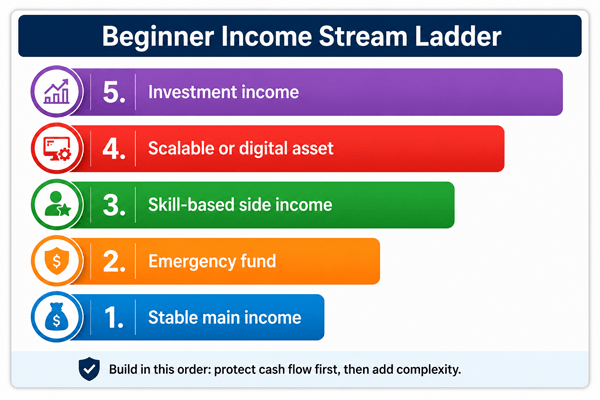
Figure: A practical order for beginners: protect your main cash flow first, then add a simple side stream, then build scalable and investment income over time.
4. The Main Types of Income Streams
Before choosing an idea, understand the different types of income. This helps you avoid confusing “extra income” with “passive income.” Most income streams require work at the beginning, and many require ongoing maintenance.
You may also see people search for the “7 streams of income.” In practice, those labels usually point to earned income, profit income, interest income, dividend income, rental income, capital gains, and royalty or licensing income. The beginner-friendly approach is the same: understand the work, cost, risk, and rules behind each stream before relying on it.
| Income type | How it works | Examples | Best for beginners? |
|---|---|---|---|
| Active income | You trade time and effort for money. | Salary, overtime, part-time job, delivery work. | Yes, if time is available. |
| Skill-based side income | You sell a useful skill or service. | Freelancing, tutoring, bookkeeping, design, repairs. | Often the best starting point. |
| Business income | You build a product or service system that may scale. | Online store, local service business, agency. | Good later, after testing demand. |
| Digital income | You sell or monetize digital assets. | Templates, courses, ebooks, content, software. | Good if you can create and market. |
| Portfolio income | You earn from investments. | Dividends, interest, capital gains. | Good after emergency savings and debt plan. |
| Rental or asset income | You earn from property or items you own. | Room rental, equipment rental, parking space. | Good if risk and rules are understood. |
| Royalties/licensing | You earn when others use your creative or intellectual property. | Books, music, stock photos, patents. | Possible, but usually slow to build. |
5. Active Income vs Passive Income: What Beginners Should Know
Many beginners search for passive income because it sounds easy: earn money while doing little or nothing. In real life, most so-called passive income is either active work done upfront, money invested upfront, or risk accepted upfront.
For example, a rental property may produce monthly rent, but it can also involve repairs, vacancies, legal rules, insurance, taxes, and tenant issues. A blog or YouTube channel may earn advertising income later, but it may require months or years of content creation first. Dividend investing can generate income, but you need capital and must accept market risk.
| Practical Rule Do not ask, “Is this passive?” Ask, “What work, money, skill, risk, and maintenance does this require?” That question leads to better decisions. |
|---|
■ How to Build Multiple Income Streams Step by Step
Step 1: Strengthen your main income first
Your first income stream is usually your job, profession, trade, or main business. Before adding another stream, look for ways to improve the income source you already have. This may mean negotiating pay, applying for better roles, asking for more hours, improving your skills, earning a certification, or reducing unpaid work that drains your time.
Step 2: Build a small emergency fund
Extra income works best when you are not forced to take desperate risks. Even a small emergency fund can prevent you from using credit cards for every surprise expense. A beginner can start with a starter goal such as one month of essential expenses, then build toward three to six months over time.
Step 3: Know your income gap
Calculate how much extra money you actually need. Someone trying to earn an extra $200 per month has different options than someone trying to replace a full-time salary. A clear target helps you choose the right stream and avoid unrealistic ideas.
Step 4: List your skills, assets, time, and constraints
A good income stream fits your real life. Write down skills you can sell, items you can rent or resell, hours you can work, startup money available, and responsibilities such as family, school, or health needs.
Step 5: Choose one income stream to test
Beginners often fail because they start five ideas at once. Pick one idea that is low cost, legal, realistic, and connected to something you can do now. Test it for 30 to 90 days before adding another idea.
Step 6: Track profit, not just revenue
Revenue is the money you bring in. Profit is what remains after expenses, fees, taxes, supplies, transport, software, refunds, and other costs. A side hustle that earns $500 but costs $450 is not as strong as one that earns $250 and costs $25.
Step 7: Create a simple system
Once an income stream works, make it easier to repeat. Use templates, checklists, a separate bank account, scheduled work hours, automatic savings transfers, and simple bookkeeping.
Step 8: Reinvest carefully
Use part of the profit to improve the stream, but avoid spending all earnings on tools, courses, ads, or inventory before there is proof of demand.
Step 9: Add the next stream only after the first one is stable
A stream is stable when it has predictable customers, clear costs, manageable time demands, and consistent profit. Adding too soon can create confusion and burnout.
■ How to Choose the Right Income Stream for You
The best income stream depends on your starting point. Use this simple comparison before choosing.
| Question | Why it matters | What to choose if your answer is yes |
|---|---|---|
| Do I need money quickly? | Some streams pay faster than others. | Overtime, part-time work, local services, freelancing, tutoring. |
| Do I have a valuable skill? | Skills can often be monetized with low startup costs. | Consulting, writing, design, coding, bookkeeping, coaching, repairs. |
| Do I have more time than money? | Low-cost ideas usually require more effort. | Service work, content creation, reselling, tutoring. |
| Do I have more money than time? | Capital can help buy assets, but risk increases. | Investing, rental assets, buying a small business after due diligence. |
| Do I enjoy selling or marketing? | Many income streams depend on finding customers. | Freelancing, ecommerce, digital products, agency work. |
| Do I want low stress? | Some streams have customer, legal, or operational pressure. | Interest income, simple investing, very small local services. |
6. Beginner-Friendly Multiple Income Stream Ideas
The following ideas are practical starting points. Not every idea is right for every person. Check local laws, platform rules, taxes, insurance, safety requirements, licenses, permits, employment contracts, and payment terms before starting. Avoid opportunities that depend on misleading claims, hidden fees, or guaranteed-return promises.
| Idea | How it works | Pros | Risks / limits |
|---|---|---|---|
| Freelancing | Sell a skill such as writing, design, data entry, bookkeeping, coding, video editing, translation, virtual assistance, or marketing. Start by offering one clear service to one clear type of customer. | Low startup cost, flexible, skill-building. | Income can be inconsistent; clients may delay payment; requires communication and quality control. |
| Tutoring or teaching | Help students or adults learn a subject, language, exam skill, software tool, or professional skill. | Good for people with expertise; can start locally or online. | Requires preparation, patience, and reliable scheduling. |
| Local service business | Offer practical services such as cleaning, lawn care, handyman tasks, pet sitting, car washing, home organization, or small repairs. | Can produce cash flow quickly; demand is easy to test. | Physical effort, transport, liability, and local competition. |
| Reselling | Buy undervalued items and sell them for more through marketplaces or local buyers. | Simple to understand; can start with items you already own. | Inventory risk, platform fees, shipping, returns, and time spent sourcing. |
| Content creation | Create useful articles, videos, podcasts, newsletters, or social content that can later earn through ads, sponsorships, products, or affiliate links. | Can become scalable over time. | Slow to monetize; requires consistency and audience trust. |
More Beginner Income Stream Ideas
| Idea | How it works | Pros | Risks / limits |
|---|---|---|---|
| Digital products | Sell templates, planners, ebooks, printables, courses, spreadsheets, design assets, or software tools. | Low delivery cost after creation; scalable. | Requires a useful product, marketing, updates, and customer support. |
| Affiliate marketing | Recommend products or services and earn a commission when someone buys through your link. | Can pair with content creation. | Requires disclosure, trust, traffic, and ethical recommendations. |
| Investing for portfolio income | Invest in assets that may produce dividends, interest, or long-term growth. | Can build wealth over time. | Requires capital; values can fall; returns are not guaranteed. |
| Renting unused assets | Rent a room, parking space, vehicle, tools, camera gear, storage space, or event equipment if legal and insured. | Uses assets you already own. | Damage, liability, rules, maintenance, and vacancy risk. |
7. Practical Beginner Scenarios
Scenario 1: Full-time employee who needs an extra $300 per month
A customer service employee has evenings free twice a week. Instead of starting a complicated online business, they offer resume editing and interview practice for entry-level job seekers. They charge a simple package price, use templates to save time, and save all profits toward an emergency fund. This works because it matches available time, existing experience, and a clear customer need.
Scenario 2: Parent with limited time
A parent cannot commit to regular evening work. They create digital meal planners and budget templates and sell them through a marketplace. Sales are slow at first, but the work can be done in short blocks. This is not fully passive because listings, customer questions, and updates still require time.
Scenario 3: Beginner with no special skill and little money
A beginner starts by selling unused household items, then uses the money to buy basic cleaning supplies and offer a small home-cleaning service on weekends. After several repeat customers, they raise prices, keep records, and set aside tax money. The first stream creates cash that funds the next stream.
8. A Simple 30-60-90 Day Plan
| Time period | Main goal | Actions |
|---|---|---|
| Days 1-30 | Choose and test one idea | Review budget, set an income target, choose one stream, create a simple offer, contact potential customers, and track every cost. |
| Days 31-60 | Improve the offer | Raise quality, refine pricing, collect feedback, repeat what works, stop what does not, and set aside money for taxes and savings. |
| Days 61-90 | Systemize or pivot | Create templates, improve marketing, build repeat customers, decide whether to continue, pause, or test a better idea. |
9. How to Manage Money From Multiple Income Streams
Earning more money is only useful if you manage it well. Many people increase income but still feel broke because spending rises at the same time. Treat extra income with a plan before it arrives.
- Separate business or side-income money from personal spending when possible.
- Track every source of revenue, expense, fee, refund, and tax-related item.
- Set aside a percentage for taxes if your income is not automatically withheld.
- Use extra income for clear goals such as emergency savings, debt payoff, retirement investing, or business reinvestment.
- Avoid lifestyle inflation until the income stream is stable for several months.
- Review profit monthly so you know which streams are worth keeping.
| Use of extra income | Beginner approach |
|---|---|
| Emergency fund | Save a fixed percentage of every side-income payment until your starter fund is complete. |
| Debt repayment | Pay extra toward high-interest debt while still keeping some cash reserves. |
| Investing | Start only after basic stability is in place and you understand risk. |
| Business reinvestment | Spend on tools, ads, inventory, or training only when it supports proven demand. |
10. Taxes, Legal Rules, and Recordkeeping
Extra income may create tax obligations even if it is part-time, irregular, or earned through an app or online platform. The exact rules depend on your country, state, business structure, income level, and type of work. For personalized guidance, speak with a qualified tax professional or accountant.
At a minimum, keep records of income, expenses, invoices, receipts, mileage or transport costs, platform fees, payment processor fees, equipment, software, advertising, refunds, customer disputes, and any business-related subscriptions. Good records make tax filing easier and help you understand whether the stream is truly profitable.
| Note This article is educational and general. It is not personalized financial, tax, investment, legal, or business advice. Rules vary by location and personal situation. |
|---|
11. Pros and Cons of Multiple Income Streams
| Pros | Cons |
|---|---|
| Can reduce dependence on one job or client. | Can create stress if you take on too much. |
| Can help you save, invest, or pay debt faster. | May require taxes, licenses, insurance, or bookkeeping. |
| Can build skills and career options. | Some streams take months before earning meaningful money. |
| Can create long-term wealth if profits are managed well. | Bad ideas can waste time, money, and energy. |
| Can help test business ideas with lower risk. | Income may be inconsistent or seasonal. |
12. Common Mistakes Beginners Should Avoid
- Chasing too many ideas at once: Focus on one stream until it either works or clearly does not.
- Confusing revenue with profit: Always subtract costs, taxes, fees, supplies, and your time.
- Buying expensive courses before testing demand: Start with free or low-cost learning and real customer feedback.
- Ignoring taxes and records: Track income and expenses from the first payment.
- Underpricing your work: Low prices can attract difficult customers and make the stream unsustainable.
- Believing “passive income” hype: Most income needs upfront work, money, risk, or ongoing maintenance.
- Risking your main job: Check employment contracts, conflicts of interest, and time commitments.
- Using debt to fund untested ideas: Avoid borrowing for inventory, ads, or equipment before demand is proven.
13. How to Know If an Income Stream Is Worth Keeping
A stream is worth continuing when it supports your financial goals without damaging your health, relationships, main job, or long-term plans. Use both numbers and personal fit.
- Profit: Is money left after all costs and taxes?
- Time return: Is the hourly return acceptable compared with other options?
- Consistency: Is income repeating or improving over time?
- Scalability: Can it grow without doubling your stress?
- Risk: Are legal, financial, and safety risks manageable?
- Enjoyment and energy: Can you keep doing it without burning out?
14. When to Add Investment Income
Investment income can be powerful, but it should not be used as a shortcut to quick money. For beginners, investments are usually best after you have a basic emergency fund, a plan for high-interest debt, and stable cash flow. Investment options can include savings interest, bonds, dividend-paying funds, index funds, retirement accounts, or other regulated investment products depending on your location.
Investing carries risk. Some assets can fall in value, income can change, and past performance does not guarantee future results. Start with education, low costs, diversification, and a long-term plan rather than speculation.
15. Beginner Checklist for Building Multiple Income Streams
- ☐ I know my monthly income, expenses, debts, and savings target.
- ☐ I have chosen one income stream to test first.
- ☐ I understand the startup cost, time requirement, and main risks.
- ☐ I know who will pay for the product or service and why.
- ☐ I have a simple price, offer, and way to collect payment.
- ☐ I will track revenue, expenses, profit, and taxes.
- ☐ I will review results after 30, 60, and 90 days.
- ☐ I will not add another stream until the first is stable or intentionally stopped.
■ FAQs About Building Multiple Income Streams
1. How many income streams should a beginner have?
Start with one main income source and one additional income stream. Two well-managed streams are better than five disorganized ones. Add more only when your first extra stream is profitable, documented, and manageable.
2. What is the easiest income stream to start?
The easiest stream is usually the one connected to skills, assets, or time you already have. Examples include freelancing, tutoring, local services, overtime, part-time work, or selling unused items.
3. Can I build multiple income streams with no money?
Yes, but you may need to invest more time and effort. Low-cost options include service work, freelancing, tutoring, content creation, and selling items you already own. Avoid ideas that require large upfront spending before you have proof of demand.
4. How long does it take to build a second income stream?
Some streams can earn within days or weeks, such as local services or freelancing. Others, such as content, digital products, investments, or business systems, may take months or years to become meaningful.
5. Is passive income real?
Yes, but it is often misunderstood. Passive income usually requires upfront work, capital, risk, or maintenance. A rental property, dividend portfolio, or digital product can become more passive over time, but none is completely effortless.
6. Should I quit my job after starting a side income?
Usually not at the beginning. Consider leaving a job only when the side income is stable, profitable, legally compliant, and large enough to cover expenses, taxes, insurance, savings, and unexpected setbacks.
7. What income stream is best for students?
Students often do well with tutoring, freelancing, campus services, content creation, part-time work, or digital skills such as editing, design, or coding. The best option is flexible and does not damage academic performance.
8. What income stream is best for busy parents?
Busy parents may prefer flexible options such as digital products, remote freelancing, tutoring during set hours, selling unused items, bookkeeping, virtual assistance, or weekend-only local services.
9. How do I avoid scams?
Be careful with opportunities that promise guaranteed high returns, require large upfront payments, pressure you to recruit others, hide costs, or claim you can earn money with no skill, time, effort, or risk. When in doubt, search for independent reviews, read the terms carefully, and avoid sending money before you understand how the income is actually generated.
10. What should I do with the extra income?
Give every extra dollar a job. Common priorities include emergency savings, paying high-interest debt, retirement investing, business reinvestment, education, and important life goals.
■ Final Thoughts: Build Slowly, Track Carefully, and Stay Practical
Building multiple income streams is not about getting rich overnight. It is about creating more options, reducing dependence on one paycheck, and making your financial life more resilient. The safest path for most beginners is simple: stabilize your main income, protect yourself with savings, test one low-cost stream, track profit, improve what works, and add complexity only when you are ready.
Reader Advice: This article is for educational and informational purposes only and should not be taken as personalized financial, tax, legal, investment, or business advice. Please check the latest information from official sources or qualified professionals, as rules, information, and policies can change over time.