Common Money Management Mistakes and How to Avoid Them
Money management is not about being perfect with every dollar, rupee, pound, or euro. It is about making better decisions often enough that your financial life becomes more stable over time. Many people struggle with money not because they are careless, but because they were never taught a simple system for earning, spending, saving, borrowing, and planning.
The good news is that most money problems come from repeated habits, not one-time mistakes. Once you can identify the mistake, you can build a practical rule or routine to prevent it. This article explains the most common money management mistakes, why they are harmful, and how beginners can avoid them without using complicated financial language.
1. What Is Money Management?
Money management means deciding how your money will be used before it disappears. It includes budgeting, saving, paying bills on time, managing debt, preparing for emergencies, and planning for future goals. Good money management does not require a high income. It requires awareness, priorities, and consistent action.
A simple money management system answers five questions: How much money comes in? Where does it go? What needs to be paid first? What should be saved? What needs to change next month?
For beginners, the goal is not to copy someone else’s budget. The goal is to build a repeatable personal finance routine that fits your income, country, family responsibilities, and risk level.
2. Why Money Management Mistakes Happen
Most money mistakes are caused by one of three things: lack of information, lack of a system, or emotional pressure. For example, someone may overspend because they do not track purchases, borrow because they do not have emergency savings, or avoid checking accounts because money feels stressful. Understanding the cause matters because the solution must match the problem.
This is why good money management should be practical, not judgmental. A system that is simple enough to repeat is usually more useful than a perfect plan that is too difficult to follow.
■ Quick Summary: Common Mistakes and Better Habits
| Money mistake | Why it hurts | Better habit |
|---|---|---|
| Not tracking spending | Small purchases add up without warning. | Review spending weekly and group it into simple categories. |
| Living without a budget | Bills, wants, and savings compete with no clear plan. | Use a simple monthly spending plan before the month begins. |
| No emergency fund | A small surprise can turn into debt. | Save a starter emergency fund first, then build 3 to 6 months of basic expenses. |
| Using debt for lifestyle spending | Interest makes purchases more expensive and harder to escape. | Use credit only when repayment is planned and affordable. |
| Ignoring financial goals | Money gets spent on whatever feels urgent today. | Set short, medium, and long-term goals. |
| Not reviewing progress | Bad habits continue unnoticed. | Schedule a monthly money review. |
1. Not Knowing Where Your Money Goes
One of the most common money management mistakes is spending without tracking. Many beginners know their salary but do not know how much they spend on food, transport, subscriptions, small shopping trips, or impulse purchases. This creates the feeling that money “just disappears.”
Example
Suppose you spend 500 on snacks or coffee five times a week. That is 2,500 per week and roughly 10,000 per month. The single purchase looks small, but the monthly total can be large enough to affect savings, bills, or debt payments.
How to avoid it
- Track every expense for at least 30 days, even small purchases.
- Use simple categories such as rent, food, transport, bills, debt, savings, and personal spending.
- Review your bank statement or mobile wallet history once a week.
- Do not judge yourself during the first month. The goal is awareness, not guilt.
2. Living Without a Budget
A budget is not a punishment. It is a plan for how your income will be used. Without a budget, you may pay bills late, spend too much early in the month, or save only what is left over. Usually, nothing is left over because unplanned spending expands to fill the available money.
Beginner-friendly budgeting method
Start with a simple four-bucket budget: needs, savings, debt payments, and wants. Needs are essential costs such as housing, food, utilities, transport, and basic insurance. Savings include emergency savings and future goals. Debt payments include required payments plus any extra amount you can afford. Wants include dining out, entertainment, upgrades, and nonessential shopping.
Some readers also use the 50/30/20 budget as a starting point, but it should be adjusted for local prices, family needs, debt payments, and income level. The best budget is realistic enough to follow every month.
| Budget bucket | What it includes | Practical guideline |
|---|---|---|
| Needs | Rent, groceries, utilities, transport, basic phone/internet, essential insurance | Pay these first and look for realistic reductions. |
| Savings | Emergency fund, future purchases, retirement or investment contributions | Automate savings soon after income arrives. |
| Debt payments | Credit cards, personal loans, student loans, buy-now-pay-later obligations | Pay minimums on all debts and target extra payments strategically. |
| Wants | Eating out, entertainment, clothing upgrades, hobbies, subscriptions | Set a limit so enjoyment does not damage essentials. |
3. Confusing Wants With Needs
Many financial problems begin when wants are treated as needs. A need is something required for basic living or earning income. A want may improve comfort, status, or convenience, but it is not essential. The difference is not always obvious. A phone may be a need, but the newest premium model may be a want. Food is a need, but frequent restaurant meals are often a want.
How to avoid it
- Before buying, ask: Do I need this now, or do I simply want it?
- Use a 24-hour waiting rule for small nonessential purchases and a 7-day rule for expensive purchases.
- Keep a “planned wants” list so you can enjoy spending without impulse buying.
- Compare the purchase with your bigger goal, such as becoming debt-free or building an emergency fund.
4. Saving Only What Is Left Over
Many people plan to save at the end of the month. This often fails because daily spending consumes the money first. A better approach is to save first, even if the amount is small. This is sometimes called paying yourself first.
Practical example
If your monthly income is 100,000 and you decide to save 5,000, move that 5,000 into savings as soon as you are paid. Then plan your spending around the remaining 95,000. If 5,000 feels impossible, start with 1,000 or 2,000 and increase gradually.
How to avoid it
- Automate a fixed savings transfer on payday.
- Keep savings in a separate account or wallet so it is less tempting to spend.
- Start with a small amount you can maintain consistently.
- Increase savings when income rises or debt payments decrease.
5. Not Having an Emergency Fund
An emergency fund is money set aside for unexpected but necessary expenses, such as medical costs, urgent repairs, job loss, or family emergencies. Without emergency savings, even a small problem can force you to borrow, miss bills, or sell something important.
How much should beginners save?
Start with a small emergency fund that covers one common surprise expense. After that, aim for one month of essential expenses, then gradually build toward three to six months of essential expenses. The right amount depends on job stability, family responsibilities, health costs, and whether you have dependents.
Keep emergency savings easy to access, but separate from daily spending money. The purpose is safety and liquidity, not high returns.
| Stage | Target | Purpose |
|---|---|---|
| Starter fund | One small emergency expense | Prevents minor surprises from becoming debt. |
| Basic fund | About 1 month of essential expenses | Creates breathing room during short-term income disruption. |
| Stronger fund | 3 to 6 months of essential expenses | Protects against job loss, larger repairs, or family emergencies. |
6. Depending Too Much on Credit Cards or Short-Term Loans
Credit can be useful when used carefully, but it becomes dangerous when it pays for a lifestyle that income cannot support. Credit card balances, payday loans, personal loans, and buy-now-pay-later plans can make spending feel affordable today while creating pressure next month. Interest and fees can turn ordinary purchases into long-term problems.
Before borrowing, compare the annual percentage rate, fees, repayment schedule, and total repayment amount. A low monthly payment can still be expensive if the term is long or the interest rate is high.
Warning signs of unhealthy debt
- You use new debt to pay old debt.
- You can only afford minimum payments.
- You do not know the interest rate or total balance.
- You feel anxious opening loan or credit card messages.
- You borrow for regular expenses such as groceries or utilities.
How to avoid it
- Know the balance, interest rate, minimum payment, and due date for every debt.
- Stop using credit for nonessential purchases while paying down balances.
- Choose a payoff method: debt snowball for motivation or debt avalanche to reduce interest cost.
- Build a small emergency fund so surprises do not automatically become debt.
7. Paying Bills Late
Late payments can create fees, service interruptions, damaged credit history, and stress. Sometimes people pay late not because they lack money, but because they do not have a bill calendar or reminder system.
How to avoid it
- Write down every bill, amount, due date, and payment method.
- Set reminders 3 to 5 days before each due date.
- Where safe, use automatic payments for fixed bills.
- Keep a small buffer in your checking account to prevent failed payments.
- If a due date does not match your payday, ask the provider whether it can be changed.
8. Ignoring Small Expenses
Small expenses are not bad. The mistake is ignoring them. Snacks, delivery fees, app subscriptions, small online purchases, and convenience charges may look harmless individually, but together they can become a major spending category.
How to avoid it
- Audit subscriptions every three months.
- Set a weekly limit for small personal purchases.
- Plan one or two convenience purchases instead of allowing unlimited unplanned spending.
- Use cash or a separate spending wallet for flexible categories if digital spending feels too easy.
9. Lifestyle Inflation After Income Increases
Lifestyle inflation happens when spending rises as income rises. A raise, bonus, new job, or side income can improve your life, but if every increase turns into bigger bills, better gadgets, more restaurants, or a more expensive car, your financial position may not improve.
A practical rule
When your income increases, decide in advance how much will go to savings, debt reduction, and lifestyle improvement. For example, you might save 50 percent of the increase, use 30 percent for debt or goals, and enjoy 20 percent. The exact split can change, but the key is making the decision before the money is spent.
10. Not Setting Financial Goals
Without financial goals, money decisions are made only by mood, pressure, and immediate needs. Goals give your budget a purpose. They help you say no to spending that does not matter and yes to spending that supports the life you want.
| Goal type | Example | Suggested action |
|---|---|---|
| Short-term | Save for annual school fees, a phone replacement, or a small emergency fund | Create a sinking fund and save monthly. |
| Medium-term | Pay off debt, buy a vehicle, move homes, start a business fund | Break the total target into monthly milestones. |
| Long-term | Retirement, home ownership, education fund, financial independence | Invest or save consistently based on risk tolerance and time horizon. |
11. Making Financial Decisions Based on Emotion
Money decisions are often emotional. People overspend when stressed, lend money because of guilt, invest because of fear of missing out, or avoid financial problems because they feel embarrassed. Emotions are normal, but they should not be the only decision-maker.
How to avoid it
- Use waiting periods before large purchases or investments.
- Talk to a trusted, financially responsible person before major commitments.
- Write down the reason for a decision before you spend, borrow, or invest.
- Avoid making big money decisions when angry, scared, excited, or under pressure.
12. Not Comparing Prices or Reading Terms
Many people lose money because they focus only on the monthly payment, discount sign, or headline offer. The full cost may include fees, interest, penalties, service charges, contract length, or conditions that are easy to miss.
This is especially important for loans, subscriptions, insurance policies, installment plans, and buy-now-pay-later offers because the true cost may be spread across several months.
How to avoid it
- Compare total cost, not just monthly payment.
- Read loan terms, cancellation rules, and penalty fees.
- Get at least two or three quotes for major purchases or services.
- Be careful with “limited time” offers that pressure you to decide quickly.
13. Forgetting Irregular Expenses
A common beginner mistake is budgeting only for monthly bills while forgetting expenses that happen quarterly, yearly, or occasionally. Examples include vehicle maintenance, school expenses, annual insurance, medical visits, family events, holidays, taxes, and home repairs. When these expenses arrive, they feel like emergencies even though many were predictable.
How to avoid it
Create sinking funds. A sinking fund is money saved gradually for a known future expense. For example, if annual insurance costs 60,000, save 5,000 per month so the bill is ready when due.
14. Keeping All Money in One Account
When all money sits in one account, it is hard to know what is available to spend and what must be saved for bills or goals. This can lead to accidental overspending.
How to avoid it
- Use separate accounts, wallets, or clearly labeled categories for bills, savings, emergency fund, and spending.
- Move bill money aside as soon as income arrives.
- Do not mix emergency savings with everyday spending money.
- Keep your system simple enough that you will actually use it.
15. Not Talking About Money With Family or Partners
If you share expenses with a spouse, partner, parents, siblings, or children, money management becomes harder when nobody discusses expectations. Hidden debt, unclear responsibilities, emotional spending, and different priorities can create conflict.
How to avoid it
- Schedule a calm monthly money conversation.
- Agree on who pays which bills and when.
- Set spending limits that require discussion before large purchases.
- Discuss shared goals such as debt payoff, education, housing, or emergency savings.
16. Avoiding Insurance and Risk Planning
Insurance may feel like an unnecessary cost until a serious event happens. The right insurance can protect savings from being wiped out by medical bills, accidents, property damage, or loss of income. The mistake is either having no protection or buying policies without understanding what they cover.
How to avoid it
- Understand your biggest financial risks: health, income, dependents, property, and debt obligations.
- Compare coverage, exclusions, deductibles, and claim process before buying.
- Review policies yearly and after major life changes.
- Avoid buying insurance only because someone pressured you. Buy because the coverage solves a real risk.
17. Delaying Retirement or Long-Term Planning
Beginners often delay long-term planning because retirement feels far away or income feels too limited. But time is one of the most powerful advantages in building wealth. Starting small is usually better than waiting for the perfect moment.
How to avoid it
- Start with a small regular contribution if you cannot invest much yet.
- Increase contributions whenever income grows.
- Learn the basics of risk, diversification, and time horizon before investing.
- Avoid investing money you may need for emergencies or short-term bills.
18. Chasing Quick Money or Risky Investments
The desire to get rich quickly can lead to scams, speculative trading, fake investment schemes, or investments that are not understood. A common mistake is focusing only on possible profit while ignoring risk, liquidity, fees, and the possibility of loss.
Check whether the company, broker, or platform is properly registered or regulated in your country before sending money. Reliable investments still carry risk, but legitimate providers should be transparent about fees, risks, and rules.
How to avoid it
- Do not invest in anything you cannot clearly explain.
- Be suspicious of guaranteed high returns with little or no risk.
- Keep emergency money separate from investment money.
- Diversify instead of putting all savings into one idea.
- Take time to learn before investing large amounts.
19. Not Building Financial Knowledge
Financial education is not a one-time task. Money decisions change as life changes: first job, marriage, children, business, debt, home buying, investing, taxes, and retirement. The mistake is assuming financial knowledge is only for experts.
Useful learning sources include official government websites, central bank or regulator resources, bank disclosures, tax authority guidance, and reputable nonprofit financial education platforms.
How to avoid it
- Learn one topic at a time: budgeting, debt, saving, insurance, investing, and taxes.
- Use trustworthy sources and avoid advice based only on hype.
- Ask questions before signing financial agreements.
- Review your own numbers regularly because personal finance is personal.
20. Failing to Review and Adjust
A budget is not useful if it is never reviewed. Prices change, income changes, family needs change, and mistakes happen. A monthly review helps you improve the plan instead of repeating the same problems.
Monthly money review checklist
- Did I spend more than planned in any category?
- Which expense surprised me this month?
- Did I save the amount I planned to save?
- Did I pay bills and debts on time?
- What needs to change next month?
- What is one financial win I should continue?
■ Simple Monthly Money Management System
The best system is the one you can repeat. Beginners do not need complicated spreadsheets at first. A simple monthly routine can prevent most common money management mistakes.
- List your expected income for the month.
- List all fixed bills and due dates.
- Set aside money for food, transport, and essentials.
- Transfer savings as soon as income arrives.
- Decide how much extra to pay toward debt.
- Set a clear limit for wants and personal spending.
- Track spending weekly.
- Review the month and adjust the next budget.
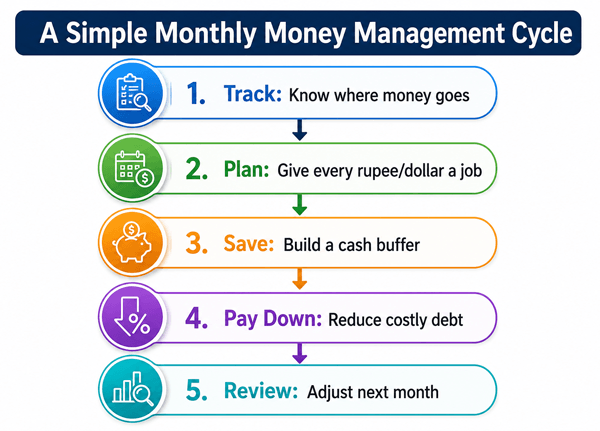
Diagram: A simple monthly money management cycle for beginners.
■ Comparison: Good Money Habits vs. Costly Money Habits
| Costly habit | Better habit | Why it works |
|---|---|---|
| Spending first and saving later | Saving first and spending what remains | Savings become a priority instead of an afterthought. |
| Buying based on monthly payment only | Checking total cost and fees | Prevents expensive contracts that look affordable at first. |
| Using debt for everyday wants | Using a planned wants category | Keeps lifestyle spending within income. |
| Ignoring financial problems | Reviewing accounts weekly | Small problems are easier to fix early. |
| Copying other people’s lifestyles | Building a plan based on your income and goals | Personal finance decisions fit your actual life. |
■ Practical 30-Day Plan to Avoid Money Mistakes
| Week | Main focus | Action steps |
|---|---|---|
| Week 1 | Awareness | Track every expense. List debts, bills, due dates, and account balances. |
| Week 2 | Budget setup | Create a simple budget with needs, savings, debt, and wants. Set reminders for bills. |
| Week 3 | Savings and debt | Open or separate an emergency fund. Choose a debt payoff method if needed. |
| Week 4 | Review and improve | Identify overspending patterns. Cancel unused subscriptions. Adjust next month’s plan. |
■ Common Misconceptions About Money Management
“I do not earn enough to manage money.”
Money management is even more important when income is limited. A budget cannot solve every income problem, but it can reduce waste, prevent late fees, and help you make better decisions with what you have.
“Budgeting means I cannot enjoy life.”
A good budget includes enjoyment. The goal is not to remove all fun spending. The goal is to enjoy spending without harming bills, savings, or future goals.
“Debt is always bad.”
Debt is not always bad, but it must be understood and affordable. Debt used for productive purposes may be reasonable in some cases, while high-interest debt used for lifestyle spending can be harmful.
“I will start when I make more money.”
Higher income helps, but habits matter. If spending rises with every raise, financial stress can continue. Starting with small habits now makes future income more useful.
■ When to Get Professional Help
Consider speaking with a qualified financial counselor, debt advisor, tax professional, or certified financial planner if you are overwhelmed by debt, facing legal or tax issues, supporting dependents, planning major investments, or making decisions that could affect your long-term security. Professional help is especially useful when the cost of a mistake is high.
Before paying for advice, check the person’s qualifications, fees, conflicts of interest, and whether they are regulated or recognized in your country.
This article is for educational purposes only. Personal finance decisions depend on your income, country, tax rules, debts, family responsibilities, risk tolerance, and goals. Always consider your own situation before acting.
■ Frequently Asked Questions
1. What is the biggest money management mistake?
The biggest mistake is not knowing where your money goes. Without tracking, it is difficult to budget, save, repay debt, or make better decisions.
2. How can beginners start managing money?
Start by tracking spending for 30 days, listing bills and debts, creating a simple budget, saving a small amount on payday, and reviewing progress once a month.
3. How much should I save each month?
Save what you can maintain consistently. A common starting point is 5 to 10 percent of income, but even a smaller amount is useful if it builds the habit. Increase it gradually.
4. Should I save money or pay off debt first?
Usually, build a small emergency fund first, pay minimums on all debts, then focus extra money on high-interest debt. After expensive debt is under control, increase savings and long-term investing.
5. Why do budgets fail?
Budgets often fail because they are unrealistic, too complicated, ignore irregular expenses, or do not include any personal spending. A good budget should be simple and flexible.
6. How do I stop impulse buying?
Use a waiting period, unsubscribe from promotional messages, avoid shopping when emotional, keep a wish list, and set a fixed limit for wants.
7. Is using a credit card a money mistake?
A credit card is not automatically a mistake. It becomes a problem when you carry balances you cannot repay, use it for unplanned lifestyle spending, or ignore interest and fees.
8. How often should I review my finances?
A weekly spending check and a monthly budget review are enough for many beginners. The key is consistency, not perfection.
9. What is a simple money management rule for beginners?
A simple rule is to plan spending before the month begins, pay essential bills first, save something on payday, avoid unnecessary high-interest debt, and review spending every week.
10. What are the best money habits to build first?
The best first habits are tracking expenses, creating a basic budget, saving a small emergency fund, paying bills on time, comparing costs before buying, and reviewing progress monthly.
■ Conclusion
Common money management mistakes are fixable. You do not need to master every financial topic at once. Start with the basics: track spending, create a realistic budget, save before spending, avoid high-interest debt, prepare for emergencies, and review your progress monthly. Small improvements repeated over time can create more stability, less stress, and better choices.
The goal is not perfect money management. The goal is a practical system that helps you control your money instead of feeling controlled by it.
Reader Advice: This article is for educational and informational purposes only and should not be taken as personal financial, investment, tax, or legal advice. Financial rules, products, interest rates, fees, regulations, and government policies can change over time, so please confirm the latest information from official sources and consult a qualified professional when needed.