Financial Literacy Explained: Meaning, Importance, Examples & How to Improve It
Financial literacy means understanding how money works in everyday life and using that knowledge to make better financial decisions. It includes basic skills such as budgeting, saving, borrowing, using credit, protecting yourself from scams, planning for goals, paying taxes, managing risk, and investing wisely.
For beginners, financial literacy is not about becoming a finance expert. It is about knowing enough to avoid common mistakes, ask better questions, compare options, and make decisions that support your short-term needs and long-term financial well-being.
Money affects almost every part of life: housing, food, transport, education, health care, family responsibilities, business decisions, retirement, and peace of mind. When you understand the basics, you are less likely to feel controlled by money and more likely to use money as a tool. This guide explains the meaning of financial literacy, why it is important, real-life examples, common mistakes, and practical steps to improve it.
1. What Is Financial Literacy?
Financial literacy is the combination of financial knowledge, practical money skills, attitudes, and behaviors that help a person make informed financial decisions. The OECD describes financial literacy as awareness, knowledge, skills, attitudes, and behaviors needed to make sound financial decisions and support financial well-being.
In simple words, financial literacy means you can answer practical questions like: How much money comes in? Where does it go? How much should I save? What debt is affordable? How does interest work? What risks should I avoid? What should I do before investing?
Financial literacy includes three main parts
| Part | What It Means | Simple Example |
|---|---|---|
| Knowledge | Understanding money concepts such as interest, inflation, credit scores, insurance, taxes, and investing. | Knowing that credit card interest can grow quickly if you only pay the minimum. |
| Skills | Being able to apply knowledge through budgeting, comparing prices, reading statements, and planning. | Creating a monthly budget and tracking spending for 30 days. |
| Behavior | Making consistent choices that protect and improve your financial life. | Saving before spending instead of waiting to see what is left. |
■ Why Financial Literacy Matters
Financial literacy matters because small money decisions compound over time. A person who understands budgeting, debt, and saving may not become rich overnight, but they can reduce financial stress, avoid costly mistakes, and build a stronger foundation.
1. It helps you control daily spending
Many financial problems begin with not knowing where money is going. Financial literacy teaches you to separate needs from wants, plan bills before spending, and notice patterns such as frequent small purchases that add up.
2. It helps you prepare for emergencies
Unexpected expenses are normal: medical costs, car repairs, family support, job loss, appliance replacement, or urgent travel. Financial literacy encourages building an emergency fund so one problem does not become a debt crisis.
3. It protects you from bad debt
Debt is not always bad. A home loan, education loan, or business loan may support a useful goal if the payment is affordable and the terms are clear. However, high-interest consumer debt can trap people when they borrow for lifestyle expenses without a repayment plan.
4. It improves decision-making
A financially literate person compares total cost, interest rate, fees, risks, and alternatives before choosing a financial product. This can help with bank accounts, credit cards, insurance, loans, investments, and retirement plans.
5. It supports long-term wealth building
Saving and investing work best when started early and done consistently. Financial literacy helps people understand compound growth, diversification, risk, inflation, and the difference between speculation and investing.
■ Financial Literacy vs. Financial Education vs. Financial Capability
These terms are related, but they are not exactly the same. Understanding the difference helps beginners focus on action, not just information.
| Term | Meaning | Main Focus |
|---|---|---|
| Financial literacy | Understanding and using money concepts in real life. | Knowledge plus practical decision-making. |
| Financial education | Lessons, courses, articles, tools, or coaching that teach money topics. | Learning process. |
| Financial capability | Having the knowledge, confidence, access, and habits to manage money effectively. | Ability to act in real situations. |
| Financial well-being | Feeling secure and having freedom of choice now and in the future. | Outcome of better money decisions and life conditions. |
■ Core Areas of Financial Literacy Beginners Should Learn
1. Income and cash flow
Income is the money you receive from salary, wages, business, freelance work, rent, dividends, pension, or other sources. Cash flow means how money moves in and out during a period of time. Positive cash flow means you spend less than you earn. Negative cash flow means expenses are higher than income.
2. Budgeting
A budget is a plan for your money before you spend it. It shows income, fixed expenses, variable expenses, debt payments, savings, and goals. A beginner-friendly budget does not need to be perfect. It needs to be honest and usable.
3. Saving money
Saving means setting money aside for future needs. Good savings habits protect you from emergencies and reduce the need to borrow. Start small if needed. Even a small amount saved consistently creates momentum.
4. Banking basics
Financial literacy includes knowing how bank accounts, debit cards, online banking, transfer fees, minimum balance rules, and account security work. Beginners should read fee schedules and avoid unnecessary charges.
5. Credit and debt
Credit lets you borrow now and repay later. Debt becomes risky when payments are unaffordable, interest rates are high, or the borrower does not understand the terms. Learn the interest rate, repayment period, total cost, late fees, and consequences before borrowing.
6. Insurance and risk protection
Insurance helps protect against large losses. Common types include health, life, disability, auto, home, renters, and business insurance. The goal is not to buy every policy available, but to protect against risks that could seriously damage your finances.
7. Investing basics
Investing means putting money into assets that may grow over time, such as retirement accounts, mutual funds, index funds, stocks, bonds, real estate, or a business. Investing involves risk, so beginners should learn about diversification, time horizon, fees, liquidity, and risk tolerance before investing.
8. Taxes
Taxes affect income, purchases, property, investments, business profits, and retirement withdrawals. Beginners should understand basic filing obligations, tax deductions, tax credits, recordkeeping, and when to consult a qualified tax professional.
9. Fraud and scam prevention
Financial literacy also protects you from fraud. Be careful with offers that promise guaranteed high returns, pressure you to act quickly, ask for passwords or verification codes, or require payment through unusual methods.
| Budget Category | Examples | Beginner Tip |
|---|---|---|
| Needs | Rent, food, utilities, transport, basic clothing, medical costs. | Pay these first and look for safe ways to reduce waste. |
| Wants | Dining out, entertainment, upgrades, subscriptions, hobbies. | Set a limit so enjoyment does not damage essentials. |
| Savings | Emergency fund, future purchases, education, retirement. | Automate savings where possible. |
| Debt payments | Credit card, personal loan, student loan, car loan. | Pay at least the minimum and target high-interest debt. |
■ How Financial Literacy Works in Real Life
Financial literacy becomes valuable when it changes real behavior. Here are practical examples.
| Situation | Low Financial Literacy Response | Financially Literate Response |
|---|---|---|
| Getting paid | Spend first and save whatever remains. | Plan bills, save first, then spend within limits. |
| Using a credit card | Pay only the minimum without checking interest. | Pay in full when possible and avoid carrying high-interest balances. |
| Taking a loan | Focus only on the monthly payment. | Compare rate, fees, total repayment, penalties, and affordability. |
| Emergency expense | Borrow immediately at high interest. | Use emergency fund first and compare lower-cost options if needed. |
| Investment offer | Invest because a friend or influencer recommends it. | Check risk, fees, regulation, time horizon, and whether it fits goals. |
■ Benefits of Improving Financial Literacy
- Better control over spending and bills.
- More confidence when making money decisions.
- Lower chance of falling into high-interest debt.
- Improved ability to save for emergencies and goals.
- Better understanding of financial products and contracts.
- More realistic planning for retirement and long-term needs.
- Greater protection from scams, fraud, and misleading advice.
- Less financial stress because decisions become clearer.
■ Risks and Limitations of Financial Literacy
Financial literacy is powerful, but it is not magic. It cannot fully solve low income, high living costs, medical emergencies, job loss, inflation, family obligations, or unfair financial systems. A person can make wise decisions and still face financial difficulty.
That is why financial literacy should be combined with realistic planning, consumer protection, fair access to financial services, and when needed, professional guidance. The goal is progress, not perfection.
3. Common Financial Literacy Mistakes Beginners Make
| Mistake | Why It Hurts | Better Approach |
|---|---|---|
| Not tracking spending | You cannot fix what you cannot see. | Track every expense for 30 days. |
| Confusing income with wealth | High income can disappear if spending is also high. | Build net worth through saving, debt reduction, and investing. |
| Ignoring small expenses | Small daily purchases can become large monthly leaks. | Review subscriptions and repeat expenses. |
| Borrowing without reading terms | Fees and interest can make debt expensive. | Compare total repayment cost before signing. |
| Investing before building basics | Emergencies may force you to sell investments at a loss. | Build an emergency fund and reduce high-interest debt first. |
| Following social media advice blindly | Advice may be biased, risky, or unsuitable. | Verify information through credible sources and qualified professionals. |
4. How to Improve Financial Literacy: A Step-by-Step Plan
You do not need to learn everything at once. Use this simple roadmap to build confidence step by step.
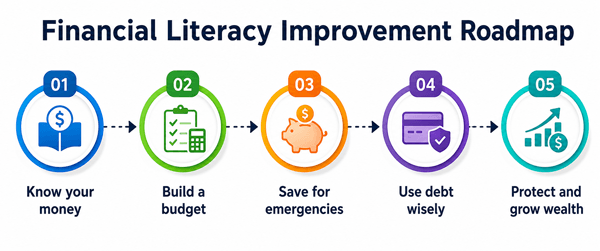
Figure: A beginner-friendly roadmap for improving financial literacy.
Step 1: Know your current financial situation
- List all income sources.
- List fixed monthly expenses.
- List variable expenses.
- List all debts with interest rates and minimum payments.
- List savings, investments, and valuable assets.
Step 2: Track spending for 30 days
Write down every expense or use a budgeting app. At the end of the month, group expenses into needs, wants, savings, and debt payments. This is often the fastest way to find easy improvements.
Step 3: Build a simple budget
Choose a budgeting method you can actually follow. The best budget is not the most complicated one; it is the one you will use consistently.
Step 4: Start an emergency fund
Begin with a small starter goal, such as enough to cover one minor emergency. Then work toward one month of essential expenses, and eventually three to six months if possible. The right amount depends on income stability, family responsibilities, health needs, and job security.
Step 5: Learn how interest works
Interest can work for you or against you. When you save or invest, compound growth may help your money grow over time. When you borrow, compound interest and fees can make debt expensive. Understanding interest is one of the most important financial literacy skills.
Step 6: Create a debt repayment strategy
Two popular methods are the debt snowball and debt avalanche.
Step 7: Learn before investing
Before investing, understand your goal, time horizon, risk tolerance, fees, diversification, liquidity, and tax impact. Avoid investing money you may need soon for rent, food, bills, or emergencies.
Step 8: Review progress monthly
A monthly money review can take 20 to 30 minutes. Check income, spending, savings, debt balances, upcoming bills, and goals. The purpose is not to blame yourself. It is to adjust your plan before problems grow.
| Budget Method | How It Works | Best For |
|---|---|---|
| 50/30/20 budget | 50% needs, 30% wants, 20% savings and debt repayment. | Beginners who want a simple framework. |
| Zero-based budget | Every unit of income is assigned to a category. | People who want detailed control. |
| Envelope method | Cash or digital categories limit spending. | People who overspend in certain areas. |
| Pay-yourself-first | Savings are moved first, then remaining money is spent. | People who struggle to save consistently. |
| Method | How It Works | Main Advantage | Possible Limitation |
|---|---|---|---|
| Debt snowball | Pay the smallest debt first while making minimum payments on others. | Builds motivation through quick wins. | May cost more interest. |
| Debt avalanche | Pay the highest-interest debt first while making minimum payments on others. | Usually saves more money on interest. | May feel slower at the beginning. |
■ A Beginner Financial Literacy Checklist
| Skill | Beginner Action | Done? |
|---|---|---|
| Understand income | Know your monthly take-home income. | |
| Track spending | Record all expenses for one month. | |
| Create a budget | Choose a simple budget method and follow it. | |
| Start saving | Open or use a safe savings account. | |
| Build emergency fund | Save a starter emergency amount. | |
| Understand debt | List balances, rates, and due dates. | |
| Check credit | Review your credit report or local equivalent where available. | |
| Learn investing basics | Understand risk, diversification, and fees before investing. | |
| Protect yourself | Learn common scam warning signs. | |
| Review monthly | Schedule a monthly money check-in. |
5. Best Practices for Building Strong Money Habits
- Spend less than you earn whenever possible.
- Save before spending, even if the amount is small.
- Keep essential expenses lower than income so you have flexibility.
- Avoid borrowing for wants unless you can repay quickly and comfortably.
- Compare financial products before choosing them.
- Read contracts, fees, and terms before signing.
- Use credit cards only with a clear repayment plan.
- Avoid investments you do not understand.
- Protect passwords, PINs, and verification codes.
- Review your budget and goals every month.
6. Financial Literacy for Different Life Stages
| Life Stage | Key Focus Areas | Practical Priority |
|---|---|---|
| Students and young adults | Budgeting, avoiding unnecessary debt, basic banking, first job income. | Build habits early and avoid lifestyle inflation. |
| New workers | Emergency fund, benefits, taxes, retirement contributions. | Automate savings and understand workplace benefits. |
| Families | Insurance, education planning, housing, emergency fund, debt control. | Protect dependents and plan large expenses. |
| Business owners/freelancers | Irregular income, taxes, cash reserves, separate accounts. | Separate personal and business finances. |
| Pre-retirees | Retirement income, health costs, debt reduction, asset allocation. | Estimate future expenses and reduce major risks. |
7. Misconceptions About Financial Literacy
Misconception 1: Financial literacy is only for rich people
Financial literacy is useful at every income level. In fact, it may be most important when money is limited because each decision matters more.
Misconception 2: Budgeting means you cannot enjoy life
A budget does not remove enjoyment. It helps you enjoy money without damaging essentials, savings, or future goals.
Misconception 3: Investing is the first step to becoming wealthy
Investing can help build wealth, but beginners should first understand cash flow, emergency savings, high-interest debt, and risk. A weak foundation can make investing stressful and unsafe.
Misconception 4: Financial advice on social media is always reliable
Some online education is useful, but not all advice is accurate, complete, or suitable for your situation. Be cautious with influencers who earn money from selling courses, products, referrals, or hype.
8. Practical Example: Improving Financial Literacy in 90 Days
Here is a realistic 90-day beginner plan.
| Time Period | Main Goal | Actions |
|---|---|---|
| Days 1-30 | Understand your money | Track spending, list debts, calculate income, identify spending leaks. |
| Days 31-60 | Build control | Create a budget, reduce one unnecessary expense, start emergency savings, set bill reminders. |
| Days 61-90 | Improve decisions | Compare debt repayment methods, learn interest basics, review insurance, read beginner investing resources. |
9. When to Get Professional Help
Self-education is helpful, but some situations deserve professional guidance. Consider speaking with a qualified financial planner, credit counselor, tax professional, attorney, or insurance specialist when decisions are complex or high-impact.
- You are overwhelmed by debt and missing payments.
- You are buying a home or signing a large loan agreement.
- You are starting or closing a business.
- You have tax problems or complex income sources.
- You are planning retirement or managing inherited money.
- You are unsure whether an investment or insurance product is suitable.
Before hiring anyone, check credentials, fees, conflicts of interest, and whether they are licensed or regulated in your country or region.
■ FAQs About Financial Literacy
1. What is financial literacy in simple words?
Financial literacy is the ability to understand and use money skills such as budgeting, saving, borrowing, investing, and protecting yourself from financial risks.
2. Why is financial literacy important?
It helps you make better decisions, avoid costly mistakes, reduce financial stress, prepare for emergencies, and work toward long-term goals.
3. What are the five basic areas of financial literacy?
Common areas include earning, budgeting, saving, borrowing, and investing. Insurance, taxes, fraud prevention, and retirement planning are also important.
4. How can a beginner become financially literate?
Start by tracking spending, creating a basic budget, learning how interest works, building an emergency fund, understanding debt, and reading reliable personal finance resources regularly.
5. Does financial literacy guarantee wealth?
No. Income, health, family duties, inflation, job market conditions, and emergencies also matter. Financial literacy improves decision-making, but it does not remove every financial challenge.
6. What is the difference between financial literacy and money management?
Financial literacy is the knowledge and skill set. Money management is the practical use of that knowledge in daily actions such as budgeting, saving, paying bills, and managing debt.
7. How often should I review my finances?
A monthly review is a good starting point. You may also review finances after major life changes such as a new job, marriage, moving, having a child, or taking a loan.
8. What is the best first step to improve financial literacy?
Track your income and expenses for 30 days. This gives you real information about your money habits and helps you make practical changes.
9. What are examples of financial literacy skills?
Examples include budgeting, comparing loan costs, understanding interest, reading financial statements, building emergency savings, checking fees, and spotting scam warning signs.
10. Is financial literacy the same in every country?
The basic principles are similar, but tax rules, credit systems, investment products, consumer protections, and retirement plans differ by country. Always check local official sources.
■ Conclusion
Financial literacy is one of the most useful life skills a person can develop. It helps you understand money, make informed choices, avoid unnecessary risks, and build a more stable future. You do not need to master everything immediately. Start with the basics: know your income, track spending, create a budget, save for emergencies, understand debt, and learn before investing.
The real value of financial literacy is not just knowing financial terms. It is using that knowledge in everyday decisions. Small improvements, repeated consistently, can create meaningful progress over time.
Sources and References
- OECD. Financial education topic page. Defines financial literacy as awareness, knowledge, skills, attitudes, and behaviours that support informed financial decisions.
- OECD/INFE. 2023 International Survey of Adult Financial Literacy.
- Consumer Financial Protection Bureau (CFPB). Adult financial education tools and resources.
- Consumer Financial Protection Bureau (CFPB). Financial well-being resources and scale.
- FINRA Investor Education Foundation. National Financial Capability Study.
Reader Advice: This article is for educational and informational purposes only and should not be taken as personal financial, legal, tax, or investment advice. Please check the latest information from official sources or qualified professionals, because rules, policies, fees, and financial products can change over time.