Personal Finance for Beginners: Complete Guide to Budgeting, Saving, Debt & Investing
Personal finance is the way you manage your money in everyday life. It includes how you earn, spend, save, borrow, invest, protect, and plan for the future. Good personal finance does not mean being rich, perfect, or strict with every rupee or dollar. It means making clear money decisions that help you live with less stress and more control.
For beginners, personal finance can feel confusing because many topics are connected. Budgeting affects saving. Saving affects debt. Debt affects credit. Credit affects borrowing costs. Investing affects long-term wealth. This guide explains each part in simple language and shows how to build a money system that works in real life.
1. What Is Personal Finance?
Personal finance is the management of your personal or household money. It covers short-term decisions, such as paying bills this month, and long-term decisions, such as buying a home, funding education, or retiring comfortably.
Because personal finance rules vary by country, beginners should also check local banking protections, tax rules, retirement account options, and consumer-credit laws before making major decisions.
| Personal Finance Area | What It Means | Beginner Example |
|---|---|---|
| Income | Money you receive from work, business, benefits, or investments. | Salary, freelance income, rental income, or profit from a small business. |
| Budgeting | A plan for how your income will be used. | Dividing monthly pay between rent, food, transport, debt, savings, and fun. |
| Saving | Money kept for future needs or emergencies. | Building a cash emergency fund for medical bills or job loss. |
| Debt management | Using borrowed money carefully and repaying it on time. | Paying more than the minimum on a credit card balance. |
| Credit | Your record of borrowing and repaying money. | A good credit history can help you qualify for better loan terms. |
| Investing | Putting money into assets that may grow over time. | Buying diversified funds for retirement or long-term goals. |
| Insurance and protection | Reducing financial damage from major risks. | Health, auto, home, disability, or life insurance where relevant. |
2. The Simple Money System Every Beginner Needs
A beginner does not need a complicated financial plan on day one. Start with a simple system that gives every unit of income a job before it disappears into random spending.
For best results, write your plan in one place: income, bills, debt payments, savings goals, and review dates. This makes the system easier to follow and easier to update when income or expenses change.
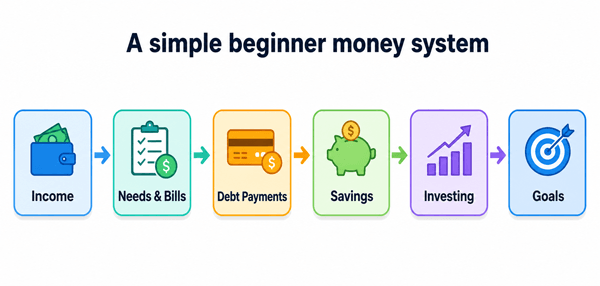
Figure: A practical flow for deciding where your money should go each month.
Step 1: Know Your Income and Expenses
You cannot manage what you do not measure. The first step is to understand how much money comes in, how much goes out, and where it goes.
How to track your money
- Write down all income sources for the month.
- List fixed expenses such as rent, loan payments, insurance, school fees, and subscriptions.
- List variable expenses such as food, fuel, clothing, entertainment, gifts, and repairs.
- Review bank statements, mobile wallet history, receipts, and cash withdrawals.
- Separate needs, wants, savings, and debt payments.
Example monthly money snapshot
| Category | Example Amount | Notes |
|---|---|---|
| Monthly take-home income | 100,000 | Use net income after taxes or deductions. |
| Needs | 55,000 | Rent, utilities, groceries, transport, basic phone/internet. |
| Debt payments | 15,000 | Credit card, personal loan, student loan, family loan. |
| Savings | 10,000 | Emergency fund, short-term goals. |
| Investing | 5,000 | Long-term goals after basic stability is in place. |
| Wants and lifestyle | 15,000 | Dining out, entertainment, upgrades, non-essential shopping. |
Step 2: Create a Beginner-Friendly Budget
A budget is not a punishment. It is a spending plan that protects your priorities. The best budget is the one you can actually follow.
If your income changes from month to month, budget from your lowest realistic monthly income and treat extra income as money for emergency savings, debt payoff, or priority goals.
| Category | Example Amount | Notes |
|---|---|---|
| Monthly take-home income | 100,000 | Use net income after taxes or deductions. |
| Needs | 55,000 | Rent, utilities, groceries, transport, basic phone/internet. |
| Debt payments | 15,000 | Credit card, personal loan, student loan, family loan. |
| Savings | 10,000 | Emergency fund, short-term goals. |
| Investing | 5,000 | Long-term goals after basic stability is in place. |
| Wants and lifestyle | 15,000 | Dining out, entertainment, upgrades, non-essential shopping. |
A practical starter budget formula
If you are new, begin with this order instead of forcing a perfect percentage:
- Pay essential bills first.
- Make minimum debt payments to avoid penalties.
- Save a small emergency amount automatically.
- Use remaining money for groceries, transport, and planned wants.
- At the end of the month, send any leftover money to savings or high-interest debt.
Step 3: Build an Emergency Fund
An emergency fund is money set aside only for unexpected expenses or income disruption. It helps you avoid borrowing at a bad time. Common emergencies include medical costs, urgent home or car repairs, job loss, and family crises.
A useful beginner target is to save a small starter fund first, then build toward several months of essential expenses. The exact amount depends on your job stability, family responsibilities, health costs, and access to support.
Keep emergency savings separate from daily spending so it is available when needed but not too easy to use for ordinary purchases.
| Stage | Savings Target | Purpose |
|---|---|---|
| Starter emergency fund | Enough to cover a small urgent bill | Prevents minor problems from becoming debt. |
| Basic emergency fund | About 1 month of essential expenses | Creates breathing room if income is delayed. |
| Stronger emergency fund | 3 to 6 months of essential expenses | Helps during job loss, illness, or major disruption. |
| Higher-risk households | 6+ months may be useful | Helpful for self-employed workers, single-income families, or unstable income. |
Step 4: Manage Debt Wisely
Debt is borrowed money that must be repaid, usually with interest. Some debt can support useful goals, such as education, a modest home, or a business asset. Other debt can damage your finances, especially high-interest consumer debt used for lifestyle spending.
Before taking any new loan, compare the total repayment amount, fees, interest rate, payment schedule, and the effect on your monthly cash flow.
| Debt Type | Usually Lower Risk When... | Higher Risk When... |
|---|---|---|
| Credit card debt | Paid in full every month. | Balances roll over at high interest. |
| Student loan | Education improves realistic earning power. | Borrowing is far above likely income. |
| Car loan | Car is affordable and needed for work or family. | Payment, fuel, insurance, and repairs strain the budget. |
| Mortgage | Payment is affordable and emergency savings exist. | House costs leave no room for maintenance or life changes. |
| Buy now, pay later | Used rarely for planned purchases. | Used to hide overspending or stack many payments. |
Debt payoff methods
| Method | How It Works | Main Benefit | Best For |
|---|---|---|---|
| Debt snowball | Pay the smallest balance first while making minimum payments on other debts. | Quick wins and motivation. | People who need emotional momentum. |
| Debt avalanche | Pay the highest interest rate first while making minimum payments on other debts. | Usually saves the most interest. | People focused on math and total cost. |
| Debt consolidation | Combine debts into one payment, ideally at a lower interest rate. | Simplifies repayment. | People who qualify and will not create new debt. |
Step 5: Understand Credit Scores and Credit Reports
Credit is your reputation as a borrower. Lenders may use credit reports and credit scores to decide whether to approve you and what interest rate to charge. A higher score can reduce borrowing costs, but credit should be used carefully, not chased blindly.
FICO explains that its score calculation is grouped into five broad categories: payment history, amounts owed, length of credit history, new credit, and credit mix. Payment history and amounts owed are the largest categories.
Credit scoring systems and credit-report access rules differ by country, but the core habits are similar: pay on time, keep balances manageable, borrow only when needed, and correct errors when you find them.
| Credit Factor | Why It Matters | Beginner Action |
|---|---|---|
| Payment history | Late payments can seriously hurt your credit. | Pay every bill on time; use reminders or auto-pay where safe. |
| Amounts owed | High balances can make you look risky. | Keep credit card balances low compared with your credit limits. |
| Length of credit history | A longer responsible credit history can help. | Avoid closing old useful accounts without a good reason. |
| New credit | Many recent applications can signal higher risk. | Apply for new credit only when needed. |
| Credit mix | Different account types may help when managed responsibly. | Do not borrow money just to improve your credit mix. |
Step 6: Save for Short-Term Goals
Short-term goals are expenses you expect within the next few months or years. Examples include annual insurance, school fees, a laptop, a wedding, a home repair, travel, or a down payment. These goals should usually be kept in safe, accessible savings rather than risky investments.
A good short-term goal should include a clear amount, a deadline, and a monthly saving target. For example: save 120,000 in 12 months by setting aside 10,000 per month.
Sinking fund example
A sinking fund means saving a little each month for a known future cost. If you need 60,000 in 12 months for annual fees, save 5,000 per month. This turns a stressful future bill into a normal monthly expense.
Step 7: Start Investing for Long-Term Goals
Investing means putting money into assets that may grow over time, such as stocks, bonds, mutual funds, exchange-traded funds, retirement accounts, or business assets. Investing is different from saving because investment values can rise and fall.
Before investing, understand what you are buying, how it can lose money, what fees apply, how easily you can sell it, and whether it matches your time horizon.
Beginners should understand two key ideas before investing: risk and time. Money needed soon should usually be kept safer. Money for long-term goals can often handle more market ups and downs because there is more time to recover.
| Concept | Simple Meaning | Practical Beginner Lesson |
|---|---|---|
| Compound growth | Money can earn returns, and those returns can earn more returns. | Starting early can matter more than starting big. |
| Diversification | Spreading money across different investments. | Avoid putting all your money into one stock, coin, or idea. |
| Asset allocation | Choosing a mix of stocks, bonds, cash, and other assets. | Your mix should match your goal, time horizon, and risk tolerance. |
| Fees | Costs charged by funds, platforms, or advisors. | High fees can reduce long-term returns. |
| Risk tolerance | How much uncertainty you can emotionally and financially handle. | Do not choose an investment just because others are excited about it. |
Step 8: Plan for Retirement Early
Retirement planning means preparing for the time when you may not want or be able to work full time. The earlier you start, the more time your savings and investments have to grow. But it is never too late to improve your plan.
A beginner retirement plan can be simple: estimate future needs, contribute regularly, increase contributions when income rises, avoid unnecessary withdrawals, and invest in a diversified way that matches your time horizon.
If your employer, government, or local market offers tax-advantaged retirement accounts, study the rules carefully because limits, benefits, and withdrawal conditions can change over time.
Step 9: Protect Your Money and Reduce Risk
Managing money is not only about growth. It is also about protection. One major event can damage years of progress if you are not prepared.
Protection also includes keeping financial accounts secure, avoiding emotional decisions during market swings, and discussing major money commitments with trusted family members or qualified professionals when appropriate.
- Use strong passwords and two-factor authentication for financial accounts.
- Keep emergency savings in a safe and accessible place.
- Understand deposit protection rules in your country or region.
- Use insurance for major risks you cannot afford to cover yourself.
- Avoid scams, guaranteed-profit promises, pressure tactics, and investments you do not understand.
- Keep copies of important financial documents.
Step 10: Build Net Worth and Long-Term Wealth
Net worth is what you own minus what you owe. It is a useful measure of financial progress because income alone does not show whether you are building stability.
Track net worth every month or quarter rather than every day. The goal is long-term progress, not perfect results in a single week.
How to increase net worth
- Spend less than you earn consistently.
- Build and protect emergency savings.
- Pay down high-interest debt.
- Invest for long-term goals with a diversified plan.
- Increase income through skills, career growth, business, or side income.
- Avoid lifestyle inflation when income rises.
■ Common Personal Finance Mistakes Beginners Should Avoid
| Mistake | Why It Hurts | Better Approach |
|---|---|---|
| Not tracking spending | Money disappears without a clear reason. | Review expenses weekly for the first 60 days. |
| Saving only what is left | Usually nothing is left. | Automate savings after payday. |
| Using debt for lifestyle | Interest makes purchases more expensive. | Use debt only with a repayment plan. |
| Ignoring small recurring charges | Subscriptions silently reduce cash flow. | Audit subscriptions monthly. |
| Investing before emergency savings | You may sell investments at a bad time. | Build basic cash reserves first. |
| Following hype | Trends can lead to losses. | Understand risk before investing. |
| No written goals | Money decisions feel random. | Set clear goals with amounts and dates. |
■ A 30-Day Personal Finance Plan for Beginners
| Day Range | Action | Result |
|---|---|---|
| Days 1-3 | List income, bills, debts, savings, and financial accounts. | You know your starting point. |
| Days 4-7 | Track every expense and group spending into categories. | You see where your money is going. |
| Days 8-10 | Create a basic monthly budget. | Your income has a clear plan. |
| Days 11-15 | Open or separate an emergency savings account if needed. | Emergency money is not mixed with spending money. |
| Days 16-20 | Choose a debt payoff method. | Debt repayment becomes intentional. |
| Days 21-23 | Review credit reports and bill due dates where available. | You reduce surprises and late payments. |
| Days 24-26 | Set 1 short-term, 1 medium-term, and 1 long-term goal. | You connect money habits to real life. |
| Days 27-30 | Automate savings or schedule recurring transfers. | Progress continues without relying only on willpower. |
■ Personal Finance Checklist
- ☐ I know my monthly take-home income.
- ☐ I know my essential monthly expenses.
- ☐ I have a written budget.
- ☐ I am building an emergency fund.
- ☐ I pay bills on time.
- ☐ I have a debt payoff plan if I owe money.
- ☐ I understand my credit basics.
- ☐ I save for expected future expenses.
- ☐ I invest only after understanding the risk.
- ☐ I review my finances at least once a month.
■ Frequently Asked Questions
1. What is the first step in personal finance?
The first step is knowing your numbers: income, expenses, debts, savings, and upcoming bills. Once you know your starting point, you can create a budget and choose priorities.
2. How much money should a beginner save each month?
Save any amount you can do consistently. A small automatic amount is better than an unrealistic target that fails. Over time, aim to increase savings as income rises or expenses fall.
3. Should I save money or pay off debt first?
Usually, build a small emergency fund first, make all minimum payments, then focus extra money on high-interest debt. After expensive debt is controlled, build a larger emergency fund and invest for long-term goals.
4. Is budgeting only for people with low income?
No. Budgeting is useful at every income level because it helps you direct money toward priorities instead of guessing where it went.
5. When should beginners start investing?
Start investing when essential bills are covered, high-interest debt is under control, and you have some emergency savings. Invest for long-term goals, not money you may need soon.
6. What is the safest place for emergency savings?
Emergency savings should be kept somewhere safe, liquid, and easy to access. The exact account type depends on your country, banking system, and deposit protection rules.
7. How often should I review my finances?
Beginners should review spending weekly at first. Once habits improve, a monthly review may be enough for budgeting, goals, debt, and savings progress.
8. What is a good financial goal for a beginner?
A strong beginner goal is to save a starter emergency fund, pay every bill on time for three months, and create a budget that you can follow without feeling deprived.
9. How can beginners avoid financial scams?
Be careful with guaranteed-profit claims, pressure to act quickly, requests for secrecy, unclear fees, and investments you cannot explain in simple words.
10. What is the difference between saving and investing?
Saving is for safety and near-term access. Investing is for long-term growth, but it involves risk and prices can rise or fall.
■ Conclusion: Personal Finance Is a Skill You Build Step by Step
Personal finance is not about perfection. It is about making steady, informed choices with the money you have. Start by tracking your income and expenses. Build a realistic budget. Save for emergencies. Pay down harmful debt. Learn credit basics. Invest carefully for long-term goals. Protect yourself from major risks. Review your progress regularly.
The most important beginner lesson is this: small actions repeated consistently can create major financial improvement over time. You do not need to fix everything today. You need a simple plan and the patience to keep improving it.
Reader Advice: This article is for educational and informational purposes only and should not be taken as personal financial, legal, tax, or investment advice. Please check the latest information from official sources because rules, policies, and financial products can change over time.