How to Stop Living Paycheck to Paycheck
Quick Answer: How Do You Stop Living Paycheck to Paycheck?
To stop living paycheck to paycheck, you need to create a small gap between what comes in and what goes out. That gap becomes your cash buffer, emergency savings, and eventually your financial freedom. The process is not about becoming perfect with money overnight. It is about taking control of the next paycheck, then the next month, then the next year. Because money advice affects real financial stability, use the steps that fit your income, country, debt rules, and family situation, and check official or qualified local sources for programs, creditor rights, taxes, and debt-relief options.
- Know exactly how much money comes in and when it arrives.
- List every bill, debt payment, and necessary expense before spending on wants.
- Cut or pause expenses that do not protect your home, food, transport, health, work, or family needs.
- Build a starter emergency fund of at least one small amount first, such as $250, $500, or one week of expenses.
- Use a simple paycheck budget so each paycheck has a job before it arrives.
- Pay down high-interest debt while avoiding new debt for everyday expenses.
- Increase income where possible through overtime, side work, skill building, negotiation, or better job opportunities.
1. What Does Living Paycheck to Paycheck Mean?
Living paycheck to paycheck means most or all of your income is used before the next payday. When the next paycheck arrives, it is already needed for overdue bills, rent, groceries, debt payments, transport, or other basic costs. There is little or no money left for savings, emergencies, or future goals.
This situation can happen at any income level. A low-income household may struggle because basic costs are higher than earnings. A higher-income household may struggle because lifestyle costs, debt, housing, vehicles, subscriptions, or impulse spending consume the income. The details differ, but the feeling is similar: one late paycheck or unexpected bill can create stress.
Common signs you are stuck in the paycheck cycle
- You regularly run out of money before payday.
- You use credit cards, overdrafts, payday loans, or borrowing from family to cover normal expenses.
- You delay bills until the next paycheck arrives.
- You feel anxious when checking your bank balance.
- You cannot handle a small emergency without debt.
- You earn money but do not know where it goes.
- You plan to save, but there is nothing left at the end of the month.
Important: if you are behind on rent, utilities, loan payments, or essential medical needs, prioritize safety, housing, food, transport to work, and communication with providers before making aggressive debt payments. This keeps the plan realistic and reduces avoidable fees.
2. Why People End Up Living Paycheck to Paycheck
The paycheck-to-paycheck cycle usually has more than one cause. It is not always the result of careless spending. Sometimes the real issue is low income, unstable work, medical costs, family responsibilities, inflation, debt, or a mismatch between bill due dates and paydays. Understanding the cause helps you choose the right solution.
A helpful first question is: “Is this mainly a cash-flow problem, a spending-leak problem, a debt-payment problem, or an income problem?” The answer decides whether your next best move is tracking, cutting, due-date changes, debt help, or income growth.
| Cause | What it looks like | Best first response |
|---|---|---|
| Income is too low | Basic needs take almost all income. | Focus on benefit eligibility, income growth, lower fixed costs, and crisis budgeting. |
| Spending is unclear | Money disappears without a clear record. | Track spending for 14 to 30 days and build a paycheck budget. |
| Bills are poorly timed | Several bills hit before payday. | Request new due dates and create a bill calendar. |
| Debt payments are too high | Credit card, loan, or buy-now-pay-later payments crowd out savings. | List debts, stop new debt, and choose a repayment strategy. |
| No emergency fund | Every surprise expense becomes a crisis. | Build a starter buffer before aggressive debt payoff. |
| Lifestyle creep | Income rose but spending rose with it. | Reset priorities and automate savings first. |
| Irregular income | Freelance, commission, seasonal, or gig income varies. | Budget from the lowest expected income and save surplus in stronger months. |
Step 1: Get a Clear Picture of Your Money
The first step is not cutting everything. It is seeing the truth clearly. You cannot fix what you cannot measure. Start with a simple money snapshot.
Create a one-page money snapshot
Write down these four numbers:
- Monthly take-home income: money that actually reaches your bank account after tax and deductions.
- Fixed expenses: rent or mortgage, utilities, insurance, loan payments, school fees, phone, internet, subscriptions, and other recurring bills.
- Variable essentials: groceries, fuel, medicine, transport, household supplies, childcare, and basic personal care.
- Debt and savings: minimum debt payments, extra debt payments, emergency savings, and any investments.
Do not worry if the first version is messy. A rough but honest snapshot is better than a perfect plan you never start.
Simple formula: Take-home income - essential bills - minimum debt payments - basic living costs = the first gap you can use for savings, debt payoff, and flexible spending.
Example money snapshot
| Category | Monthly amount | Notes |
|---|---|---|
| Take-home income | $3,000 | Two paychecks of $1,500 each |
| Fixed bills | $1,650 | Rent, utilities, insurance, phone, internet, minimum debt payments |
| Variable essentials | $850 | Groceries, fuel, transport, medicine, household needs |
| Current savings | $0 | No automatic transfer yet |
| Money left before wants | $500 | This is the starting point for savings, debt payoff, and flexible spending |
Step 2: Track Spending Without Shame
Tracking spending is not about blaming yourself. It is about finding leaks. For 14 to 30 days, record every purchase. Use a notes app, spreadsheet, budgeting app, or paper notebook. The tool matters less than the habit.
Use simple spending categories
| Category | Examples | Question to ask |
|---|---|---|
| Needs | Rent, food, utilities, transport, medicine | Is this required for safety, work, health, or family stability? |
| Wants | Dining out, entertainment, upgrades, nonessential shopping | Does this fit after savings and bills are handled? |
| Leaks | Unused subscriptions, fees, impulse buys, convenience spending | Can I pause, reduce, replace, or remove this? |
| Debt | Credit cards, loans, overdrafts, buy-now-pay-later | Is this helping me move forward or keeping me trapped? |
Many people discover that one large problem is not the only issue. Small repeated purchases can quietly create a large monthly gap. For example, $8 spent on convenience food five times per week is about $160 per month. That may be the difference between having no emergency fund and building one.
Step 3: Build a Paycheck Budget
A monthly budget is helpful, but a paycheck budget is often better when money is tight. Instead of planning the whole month at once, you decide what each paycheck must cover until the next payday.
How a paycheck budget works
- Write your next payday and paycheck amount.
If a paycheck budget shows a negative number, do not ignore it. Use a temporary bare-bones budget, call providers before bills are late, pause nonessential spending, and look for short-term income or support options until the gap is positive.
- List bills due before the following payday.
- Add groceries, transport, medicine, and other essentials needed during that period.
- Set aside a small amount for savings, even if it is very small.
- Decide the maximum amount available for flexible spending.
- Stop spending when a category is used up.
Example paycheck budget
| Paycheck use | Amount | Purpose |
|---|---|---|
| Paycheck received | $1,500 | Income for the next two weeks |
| Rent share or housing set-aside | $600 | Prepare for rent or mortgage |
| Utilities and phone | $180 | Bills due before next payday |
| Groceries | $250 | Meal plan and household basics |
| Transport/fuel | $120 | Work and essential travel |
| Minimum debt payments | $150 | Avoid late fees and credit damage |
| Starter emergency fund | $50 | Build breathing room |
| Flexible spending | $150 | Clothing, small wants, personal spending |
| Remaining cushion | $0 | Every dollar has a job |
Step 4: Create a Starter Emergency Fund
An emergency fund is money kept separate for unexpected but necessary expenses, such as a medical bill, car repair, urgent travel, job loss, or appliance repair. When you are living paycheck to paycheck, the first goal is not a huge fund. The first goal is a starter buffer that prevents every small problem from becoming debt.
Starter emergency fund targets
| Stage | Target | Why it helps |
|---|---|---|
| First buffer | $100 to $250 | Covers very small surprises and reduces panic. |
| Starter fund | $500 to $1,000 | Covers many common emergencies without credit cards. |
| One-paycheck buffer | One full paycheck | Breaks the cycle of waiting for payday. |
| Full emergency fund | 3 to 6 months of essential expenses | Protects against job loss, illness, or major income disruption. |
Keep this money separate from your everyday spending account if possible. A separate savings account can reduce the temptation to spend it casually. Do not invest your emergency fund in risky assets because emergency money needs to be available when you need it.
For safety and access, emergency savings usually belong in an insured bank or credit-union account where available. The exact account type depends on your country and local banking protections.
The chart below shows a simple example of how small consistent savings can create a useful starter buffer over time.
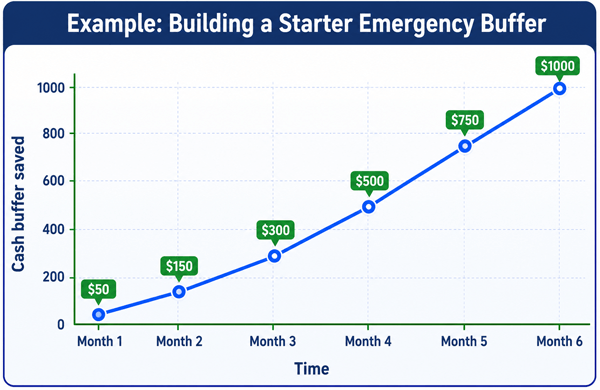
Figure 1: Example of building a starter emergency buffer over six months.
Step 5: Reduce Expenses in the Right Order
When money is tight, random cutting can backfire. If you cut the wrong things, you may damage your health, job stability, or long-term financial progress. Start with expenses that offer the least value, then review bigger fixed costs if needed.
Expense-cutting priority list
| Priority | Review this first | Examples |
|---|---|---|
| 1 | Waste and unused costs | Unused subscriptions, late fees, overdraft fees, duplicate services |
| 2 | Convenience spending | Delivery fees, frequent takeout, last-minute shopping, premium upgrades |
| 3 | Flexible wants | Entertainment, clothing upgrades, hobbies, nonessential online purchases |
| 4 | Negotiable bills | Phone, internet, insurance, bank fees, memberships |
| 5 | Major fixed costs | Housing, vehicles, childcare arrangements, commuting costs |
Practical ways to lower spending quickly
- Meal plan for one week instead of trying to change your entire diet.
- Switch to a cheaper phone or internet plan if it still meets your needs.
- Cancel subscriptions you have not used in the last 30 days.
- Use a waiting rule for nonessential purchases, such as 24 hours for small items and 7 days for larger items.
- Set a weekly cash or debit limit for flexible spending.
- Buy groceries with a list based on meals you will actually cook.
- Check insurance, banking, and service fees once or twice per year.
Cutting expenses has limits. If your basic costs are higher than your income even after careful changes, the main solution is not more guilt. You need income growth, help with benefits or support programs, debt restructuring, or larger changes to fixed costs.
Step 6: Fix Bill Timing Problems
Sometimes people have enough monthly income on paper, but the timing is wrong. If most bills are due before the paycheck arrives, you may face late fees even though the month would balance overall.
Create a bill calendar
Make a calendar with every bill name, amount, due date, and payment method. Then compare due dates with paydays. Your goal is to prevent too many bills from landing in the same week.
| Bill | Current due date | Problem | Possible fix |
|---|---|---|---|
| Rent | 1st | Due before first paycheck clears | Set aside rent from both paychecks. |
| Phone | 3rd | Crowds same week as rent | Ask provider to move due date to 15th or 20th. |
| Credit card | 5th | Late risk | Change due date or automate minimum payment. |
| Insurance | 22nd | Usually manageable | Keep as is if it matches second paycheck. |
Many lenders, credit card companies, phone providers, and utilities allow due-date changes. One phone call or online request can reduce stress for months.
Step 7: Deal With Debt Without Making the Cycle Worse
Debt can be useful when managed carefully, but high-interest debt can keep you trapped. If you are using debt to cover groceries, rent, fuel, or bills, the debt is not solving the problem. It is moving the shortage into the future, often with interest and fees.
Start with a complete debt list
| Debt | Balance | Minimum payment | Interest rate | Priority note |
|---|---|---|---|---|
| Credit card A | $1,200 | $45 | High | Pay aggressively after starter fund. |
| Personal loan | $3,500 | $160 | Medium | Keep current. |
| Buy-now-pay-later | $240 | $60 | Varies | Clear quickly to free cash flow. |
| Family loan | $500 | $50 | None | Communicate clearly and keep agreement. |
Debt snowball vs. debt avalanche
| Debt | Balance | Minimum payment | Interest rate | Priority note |
|---|---|---|---|---|
| Credit card A | $1,200 | $45 | High | Pay aggressively after starter fund. |
| Personal loan | $3,500 | $160 | Medium | Keep current. |
| Buy-now-pay-later | $240 | $60 | Varies | Clear quickly to free cash flow. |
| Family loan | $500 | $50 | None | Communicate clearly and keep agreement. |
Before paying extra on debt, build at least a small emergency buffer. Without a buffer, the next emergency may go right back onto the credit card.
Be careful with payday loans, high-fee cash advances, and repeated overdrafts. They may feel like quick fixes, but fees and interest can make the next paycheck even harder to manage.
Step 8: Increase Income Strategically
Cutting costs can help, but you cannot cut your way below zero. If your income is not enough to cover basic needs and savings, increasing income becomes essential. This does not always mean working nonstop. It means choosing the income moves with the highest return for your situation.
Income ideas ranked by speed
Income option |
Speed |
Best use |
Watch out for |
Overtime or extra shifts |
Fast |
Short-term cash buffer or debt payoff. |
Burnout and childcare/transport costs. |
Selling unused items |
Fast |
Starter emergency fund. |
One-time solution, not steady income. |
Freelance or side work |
Medium |
Flexible income around a job. |
Taxes, unstable demand, platform fees. |
Negotiating pay |
Medium |
Increasing income without extra hours. |
Requires preparation and timing. |
Job change or promotion |
Medium to slow |
Long-term income growth. |
May require training, applications, or relocation. |
Skill building |
Slow but powerful |
Higher earning potential. |
Requires time, focus, and sometimes upfront cost. |
A useful rule is to connect extra income to a specific purpose before it arrives. For example: “The first $500 from overtime goes to my emergency fund, then the next $500 goes to credit card debt.” Without a plan, extra income often disappears into normal spending.
Also remember that side income may create tax, recordkeeping, transport, childcare, equipment, or platform-fee costs. Track those costs so the extra work truly improves your cash flow.
Step 9: Avoid Common Mistakes
Breaking the paycheck cycle is partly about doing the right things and partly about avoiding traps that make the situation worse.
| Debt | Balance | Minimum payment | Interest rate | Priority note |
|---|---|---|---|---|
| Credit card A | $1,200 | $45 | High | Pay aggressively after starter fund. |
| Personal loan | $3,500 | $160 | Medium | Keep current. |
| Buy-now-pay-later | $240 | $60 | Varies | Clear quickly to free cash flow. |
| Family loan | $500 | $50 | None | Communicate clearly and keep agreement. |
Step 10: Use Sinking Funds for Predictable Expenses
A sinking fund is money saved gradually for a known future expense. It is different from an emergency fund because the expense is expected. Examples include car insurance, annual school fees, holiday spending, home repairs, vehicle maintenance, and medical checkups.
Sinking fund example
Suppose your car insurance is $600 every six months. Instead of panicking when the bill arrives, save $100 per month. When the bill comes, the money is already waiting.
| Future expense | Due amount | Due in | Monthly sinking fund |
|---|---|---|---|
| Car insurance | $600 | 6 months | $100 |
| School supplies | $300 | 5 months | $60 |
| Holiday gifts/travel | $480 | 8 months | $60 |
| Vehicle maintenance | $360 | 12 months | $30 |
■ A Simple 30-Day Plan to Stop Living Paycheck to Paycheck
You do not need to fix everything this week. Use the first 30 days to create control, reduce immediate pressure, and start building a buffer.
| Time period | Main goal | Actions |
|---|---|---|
| Days 1-3 | See your real situation | List income, bills, debts, bank balances, and due dates. |
| Days 4-7 | Stop the leaks | Cancel unused subscriptions, pause nonessential spending, and set a grocery plan. |
| Week 2 | Build the first paycheck budget | Assign every dollar from the next paycheck to bills, essentials, savings, debt, or flexible spending. |
| Week 3 | Create breathing room | Save the first $25, $50, or $100; request bill due-date changes if needed. |
| Week 4 | Make the plan repeatable | Choose a debt strategy, create sinking funds, and set automatic savings for payday. |
■ Example: From Paycheck Stress to a Small Buffer
Consider a household bringing home $3,000 per month. They usually end the month at $0 and use a credit card for groceries during the final week. After tracking spending, they find $220 per month in unused subscriptions, extra delivery fees, and impulse purchases. They also move a phone bill due date from the 3rd to the 18th.
Their first month is not perfect, but they save $100 and avoid one credit card purchase. In month two, they use $120 of the spending reduction toward savings and $100 toward debt. After six months, they have a $700 starter emergency fund and one credit card balance is lower. The biggest improvement is not just mathematical. They no longer feel completely trapped by every payday.
■ Best Budgeting Methods for Paycheck-to-Paycheck Households
| Budgeting method | How it works | Good for | Not ideal when |
|---|---|---|---|
| Paycheck budget | Plan each paycheck until the next one arrives. | People paid weekly, biweekly, or irregularly. | You prefer a broad monthly view only. |
| Zero-based budget | Give every dollar a job: bills, savings, debt, or spending. | People who want detailed control. | You dislike tracking categories closely. |
| 50/30/20 budget | Aim for 50% needs, 30% wants, 20% savings/debt. | People with stable income and enough breathing room. | Needs already exceed 50% of income. |
| Envelope system | Divide spending into physical or digital envelopes. | People who overspend in flexible categories. | Most bills are automatic and hard to separate. |
| Bare-bones budget | Temporarily cover only essentials and minimum payments. | Crisis periods or emergency catch-up. | Long-term lifestyle if it causes burnout. |
■ When the Problem Is Not Spending but Income
Some advice about living paycheck to paycheck focuses too much on cutting coffee or entertainment. That can help in some cases, but it is not enough when income is truly too low. If rent, utilities, food, transport, medicine, and minimum debt payments already use nearly all income, the plan must include bigger moves.
- Look for government, employer, community, or nonprofit support programs if you qualify.
- Review whether housing, transport, or childcare costs can be changed over time.
- Ask creditors about hardship plans before missing payments.
- Seek free or low-cost financial counseling from reputable nonprofit sources if debt is overwhelming.
- Focus on income growth through job applications, training, extra shifts, or better-paying work where realistic.
This is not failure. It is a math problem. The solution is to increase the gap between income and expenses, and sometimes that requires structural changes, not just willpower.
■ How to Stay Motivated While Fixing Your Money
Progress can feel slow at first. The goal is to build evidence that your choices are working. Track small wins, not only big milestones.
- Celebrate the first week you do not overdraft.
- Track each $25 or $50 added to savings.
- Notice when a bill is paid on time without panic.
- Keep a visible debt payoff chart or savings tracker.
- Review your budget weekly instead of waiting until something goes wrong.
- Use setbacks as information, not proof that the plan failed.
■ Beginner-Friendly Checklist
| Action | Done? |
|---|---|
| List all income and paydays. | |
| List all bills, due dates, and minimum debt payments. | |
| Track spending for at least 14 days. | |
| Create a paycheck budget for the next payday. | |
| Start a separate emergency fund, even with a small amount. | |
| Cancel or reduce at least one low-value expense. | |
| Ask to change one difficult bill due date if needed. | |
| Choose a debt payoff method. | |
| Create one sinking fund for a predictable future expense. | |
| Set a weekly money check-in time. | |
| Add one realistic emergency-fund target with a date. | |
| Review one official/local resource for benefits, debt rights, or consumer protection if money is extremely tight. | |
| Save receipts or notes for any new side income and related costs. |
■ Frequently Asked Questions
1. How long does it take to stop living paycheck to paycheck?
It depends on income, expenses, debt, and emergencies. Some people create breathing room in one or two months by cutting leaks and changing bill timing. Others need six months or more because they must increase income, reduce debt, or change major expenses. The first realistic milestone is usually a starter emergency fund and one paycheck budget that works.
2. Should I save money or pay off debt first?
Usually, do both in stages. Build a small starter emergency fund first, then pay extra toward high-interest debt while continuing small savings. If you use every extra dollar for debt and have no emergency money, the next surprise expense may push you back into debt.
3. What if my income is irregular?
Budget from your lowest expected income, not your best month. In higher-income months, save the surplus in a holding account. Use that account to pay yourself a steady amount during lower-income months.
4. Is it possible to stop living paycheck to paycheck on a low income?
It can be possible, but it may require more than budgeting. You may need income support, lower fixed costs, debt help, extra work, or a better-paying job. Budgeting helps you see the gap, but income and cost realities still matter.
5. What should I cut first?
Start with unused subscriptions, avoidable fees, impulse spending, convenience purchases, and negotiable bills. Be careful about cutting essentials such as food, medicine, transport to work, insurance, or childcare.
6. How much emergency savings should I have?
Start with a small goal such as $250, $500, or $1,000. After that, work toward one full paycheck, then one month of essential expenses, and eventually three to six months if realistic.
7. Why do I keep failing at budgeting?
Many budgets fail because they are too complicated, too strict, or not connected to actual paydays. A paycheck budget, weekly review, and small emergency buffer usually work better for beginners than a perfect monthly spreadsheet.
8. Should I use a budgeting app?
A budgeting app can help if you use it regularly and understand the categories. But an app is only a tool. A notebook, calendar, spreadsheet, or envelope system can work just as well if it helps you make better decisions before spending.
9. What is the fastest way to create breathing room before the next payday?
Start with a crisis version of the paycheck budget: cover housing, food, utilities, transport to work, medicine, and minimum payments first. Then pause nonessential spending, ask about due-date changes, and use any extra cash for a small buffer instead of new wants.
10. When should I get professional help?
Get help early if you are facing eviction, legal collection, wage garnishment, bankruptcy, foreclosure, or debt payments you cannot realistically maintain. A qualified nonprofit credit counselor, legal aid service, or licensed financial professional can explain options based on your local rules.
■ Final Thoughts: The Goal Is Breathing Room
Stopping the paycheck-to-paycheck cycle is not about becoming rich quickly or never enjoying life. It is about creating breathing room. When you know where your money goes, plan each paycheck, build a small emergency fund, reduce low-value spending, manage debt, and grow income where possible, you begin to control your money instead of reacting to it.
Start small. Save the first $25. Plan the next paycheck. Cancel one wasteful expense. Move one bill to a better date. These actions may look small, but repeated consistently, they can change your financial life.
Reader Advice: This article is for educational and informational purposes only and should not be taken as personalized financial, tax, legal, debt, or investment advice. Please check the latest information from official sources or qualified professionals, because rules, programs, policies, fees, and consumer protections can change over time.