How to Become Financially Stable: Practical Steps and Tips
Financial stability means having enough control over your money that normal life expenses, small emergencies, and future goals do not constantly create stress. It does not mean being rich, owning a large home, or never worrying about money again. It means your income, spending, saving, debt, and financial habits are working together instead of pulling you in different directions.
For a beginner, becoming financially stable can feel overwhelming because there are many moving parts: bills, debt, savings, budgeting, income, insurance, retirement, and unexpected costs. The good news is that financial stability is built step by step. You do not need to fix everything at once. You need a clear order of priorities and consistent habits.
This guide explains how to become financially stable in practical terms. You will learn what financial stability looks like, how to assess your current situation, what steps to take first, how to avoid common mistakes, and how to build a simple plan that fits real life.
1. What Does It Mean to Be Financially Stable?
Financial stability means you can meet your regular financial obligations, handle reasonable emergencies, make progress toward important goals, and avoid relying on high-interest debt to survive month to month.
| Sign of Financial Stability | What It Means in Real Life |
|---|---|
| You spend less than you earn | Your monthly expenses do not regularly exceed your income. |
| You have emergency savings | A car repair, medical bill, or job delay does not immediately force you into debt. |
| Your debt is manageable | Minimum payments do not consume most of your income, and you have a repayment plan. |
| You know where your money goes | You can identify major spending categories and make informed decisions. |
| You save for future goals | You are building money for goals such as education, home repairs, retirement, or family responsibilities. |
| You feel more in control | Money decisions are still important, but they are less chaotic and less emotional. |
Financial stability is not a single number. A person earning a modest income can be financially stable if their expenses are controlled and they have savings. A high-income earner can be unstable if their lifestyle, debt, and obligations are larger than their income.
2. Why Financial Stability Matters
Financial stability affects more than your bank account. It influences your stress level, choices, relationships, career options, and ability to respond to emergencies. When your finances are unstable, even small problems can feel urgent. When your finances are stable, you have more room to think clearly and make better decisions.
Key benefits of becoming financially stable
- Less stress because bills and emergencies are easier to manage.
- More freedom to make choices, such as changing jobs, moving, studying, or starting a business.
- Lower reliance on credit cards, payday loans, or borrowing from family and friends.
- Better ability to save for long-term goals like retirement, education, or home ownership.
- More confidence because you understand your money and have a plan.
Important reality check
Financial stability does not eliminate every financial problem. Prices can rise, jobs can change, medical needs can appear, and families can face unexpected responsibilities. Stability is about becoming more prepared, not becoming immune to life.
Step 1: Understand Your Current Financial Situation
Before you can improve your financial life, you need a clear picture of where you stand. Many people avoid this step because they fear what they will find. But uncertainty usually creates more stress than the facts.
Create a simple money snapshot
Write down four things:
- Monthly income after tax or deductions.
- Monthly essential expenses such as rent, food, utilities, transport, insurance, and minimum debt payments.
- Total debt balances, interest rates, and minimum payments.
- Current savings, including cash, bank balances, and emergency money.
Example: basic financial snapshot
| Category | Example Amount | What It Tells You |
|---|---|---|
| Monthly take-home income | $3,000 | The money available to spend, save, and repay debt. |
| Essential expenses | $2,100 | Needs consume 70% of income, leaving limited flexibility. |
| Debt payments | $350 | Debt is manageable if paid consistently, but interest still matters. |
| Current savings | $400 | Some financial cushion exists, but the emergency fund needs improvement. |
| Monthly surplus | $150 | There is room for progress, but the financial plan must be realistic. |
This snapshot helps you see the starting point. It also helps you avoid vague goals such as “save more money” and replace them with specific actions like “increase emergency savings by $100 per month.”
Note: The dollar amounts in this article are simple examples for explanation. Replace them with your own currency and realistic local costs before making decisions.
Step 2: Build a Realistic Budget
A budget is not a punishment. It is a spending plan. It tells your money where to go before it disappears. A good budget should fit your life, not make you feel like you failed every time you buy something small.
A simple beginner budget formula
One common starting point is the 50/30/20 guideline:
| Budget Category | Suggested Target | Examples |
|---|---|---|
| Needs | About 50% | Housing, groceries, transport, basic utilities, insurance, and minimum debt payments. |
| Wants | About 30% | Eating out, entertainment, subscriptions, hobbies, and upgrades. |
| Savings and extra debt payments | About 20% | Emergency fund, retirement, sinking funds, and extra loan payments. |
This formula is a guide, not a strict rule. If rent or food costs are high, your needs may be more than 50%. If your income is low, saving 20% may not be possible at first. The goal is to create awareness and gradually improve your ratios. Treat it as a flexible benchmark rather than a rule, especially if housing, food, healthcare, or transport costs are unusually high in your area.
How to create your first budget
- List your income and fixed bills.
- Estimate variable expenses such as groceries, fuel, and personal spending.
- Choose a savings amount, even if it is small.
- Set spending limits for non-essential categories.
- Review your budget weekly for the first month.
Practical budgeting tip
Start by tracking your spending for 30 days. Do not judge yourself during this period. Just collect the facts. After 30 days, look for patterns: unused subscriptions, frequent small purchases, expensive convenience spending, or bills that can be renegotiated.
Step 3: Spend Less Than You Earn
The foundation of financial stability is positive cash flow. This means money coming in is greater than money going out. Without positive cash flow, it is difficult to save, reduce debt, or plan for the future.
Two ways to improve cash flow
| Approach | What It Means | Best For | Limitation |
|---|---|---|---|
| Cut expenses | Reduce or eliminate spending that is not essential or no longer provides enough value. | People with spending leaks or lifestyle inflation. | You can only cut so much before your quality of life begins to suffer. |
| Increase income | Earn more through raises, side work, new skills, overtime, a business, or better job opportunities. | People whose essential costs are too close to their income. | May require time, energy, training, or temporary sacrifice. |
Small spending changes that can help
- Cancel subscriptions you rarely use.
- Plan meals to reduce food waste and expensive takeout.
- Compare insurance, phone, and internet plans once or twice a year.
- Use a waiting period before buying non-essential items.
- Set a weekly spending limit for personal purchases.
The goal is not to remove every enjoyable expense. The goal is to stop unconscious spending so you can direct money toward stability.
Step 4: Build an Emergency Fund
An emergency fund is money set aside for unexpected but necessary expenses. It protects you from using high-interest debt when life happens.
How much emergency savings do you need?
| Stage | Target Amount | Purpose |
|---|---|---|
| Starter emergency fund | $500 to $1,000 | Covers small emergencies and helps break the borrowing cycle. |
| Basic stability fund | 1 month of essential expenses | Protects against short income delays or urgent bills. |
| Stronger emergency fund | 3 to 6 months of essential expenses | Helps during job loss, illness, family emergencies, or major repairs. |
Where to keep your emergency fund
Keep emergency money somewhere safe, separate, and easy to access, such as a savings account. Do not invest your emergency fund in risky assets because you may need it quickly. The purpose is protection, not high returns.
Tip: Consumer financial education agencies commonly recommend keeping emergency savings accessible and separate from daily spending, because the goal is fast access and protection from high-interest borrowing.
What counts as an emergency?
- Necessary car repair needed for work.
- Medical or dental expense that cannot wait.
- Urgent home repair.
- Temporary income loss.
- Essential family travel for a serious situation.
A sale, vacation, new phone, or regular annual bill is usually not an emergency. Those should be planned with separate savings.
Step 5: Manage and Reduce Debt
Debt can make financial stability harder because interest payments reduce your future options. Not all debt is equally harmful, but high-interest debt such as credit card balances and payday loans can keep people stuck.
Debt snowball vs debt avalanche
| Method | How It Works | Main Benefit | Best For |
|---|---|---|---|
| Debt snowball | Pay extra toward the smallest balance first while making minimum payments on all other debts. | Quick wins and motivation. | People who need momentum and encouragement. |
| Debt avalanche | Pay extra toward the highest-interest debt first while making minimum payments on all other debts. | Usually saves the most money on interest. | People focused on math and total borrowing costs. |
Beginner debt repayment plan
- List all debts, balances, interest rates, and minimum payments.
- Stop adding new debt where possible.
- Pay at least the minimum on every account to avoid penalties.
- Choose either snowball or avalanche for extra payments.
- Use any extra income, refunds, bonuses, or spending cuts to speed up repayment.
When debt is a warning sign
Debt becomes dangerous when you borrow for regular living expenses, miss payments, use one loan to pay another, or feel unable to cover minimum payments. In that situation, consider contacting a qualified nonprofit credit counselor, financial coach, or regulated debt advice service in your country. If fees, collection notices, or legal deadlines are involved, act early and keep written records of any advice, payment agreement, or settlement offer.
Step 6: Create Separate Savings Goals
Financial stability improves when you plan for expenses before they arrive. Many so-called emergencies are actually predictable irregular expenses, such as school fees, vehicle registration, home maintenance, holidays, gifts, and annual insurance premiums.
Use sinking funds
A sinking fund is a small amount saved regularly for a specific future expense. For example, if you need $600 for car insurance in six months, save $100 per month. This prevents a predictable bill from becoming a crisis.
| Goal | Amount Needed | Time Available | Monthly Savings Needed |
|---|---|---|---|
| Car insurance | $600 | 6 months | $100 |
| Holiday gifts | $480 | 12 months | $40 |
| Laptop replacement | $900 | 18 months | $50 |
| School expenses | $300 | 3 months | $100 |
Step 7: Improve Your Income Over Time
Cutting expenses can help, but income growth is often necessary for long-term financial stability. This is especially true if your basic living costs already consume most of your pay.
Practical ways to increase income
- Ask for a raise with evidence of your results, responsibilities, and market value.
- Build a skill that improves your earning power, such as sales, coding, bookkeeping, design, project management, writing, or a trade skill.
- Apply for better-paying jobs instead of waiting for income to rise automatically.
- Use temporary side work carefully, especially if it does not harm your health or main job.
- Sell unused items to create a short-term boost for emergency savings or debt repayment.
Income tip for beginners
Do not rely only on motivation. Choose one income action you can repeat weekly, such as applying for two jobs, completing one course lesson, contacting one client, or improving one portfolio sample. Also compare the real net benefit of extra work after transport, taxes, platform fees, childcare, and fatigue.
Step 8: Protect Yourself with Basic Insurance and Risk Planning
Financial stability is not only about saving money. It is also about protecting yourself from risks that could damage your finances. Insurance needs vary by country, family situation, job, and assets, but the principle is simple: protect against losses you cannot afford to pay out of pocket.
| Protection Area | Why It Matters | Beginner Note |
|---|---|---|
| Health coverage | Medical costs can quickly disrupt your finances. | Understand what is covered, deductibles, limits, and out-of-pocket costs. |
| Auto insurance | Accidents can create legal and repair costs. | Required coverage varies by location; do not choose a policy based only on the cheapest premium. |
| Renters or homeowners insurance | Protects your belongings and property-related risks. | Renters often underestimate the value of their belongings. |
| Life insurance | Protects your dependents if your income supports others. | Term life insurance is often simpler and less expensive than permanent policies. |
| Disability or income protection | A long illness or injury can reduce your ability to earn income. | This is especially important if others rely on your income. |
Step 9: Start Saving for Retirement Early
Retirement may feel far away, especially if you are focused on current bills. But financial stability includes preparing for a future time when you may not want or be able to work full time. Starting small is better than waiting for the perfect time.
Beginner retirement priorities
- Contribute enough to receive any employer match if available.
- Start with a small automatic contribution if money is tight.
- Increase contributions when income rises or debt payments decrease.
- Understand basic investment risk before choosing funds.
- Avoid withdrawing retirement savings early unless absolutely necessary.
The earlier you start, the more time your money has to grow. Even small contributions can become meaningful when invested consistently over many years. Retirement accounts, tax treatment, employer matches, and withdrawal rules differ by country, so check your plan documents or official retirement authority before acting.
Step 10: Build Better Money Habits
Financial stability is built through repeated behavior, not one-time motivation. Habits reduce the need for constant willpower.
Helpful financial habits
- Review your money once a week for 15 minutes.
- Pay bills on time or automate them when possible.
- Automate savings right after payday.
- Use a shopping list to reduce impulse purchases.
- Talk openly with your partner or family about shared financial goals.
- Review your progress monthly instead of judging yourself daily.
A simple monthly money routine
| When | Action |
|---|---|
| Start of the month | Plan your bills, savings, debt payments, and major expenses. |
| Weekly | Review your spending and adjust budget categories before small problems grow. |
| Payday | Transfer money to savings and pay your highest-priority bills. |
| End of the month | Review what worked, what did not, and what to improve next month. |
■ Financial Stability Roadmap: What to Do First
| Priority Order | Action | Why It Comes Here |
|---|---|---|
| 1 | Know your numbers | You cannot fix what you cannot see. |
| 2 | Create a basic budget | A budget helps control your cash flow. |
| 3 | Build a starter emergency fund | Small savings prevent small crises from becoming debt. |
| 4 | Stop high-interest debt from growing | High interest can quickly destroy your financial progress. |
| 5 | Pay down expensive debt | Lower debt payments create more monthly financial freedom. |
| 6 | Build 3 to 6 months of emergency savings | A stronger emergency fund protects you against larger setbacks. |
| 7 | Save for goals and retirement | Long-term financial stability requires planning beyond this month. |
| 8 | Grow your income and protect your assets | Higher income and good risk management strengthen your financial foundation. |
■ Financial Stability Diagram
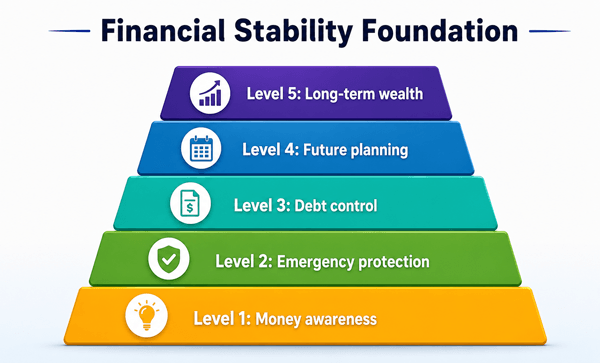
Figure: A simple foundation model for financial stability. Build awareness and protection first, then move toward debt control, future planning, and long-term wealth.
The process can be understood as a simple foundation. Each level supports the next one:| Level | Focus |
|---|---|
| Level 5 | Long-term wealth: investing, retirement, assets, education, and business growth. |
| Level 4 | Future planning: sinking funds, insurance, career growth, and family goals. |
| Level 3 | Debt control: reduce high-interest debt and avoid taking on new harmful debt. |
| Level 2 | Emergency protection: build a starter emergency fund, then save 3 to 6 months of essential expenses. |
| Level 1 | Money awareness: understand your income, expenses, budget, bills, and spending habits. |
Do not try to jump straight to investing if your bills are late, debt is growing, and you have no emergency fund. Build the foundation first, then move upward.
■ Common Mistakes That Delay Financial Stability
1. Trying to fix everything at once
A huge plan can create burnout. Start with one or two actions, such as tracking spending and saving a small emergency fund.
2. Confusing income with stability
A higher income helps, but it does not guarantee stability. Lifestyle inflation can absorb raises quickly.
3. Ignoring small expenses
Small purchases are not always the problem, but repeated unplanned spending can weaken your budget.
4. Saving while high-interest debt grows
Saving is important, but expensive debt can cost more in interest than savings accounts earn. Balance emergency savings with debt repayment.
5. Using credit as extra income
Credit cards and loans are tools, not income. If you use them to cover normal expenses, your budget needs attention.
6. Not planning for irregular expenses
Annual bills, repairs, gifts, and school costs should be planned ahead through sinking funds.
7. Comparing your progress to others
Different people have different incomes, responsibilities, family support, debts, and starting points. Compare your progress to your past behavior.
■ Practical Example: Becoming Financially Stable on a Modest Income
Consider Sara, who earns $2,500 per month after tax. Her rent, food, transport, utilities, and minimum debt payments total $2,250. She has $300 in savings and $4,000 in credit card debt. She feels stuck because only $250 remains each month before unexpected expenses.
Sara’s first 6-month plan
| Month | Action | Result |
|---|---|---|
| 1 | Track your spending and cancel two unused subscriptions. | Free up $45 per month. |
| 2 | Reduce takeout from four times a week to once a week. | Free up about $120 per month. |
| 3 | Build a starter emergency fund of $750. | Small repairs no longer require credit cards. |
| 4 | Put an extra $165 per month toward your highest-interest credit card. | Debt starts falling faster. |
| 5 | Ask your manager about overtime and apply for better-paying roles. | Create opportunities to increase your income. |
| 6 | Set up a sinking fund for car maintenance. | Predictable costs stop becoming emergencies. |
Sara is not wealthy after six months, but she is more stable. She understands her money, has a small cushion, reduced wasteful spending, and has a debt repayment plan. That is real progress. The purpose of this example is not to promise a fixed result, but to show how small repeatable changes can create breathing room.
■ Pros and Cons of Different Financial Stability Strategies
| Strategy | Pros | Cons or Limits |
|---|---|---|
| Strict budgeting | Provides fast control and clear spending limits. | Can feel restrictive and may be difficult to maintain. |
| Flexible budgeting | Easier to follow over the long term. | Requires regular reviews to avoid overspending. |
| Debt snowball | Provides motivating quick wins. | May cost more in interest than the debt avalanche method. |
| Debt avalanche | Often saves the most money on interest. | Progress may feel slow if the highest-interest debt has a large balance. |
| Side income | Can speed up savings and debt repayment. | Can lead to burnout if not managed carefully. |
| Automatic savings | Builds consistent saving habits with less effort. | Can cause overdrafts if your budget is too tight. |
■ How Long Does It Take to Become Financially Stable?
The timeline depends on income, expenses, debt, family responsibilities, cost of living, and unexpected events. Some people can create basic stability in a few months by budgeting and building a starter emergency fund. Others may need several years to pay down debt, increase income, and build stronger savings.
A realistic way to think about progress is in stages:
| Stage | Typical Focus | Progress Sign |
|---|---|---|
| First 30 days | Understand your income, expenses, debt, and spending habits. | You know your financial numbers. |
| First 3 months | Create a budget and build a starter emergency fund. | You rely less on borrowing for small unexpected expenses. |
| First 6 to 12 months | Reduce high-interest debt and strengthen your saving habits. | Your monthly cash flow feels less pressured. |
| 1 to 3 years | Build a larger emergency fund, invest for the future, and increase your income. | You can handle bigger setbacks and plan ahead with confidence. |
■ Checklist: How to Become Financially Stable
- Calculate your monthly take-home income.
- List all expenses and separate needs from wants.
- Track spending for at least 30 days.
- Create a realistic budget you can follow.
- Build a starter emergency fund of $500 to $1,000.
- Pay bills on time and avoid late fees.
- List debts by balance, interest rate, and minimum payment.
- Choose a debt payoff method.
- Create sinking funds for predictable irregular expenses.
- Automate savings where possible.
- Review insurance and basic financial protection.
- Start or increase retirement contributions when possible.
- Look for ways to increase income over time.
- Review your plan monthly and adjust as life changes.
■ Frequently Asked Questions
1. What is the first step to becoming financially stable?
The first step is understanding your current financial situation. List your income, expenses, debts, and savings. Once you know your numbers, you can build a realistic budget and decide what to fix first.
2. How much money do I need to be financially stable?
There is no universal amount. Financial stability depends on your expenses, income, debt, family responsibilities, and cost of living. A good early goal is to spend less than you earn, build a starter emergency fund, and avoid relying on high-interest debt.
3. Can I become financially stable on a low income?
Yes, but it may take more planning and patience. Focus first on tracking spending, covering essentials, building a small emergency fund, reducing harmful debt, and gradually improving income through skills, job changes, or side work.
4. Should I save money or pay off debt first?
Many people should do both in stages. Build a small starter emergency fund first so you do not borrow for every surprise. Then focus extra money on high-interest debt while continuing small savings if possible.
5. Is budgeting necessary for financial stability?
Budgeting is strongly helpful because it gives your money a plan. The budget does not have to be complicated. Even a simple monthly list of income, bills, savings, and spending limits can make a big difference.
6. What is the biggest mistake beginners make?
One common mistake is trying to change everything at once. Another is ignoring the numbers because they feel stressful. Small consistent actions usually work better than a perfect plan that is too hard to follow.
7. How do I stay motivated when progress is slow?
Track small wins, such as paying a bill on time, saving your first $100, reducing one balance, or avoiding one unnecessary purchase. Financial stability is built through repeated progress, not overnight transformation.
8. When should I get professional financial help?
Consider professional help if you cannot make minimum debt payments, face legal or tax problems, need investment advice, are planning major life changes, or feel overwhelmed by complex decisions. Choose qualified, reputable professionals and understand any fees before agreeing.
9. Does financial stability mean having no debt?
Not always. Some debt may be manageable if payments are affordable, interest is reasonable, and the debt supports a useful goal. Financial instability is more likely when debt grows faster than your ability to repay it or when you depend on debt for regular living expenses.■ Final Thoughts
Becoming financially stable is not about perfection. It is about building a life where money is less chaotic and more intentional. Start by understanding your numbers, creating a simple budget, building emergency savings, reducing harmful debt, and improving your income and habits over time.
The most useful financial plan is one you can actually follow. Keep it simple at first. Review your progress regularly. Adjust when life changes. Every responsible step you take makes the next step easier.
Reader Advice: This article is for educational and information purposes only and should not be taken as personalized financial, tax, legal, investment, or debt advice. Please check the latest information from official sources or qualified professionals, as rules, policies, and financial products can change over time.