Good Financial Habits That Build Long-Term Wealth
Good financial habits are the daily, weekly, and monthly money behaviors that help you keep more of what you earn, protect yourself from financial shocks, and grow your assets over time. Long-term wealth is rarely created by one lucky decision. For most people, it is built by repeating sensible habits for many years: spending less than they earn, saving consistently, investing patiently, avoiding harmful debt, and reviewing progress regularly.
Good financial habits that build long-term wealth include tracking spending, using a realistic budget, living below your means, paying yourself first, building an emergency fund, avoiding high-interest debt, investing consistently, protecting your income, tracking net worth, and reviewing your plan regularly. These habits work best when they are simple, automated, and repeated over many years.
This guide is written for beginners. You do not need a finance degree, a high income, or complicated investment knowledge to start. You need clear priorities, simple systems, and the patience to let time work for you. The goal is not to look rich today. The goal is to become financially stronger year after year.
1. What Are Good Financial Habits?
A financial habit is a repeated money behavior. Some habits make your financial life stronger, such as saving automatically or comparing prices before a large purchase. Other habits weaken your finances, such as spending without tracking, relying on credit cards for normal expenses, or upgrading your lifestyle every time your income rises.
Good financial habits work because they reduce dependence on willpower. Instead of deciding every month whether to save, you set up an automatic transfer. Instead of guessing where your money went, you track spending. Instead of reacting emotionally to every market change, you follow a long-term investment plan.
| Financial habit | What it means | Why it builds wealth |
|---|---|---|
| Budgeting | Planning where income will go before it is spent | Creates control and reduces waste |
| Saving first | Moving money to savings before spending on wants | Makes saving consistent |
| Investing regularly | Putting money into assets with long-term growth potential | Uses compounding over time |
| Debt control | Avoiding or quickly repaying expensive debt | Keeps interest from consuming income |
| Net worth tracking | Measuring assets minus liabilities | Shows real financial progress |
2. Why Small Financial Habits Matter More Than Big Occasional Effort
Many beginners think wealth building requires dramatic sacrifices or advanced investment strategies. In reality, small actions repeated consistently can be powerful. Saving $10 once will not change your life. Saving $10 every day, investing part of it, and avoiding unnecessary debt for years can create real progress. The exact amount matters less than building a repeatable system that fits your income.
This is because personal finance is cumulative. Every dollar you save gives you more flexibility. Every dollar of high-interest debt you avoid protects future income. Every investment contribution gives compound growth more time to work. Wealth building is not about perfection; it is about direction and consistency.
3. The Foundation: Know Where Your Money Goes
Habit 1: Track Your Income and Expenses
You cannot improve what you do not measure. Tracking your money shows exactly how much comes in, where it goes, and which spending habits are helping or hurting you. Many people feel they do not earn enough, but after tracking expenses they discover money leaks in food delivery, subscriptions, impulse shopping, bank fees, or unused services.
A beginner-friendly way to start is to track every expense for 30 days. Use a notebook, spreadsheet, budgeting app, or your bank statement. The tool matters less than the habit.
- Write down every source of income after tax.
- List fixed expenses such as rent, insurance, loan payments, and internet.
- List variable expenses such as groceries, fuel, transport, gifts, and entertainment.
- Separate needs from wants honestly.
- Identify three areas where spending can be reduced without damaging your quality of life.
Habit 2: Use a Realistic Budget
A budget is not a punishment. It is a plan for using money on purpose. A good budget tells your money what job to do: pay bills, buy essentials, reduce debt, build savings, invest for the future, and allow some guilt-free enjoyment.
Beginners often fail with budgets because they make them too strict. A useful budget should be realistic enough to follow, flexible enough for real life, and clear enough to guide decisions.
Budget method |
How it works |
Best for |
Limitation |
50/30/20 budget |
50% needs, 30% wants, 20% saving/debt/investing |
Simple beginner structure |
May not work in high-cost areas |
Zero-based budget |
Every dollar is assigned a job |
People who want strong control |
Requires more time |
Envelope method |
Spending categories have set limits |
Cash control and overspending prevention |
Less convenient for digital payments |
Pay-yourself-first budget |
Savings and investments happen before spending |
People who want automation |
Still needs expense awareness |
4. The Wealth-Building Core: Spend Less Than You Earn
Habit 3: Live Below Your Means
Living below your means simply means spending less than your income. This is the most basic wealth-building habit because it creates a gap between what you earn and what you spend. That gap is the money you can use to save, invest, repay debt, or build assets.
This habit does not mean living poorly. It means choosing financial stability over constant lifestyle upgrades. A person can earn a high income and still stay broke if spending rises to match or exceed income. Another person with an average income can build wealth by keeping expenses controlled and investing the difference.
| Scenario | Income | Spending | Monthly surplus | Wealth effect |
|---|---|---|---|---|
| High income, high spending | $8,000 | $8,100 | -$100 | Debt grows despite high income |
| Moderate income, controlled spending | $4,000 | $3,300 | $700 | Money available for saving and investing |
| Income increase, no lifestyle inflation | $4,000 to $4,800 | $3,300 | $1,500 | Wealth-building speed increases |
Habit 4: Avoid Lifestyle Inflation
Lifestyle inflation happens when your spending rises every time your income increases. A raise, bonus, new job, or business growth can improve your life, but if every extra dollar goes to a bigger car, better phone, expensive restaurants, or luxury purchases, your financial progress may stay the same.
A healthier approach is to enjoy part of an income increase while saving or investing the rest. For example, if your monthly income rises by $500, you might improve your lifestyle by $150 and use $350 for debt repayment, emergency savings, or investing.
5. The Safety Layer: Build Financial Protection
Habit 5: Build and Maintain an Emergency Fund
An emergency fund is money set aside for unexpected necessary expenses, such as medical bills, urgent home repairs, job loss, car repairs, or family emergencies. It protects you from using high-interest debt when life does not go as planned.
A common target is three to six months of essential expenses. Beginners can start smaller. The first milestone might be $500 or one month of basic expenses. The key is to keep it separate from everyday spending money and use it only for genuine emergencies, not planned shopping or lifestyle upgrades.
| Emergency fund stage | Target amount | Purpose |
|---|---|---|
| Starter fund | $500 to $1,000 | Covers small unexpected bills |
| Basic protection | 1 month of essential expenses | Reduces paycheck-to-paycheck stress |
| Stronger fund | 3 to 6 months of essential expenses | Protects against job loss or major disruption |
| Higher security | 6 to 12 months of expenses | Useful for unstable income, self-employment, or dependents |
Habit 6: Protect Your Income and Assets
Wealth building is not only about growing money. It is also about protecting what you already have. A single uninsured event can damage years of progress. The right protection depends on your life stage, family responsibilities, job situation, and local laws.
- Health insurance helps protect against large medical bills where applicable.
- Disability or income protection insurance may matter if others depend on your income.
- Life insurance can protect dependents if you pass away unexpectedly.
- Home, renter, and auto insurance protect important assets and liabilities.
- Strong passwords, two-factor authentication, and regular account reviews protect against fraud.
6. The Growth Layer: Save and Invest Consistently
Habit 7: Pay Yourself First
Paying yourself first means saving or investing before spending on non-essential items. Instead of waiting to see what is left at the end of the month, you move money toward your goals as soon as income arrives.
Automation makes this habit easier. Set up automatic transfers to a savings account, retirement account, brokerage account, or debt repayment account. When the money moves automatically, you are less likely to spend it impulsively.
- Choose a specific amount or percentage to save from each paycheck.
- Schedule the transfer for the same day income arrives or the next day.
- Keep goal money separate from daily spending money.
- Increase the amount gradually when income rises or debt falls.
Habit 8: Invest for the Long Term
Saving protects money. Investing helps money grow. Long-term investing means buying assets that have the potential to increase in value or produce income over many years. Examples may include diversified stock funds, bonds, retirement accounts, real estate, or business assets. The right choice depends on your risk tolerance, goals, time horizon, and local investment options.
For beginners, the most important investing habit is consistency. Trying to predict the perfect time to invest is difficult. A practical approach is to invest regularly, diversify, keep costs reasonable, understand tax effects where relevant, and avoid panic decisions during market declines.
- Start only after you understand the basic risks and have a small emergency fund.
- Prefer diversified investments over putting all money into one stock, coin, or business idea.
- Invest for goals that are several years away, not for next month’s rent.
- Review fees because high costs can reduce long-term returns.
- Avoid investments you cannot explain in simple words.
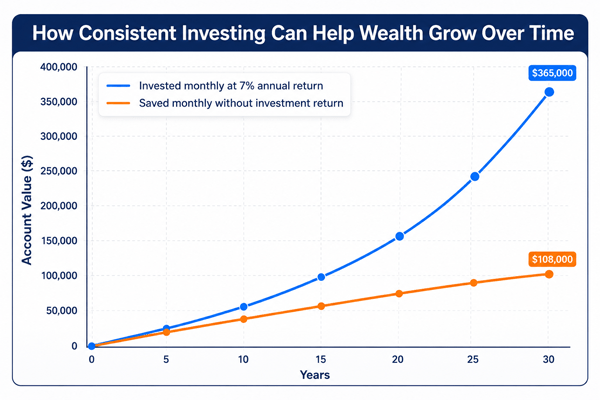
Chart: A simplified example showing how consistent monthly investing can outpace saving without investment growth over long periods. Actual investment returns vary and are never guaranteed.
Habit 9: Understand Compound Growth
Compounding happens when your money earns returns, and those returns begin earning returns too. The longer money stays invested, the more powerful compounding can become. This is why starting early matters. Even small amounts can become meaningful when given enough time and discipline.
7. The Debt Layer: Use Borrowing Wisely
Habit 10: Avoid High-Interest Debt
High-interest debt is one of the biggest enemies of long-term wealth. Credit cards, payday loans, expensive personal loans, and some consumer financing plans can absorb income that could have been saved or invested. When interest is high, your future money is already promised to lenders.
Not all debt is equally harmful. A reasonable mortgage for an affordable home may support stability. A student loan for a valuable qualification may increase income potential. But debt used for short-lived wants, status purchases, or normal living expenses can become dangerous.
Before taking new debt, check the total repayment cost, the interest rate, fees, loan term, and whether the payment still leaves room for saving and emergencies.
| Debt type | Possible use | Wealth-building view |
|---|---|---|
| Credit card debt | Convenience if paid in full | Harmful if balances carry high interest |
| Car loan | Transportation for work or family needs | Risky if payment is too large or car loses value quickly |
| Student loan | Education or skills with income potential | Can be useful if cost is reasonable |
| Mortgage | Buying an affordable home | Can be manageable if payments fit the budget |
| Payday or short-term loan | Emergency cash | Usually very expensive and risky |
Habit 11: Pay Bills on Time and Maintain Good Credit Behavior
Paying bills on time helps avoid late fees, penalty interest, service interruptions, and damage to your borrowing reputation. Good credit behavior can make future borrowing less expensive if you need a mortgage, business loan, or other financing.
- Set reminders or automatic payments for recurring bills.
- Keep a bill calendar with due dates.
- Pay credit cards in full when possible.
- Avoid using credit limits as spending targets.
- Check statements for errors or unauthorized charges.
8. The Direction Layer: Set Goals and Measure Progress
Habit 12: Set Clear Financial Goals
Financial goals turn vague wishes into practical decisions. Without goals, money can disappear into everyday spending. With goals, you can decide what matters most: debt freedom, a home deposit, education, business capital, retirement, travel, family security, or financial independence.
| Goal type | Example | Time frame | Best money tool |
|---|---|---|---|
| Short-term | Save for annual insurance payment | Under 1 year | Savings account or cash reserve |
| Medium-term | Home down payment or car replacement | 1 to 5 years | Savings or low-risk investments |
| Long-term | Retirement or financial independence | 5+ years | Diversified investing |
Habit 13: Track Your Net Worth
Net worth is the difference between what you own and what you owe. The formula is simple: net worth = assets minus liabilities. Assets include savings, investments, retirement accounts, property, and business value. Liabilities include credit card debt, loans, mortgages, and other amounts owed.
Tracking net worth helps you focus on real financial progress, not just income or possessions. A luxury car bought with debt may look impressive, but it may reduce net worth. A modest lifestyle with growing savings and investments may look ordinary, but it can build long-term wealth.
| Assets | Amount | Liabilities | Amount |
|---|---|---|---|
| Emergency savings | $3,000 | Credit card debt | $1,200 |
| Retirement investments | $12,000 | Car loan | $8,000 |
| Home equity | $25,000 | Student loan | $6,000 |
| Total assets | $40,000 | Total liabilities | $15,200 |
| Net worth | $24,800 |
9. The Decision Layer: Think Before You Spend
Habit 14: Practice Conscious Spending
Conscious spending means spending money on purpose instead of by habit, pressure, boredom, or comparison. It does not require eliminating all enjoyment. It means choosing purchases that match your values and saying no to spending that does not.
- Use a 24-hour rule for non-essential purchases.
- Compare the total cost, not only the monthly payment.
- Ask whether the purchase supports your goals or delays them.
- Calculate how many work hours the item costs.
- Avoid shopping when emotional, tired, bored, or trying to impress others.
Habit 15: Keep Learning About Money
Financial literacy improves your ability to make good decisions. You do not need to become an expert in everything. But understanding basic topics such as budgeting, debt, interest, investing, taxes, insurance, and retirement planning can help you avoid costly mistakes.
A practical learning habit is to study one money topic each month. For example, one month you learn budgeting. Next month you learn debt payoff methods. Then emergency funds, investing basics, retirement accounts, insurance, taxes, and estate planning.
10. Good Financial Habits vs Poor Financial Habits
| Good financial habit | Poor financial habit | Long-term result |
|---|---|---|
| Saving automatically | Saving only what is left over | More consistent wealth building |
| Budgeting realistically | Guessing monthly expenses | Fewer surprises and less stress |
| Investing with patience | Chasing quick profits | Lower risk of emotional mistakes |
| Paying high-interest debt quickly | Making minimum payments only | Less interest paid over time |
| Tracking net worth | Judging success by income alone | Clearer view of real progress |
| Buying based on value | Buying to impress others | More money for meaningful goals |
11. Best Practices for Building Long-Term Wealth
- Start with awareness: track income, expenses, debts, and savings.
- Create a simple budget you can actually follow.
- Build a starter emergency fund before taking unnecessary investment risk.
- Pay off high-interest debt aggressively.
- Automate savings and investment contributions.
- Increase your savings rate gradually when income rises.
- Invest for long-term goals using diversified, understandable investments.
- Protect your income, health, family, and assets with appropriate safeguards.
- Review your finances monthly and your bigger plan at least once a year.
- Avoid comparing your financial life to other people’s visible lifestyle.
12. Common Misconceptions About Wealth-Building Habits
| Misconception | Reality |
|---|---|
| You need a high income to build wealth. | Higher income helps, but habits determine whether money is kept and grown. |
| Budgeting means you cannot enjoy life. | A good budget includes planned enjoyment while protecting priorities. |
| Investing is only for rich people. | Many people start with small amounts and increase over time. |
| Debt is always bad. | Debt can be useful when affordable and tied to long-term value, but high-interest consumer debt is dangerous. |
| I will start when I earn more. | Starting small builds discipline and gives time for compounding. |
| Wealth means luxury spending. | Real wealth is financial freedom, security, and choices. |
13. A Beginner-Friendly 30-Day Financial Habits Plan
| Week | Main focus | Actions |
|---|---|---|
| Week 1 | Awareness | Track all spending, list income, collect bills, identify money leaks. |
| Week 2 | Budget and savings | Create a basic budget, open or separate emergency savings, set first automatic transfer. |
| Week 3 | Debt and protection | List debts by balance and interest rate, choose repayment priority, review insurance and account security. |
| Week 4 | Growth and review | Learn investing basics, set one long-term goal, calculate net worth, schedule monthly money review. |
Financial Habits Wealth Pyramid
Financial habits wealth pyramid showing budgeting as the base, then emergency protection, debt control, investing, and long-term wealth at the top.
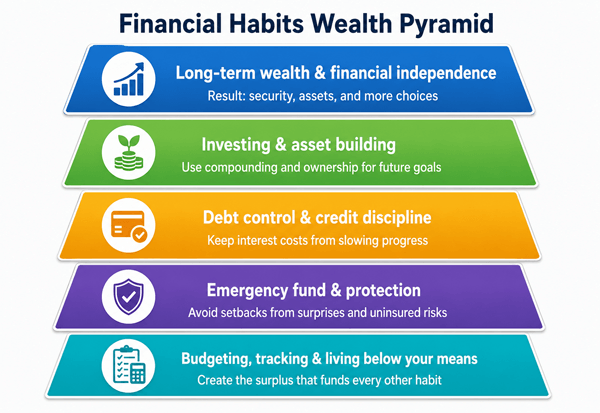
| Pyramid level | Habit category | Purpose |
|---|---|---|
| Top | Long-term wealth and financial independence | The result of consistent habits over time |
| Level 4 | Investing and asset building | Grow money through compounding and ownership |
| Level 3 | Debt control and credit discipline | Prevent interest from destroying progress |
| Level 2 | Emergency fund and protection | Avoid financial setbacks |
| Base | Budgeting, tracking, and living below your means | Create the surplus that funds everything else |
14. Risks and Limitations to Understand
Good financial habits improve your odds of building wealth, but they do not remove all risk. Job loss, health problems, family responsibilities, inflation, market declines, and economic changes can affect progress. This is why emergency savings, insurance, diversification, and flexible planning matter.
Investing also carries risk. Values can rise and fall. No investment return is guaranteed. Beginners should avoid putting money into products they do not understand, borrowing money to invest, or chasing trends because of social media excitement. When decisions are complex or high-stakes, consider speaking with a qualified financial professional who understands your personal situation and local rules.
15. Frequently Asked Questions
1. What are the best financial habits for beginners?
The best beginner habits are tracking spending, using a simple budget, saving automatically, building an emergency fund, paying bills on time, avoiding high-interest debt, and learning basic investing concepts.
2. What is the most important habit for building long-term wealth?
Living below your means is one of the most important habits because it creates the surplus needed for saving, investing, and debt repayment.
3. How much should I save each month?
A common goal is to save at least 10% to 20% of income, but beginners can start with any realistic amount. The habit of saving consistently matters more than the starting amount.
4. Should I pay off debt or invest first?
High-interest debt should usually be prioritized because it can cost more than many investments are likely to earn. Many beginners compare the debt avalanche method, which targets the highest interest rate first, with the debt snowball method, which targets the smallest balance first for motivation. At the same time, it can be wise to build a small emergency fund so you do not borrow again for every surprise expense.
5. Can I build wealth with an average income?
Yes. Many average-income earners build wealth through consistent saving, controlled spending, investing, and avoiding lifestyle inflation. Income matters, but habits determine how much income turns into assets.
6. How long does it take to build long-term wealth?
It usually takes years, not weeks or months. Wealth building is a long-term process based on repeated behavior, compounding, and disciplined decision-making.
7. Is investing necessary to build wealth?
For long-term goals, investing can be very helpful because savings alone may not keep up with inflation or provide enough growth. However, investing should be done with proper understanding, diversification, and risk awareness.
8. What should I do if I live paycheck to paycheck?
Start by tracking every expense, creating a basic budget, cutting one or two money leaks, building a small emergency fund, and looking for ways to increase income. Small improvements can create the first gap between income and spending.
9. How often should I review my finances?
A monthly review is ideal for budgeting, bills, savings, and debt progress. A deeper review once or twice a year can help update goals, insurance, investments, and retirement planning.
10. What is the difference between being rich and being wealthy?
Being rich often refers to high income or visible spending. Being wealthy means owning assets, having financial security, and having more freedom over your time and choices.
Conclusion: Build Wealth One Habit at a Time
Good financial habits build long-term wealth because they turn smart money choices into repeatable systems. You do not need to be perfect, and you do not need to master everything at once. Start with the basics: know where your money goes, spend less than you earn, save before spending, protect yourself from emergencies, avoid expensive debt, and invest consistently for the future.
The sooner you begin, the more time your habits have to work. Even small steps matter when they are repeated. Long-term wealth is not only about having more money; it is about having more security, more choices, and more control over your financial life.
Reader Advice: This article is for educational and informational purposes only and should not be taken as personal financial, legal, tax, or investment advice. Please check the latest information from official sources or a qualified professional, because rules, policies, products, and market conditions can change over time.
This article uses general personal-finance principles for educational purposes. Because financial products, taxes, benefits, and consumer-protection rules vary by country, readers should confirm important decisions with official sources or a qualified professional in their location.