Money Management Explained: Meaning, Principles & Best Practices
1. What Is Money Management?
Money management is the process of planning, controlling, saving, spending, borrowing, and investing money in a way that supports your needs, goals, and future security. In simple words, it means knowing where your money comes from, where it goes, and how to use it wisely.
Good money management is not about being rich or never enjoying life. It is about making intentional choices so your money works for you instead of disappearing without a clear purpose.
2. Why Money Management Matters
Many people earn money but still feel financially stressed because they do not have a clear plan. Money management gives structure to daily financial decisions. It helps you understand your cash flow, separate needs from wants, prepare for surprises, and make progress toward important goals.
- Start with actual take-home income rather than hoped-for income.
- Use a budget that fits your life instead of copying a rule blindly.
- Protect yourself with emergency savings before taking larger financial risks.
- Review your plan monthly because income, prices, goals, and responsibilities change.
| Benefit | What it means in real life |
|---|---|
| Less financial stress | You know what bills are due, what you can spend, and what you should save. |
| Better control over spending | You can spot wasteful expenses before they become habits. |
| Emergency protection | Savings help you handle job loss, medical costs, repairs, or urgent family needs. |
| Lower debt pressure | A clear repayment plan reduces interest costs and missed payments. |
| Progress toward goals | You can save for education, a home, business, retirement, or financial independence. |
| More confident decisions | You compare options instead of reacting emotionally. |
3. How Money Management Works
Money management works like a cycle. You earn income, make a plan, spend according to that plan, save for future needs, reduce harmful debt, and review your progress regularly. The goal is not perfection. The goal is steady improvement.
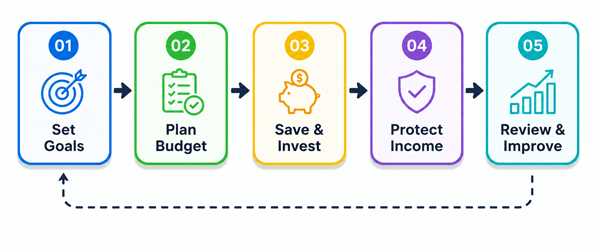
Figure: A simple money management cycle for beginners.
Step 1: Know your income
Start with your reliable take-home income, not your gross salary. Take-home income is the amount you actually receive after taxes, deductions, and other withholdings. If your income changes from month to month, use a conservative average or base your budget on your lowest typical month.
Step 2: Track your expenses
Track spending for at least 30 days. Include fixed expenses such as rent, loan payments, and subscriptions, plus variable expenses such as food, transport, clothing, gifts, and entertainment.
Step 3: Create a budget
A budget is a written plan for how your money will be used. It helps you decide in advance how much should go to needs, wants, savings, debt repayment, and goals.
Step 4: Build savings
Savings protect you from emergencies and give you options. The Consumer Financial Protection Bureau highlights emergency savings as a tool for handling unexpected expenses and reducing financial shocks.
Step 5: Manage debt
Debt is not always bad, but unmanaged debt can damage your cash flow. A good money plan includes minimum payments, a payoff strategy, and rules for avoiding unnecessary borrowing.
Step 6: Review and adjust
Your budget should change when your life changes. Review it monthly and after major events such as a new job, marriage, a child, moving home, or a large purchase.
■ Core Principles of Good Money Management
The following principles are simple, but they are powerful when practiced consistently.
Helpful way to use these principles: Choose one principle to improve this month instead of trying to fix every habit at once.
1. Spend less than you earn
This is the foundation. If your spending is always higher than your income, debt usually fills the gap. If your spending is lower than your income, the difference can build savings and wealth.
2. Give every dollar a job
Before the month begins, decide what your money is meant to do: pay bills, buy food, cover transport, reduce debt, build savings, or fund a goal.
This includes irregular costs: Give a job to money for annual fees, school expenses, vehicle maintenance, taxes, holidays, and family support so they do not become surprise debt.
3. Pay yourself first
Treat saving like a bill. Move money to savings soon after income arrives instead of waiting to see what is left.
4. Separate needs, wants, and goals
Needs keep life running. Wants improve comfort or enjoyment. Goals improve your future. A good plan makes room for all three, but not at the same priority.
5. Prepare before emergencies happen
An emergency fund should be easy to access and reserved for real unexpected needs, not everyday overspending.
6. Use debt carefully
Borrow only when repayment is realistic and the reason is worth the cost. Interest can make purchases much more expensive over time.
7. Think long term
Money decisions compound. Small savings, lower fees, and better habits can create meaningful results over years.
8. Review regularly
A budget that is never reviewed becomes outdated. A monthly money review keeps your plan connected to real life.
■ Popular Money Management and Budgeting Methods
There is no single perfect budgeting method. The best method is the one you can actually follow.
| Method | How it works | Best for | Limitation |
|---|---|---|---|
| 50/30/20 budget | 50% needs, 30% wants, 20% savings and debt goals. | Beginners who want a simple structure. | May not fit low-income, high-rent, or high-debt situations. |
| Zero-based budget | Every dollar is assigned a purpose until income minus planned spending equals zero. | People who want detailed control. | Requires more tracking and discipline. |
| Envelope method | Money is divided into spending categories, physically or digitally. | People who overspend in certain categories. | Less convenient if most spending is online. |
| Pay-yourself-first budget | Savings happen first; remaining money covers spending. | People focused on saving goals. | Can fail if basic expenses are underestimated. |
| Anti-budget | Track only savings rate and major bills; spend the rest freely. | People with stable income and low debt. | Not ideal for beginners with poor spending visibility. |
■ Practical Example: A Beginner Monthly Money Plan
Assume a person earns $2,000 per month after taxes. A simple beginner plan might look like this:
| Category | Monthly amount | Purpose |
|---|---|---|
| Housing and utilities | $650 | Rent, electricity, water, internet |
| Food and groceries | $300 | Groceries and basic household items |
| Transport | $180 | Fuel, bus, ride-share, maintenance |
| Insurance and health | $120 | Medical costs, insurance, medicine |
| Debt payments | $200 | Minimums plus extra repayment |
| Emergency savings | $150 | Build cash reserve |
| Long-term savings/investing | $150 | Retirement, education, business, or wealth goals |
| Personal and entertainment | $170 | Clothing, eating out, hobbies |
| Giving/family support/miscellaneous | $80 | Flexible life expenses |
| Total | $2,000 | Income fully assigned |
This is only an example. A good budget must fit your income, local living costs, family responsibilities, and goals.
Local-cost reminder: The percentages and amounts in any example should be adjusted for your country, city, household size, rent, transport costs, food prices, income stability, and family responsibilities.
■ Money Management Best Practices for Beginners
These practices turn money management from an idea into a daily system.
1. Track spending before making big changes
You cannot fix what you cannot see. Review bank statements, mobile wallet history, receipts, and cash spending.
Note: This step is often called expense tracking, cash-flow tracking, or spending analysis. All three mean looking honestly at where your money goes.
2. Automate important payments
Automatic transfers can help you save consistently and avoid late fees, but you should still review accounts to avoid overdrafts.
3. Build a starter emergency fund first
A small starter fund can stop minor emergencies from becoming debt. Then work toward a larger fund based on your household risk.
4. Use a separate savings account
Keeping savings away from daily spending money reduces the temptation to use it casually.
5. Attack high-interest debt
Credit card balances and expensive consumer loans can slow financial progress. Pay minimums on all debts, then put extra money toward the debt strategy you choose.
6. Compare before buying
For large purchases, compare total cost, warranty, fees, interest, and long-term maintenance, not just the monthly payment.
7. Plan for irregular expenses
Birthdays, school fees, car repairs, insurance renewals, holidays, and annual subscriptions should be planned before they arrive.
8. Review subscriptions and small leaks
Small recurring costs can quietly reduce savings. Cancel what you do not use or value.
9. Increase savings when income rises
When you get a raise or extra income, raise your savings rate before lifestyle spending expands.
10. Keep learning
The FDIC Money Smart program emphasizes practical financial skills, real-life scenarios, and confidence-building for managing money.
■ Debt Management: Snowball vs. Avalanche
Two common debt repayment methods are the debt snowball and debt avalanche. Both can work, but they help different types of people.
| Strategy | How it works | Main advantage | Best for |
|---|---|---|---|
| Debt snowball | Pay extra toward the smallest balance first, while paying minimums on all other debts. | Fast emotional wins and motivation. | People who feel overwhelmed and need momentum. |
| Debt avalanche | Pay extra toward the highest-interest debt first, while paying minimums on all other debts. | Usually saves the most interest. | People who are motivated by math and total cost savings. |
■ Common Money Management Mistakes to Avoid
Most money problems do not come from one bad decision. They often come from repeated small habits that go unnoticed.
- Budgeting with hoped-for income instead of actual take-home income.
- Ignoring small daily expenses because they seem harmless.
- Using credit cards or loans to maintain a lifestyle that income cannot support.
- Saving only what is left at the end of the month.
- Not planning for annual or irregular expenses.
- Keeping no emergency fund and relying on debt for surprises.
- Confusing minimum debt payments with a real payoff plan.
- Making financial decisions based on pressure, comparison, or social media.
- Investing before understanding basic risks, fees, and time horizon.
- Never reviewing progress or updating goals.
■ Common Misconceptions About Money Management
| Misconception | Reality |
|---|---|
| “Money management is only for rich people.” | It is especially useful when money is limited because every decision matters more. |
| “A budget means I cannot enjoy life.” | A budget helps you enjoy life responsibly by planning for fun without damaging essentials. |
| “I will start when I earn more.” | Higher income helps, but habits matter. Poor habits often grow with income. |
| “All debt is bad.” | Some debt can support education, housing, or business goals, but it must be affordable and well understood. |
| “Investing is the same as saving.” | Saving is usually for short-term safety and liquidity. Investing is for longer-term growth and involves risk. |
| “Small amounts do not matter.” | Small amounts matter because habits repeat. Compound interest and consistent saving can grow over time. |
■ Useful Money Management Tools
You do not need expensive tools to manage money. Start with whatever you will use consistently.
| Tool | How to use it | Good for |
|---|---|---|
| Notebook | Write income, bills, and spending by hand. | Simple tracking without technology. |
| Spreadsheet | Create categories, totals, and monthly comparisons. | People who like customization. |
| Budgeting app | Connect accounts or manually enter transactions. | Convenience and reminders. |
| Separate bank accounts | Use different accounts for bills, spending, savings, and goals. | Reducing accidental overspending. |
| Calendar reminders | Schedule due dates and money review days. | Avoiding missed payments. |
| Net worth tracker | List assets minus debts monthly or quarterly. | Seeing long-term progress. |
■ Beginner Money Management Checklist
Use this checklist as a simple starting point:
How to use the checklist: Do not worry if you cannot complete every item immediately. Start with tracking, bills, and a small emergency fund, then improve one step at a time.
- Write down your monthly take-home income.
- List all fixed bills and due dates.
- Track every expense for 30 days.
- Choose a budgeting method.
- Set one short-term, one medium-term, and one long-term goal.
- Start or grow an emergency fund.
- Pay all debt minimums on time.
- Choose a debt payoff strategy if needed.
- Automate savings where possible.
- Review your plan once per month.
■ A Simple Monthly Money Review
Once a month, spend 20 to 30 minutes answering these questions:
Best time to review: Choose a fixed day, such as the first weekend of the month or payday, so the review becomes a habit rather than a forgotten task.
- Did I spend less than I earned?
- Which category went over budget and why?
- Did I save the amount I planned?
- Did any upcoming expense surprise me?
- Can I reduce, cancel, or renegotiate any cost?
- What is one improvement I will make next month?
■ Frequently Asked Questions
1. What is the main goal of money management?
The main goal is to use your money intentionally so you can cover present needs, prepare for future needs, reduce financial stress, and build long-term stability.
2. How do I start managing money with a low income?
Start by tracking spending, separating needs from wants, protecting essentials, avoiding new high-interest debt, and saving a small amount consistently. Even a small emergency fund can help.
3. What is the best budgeting rule for beginners?
The 50/30/20 rule is easy to understand, but it may need adjustment. If your needs are high or debt is heavy, use it as a guide rather than a strict rule.
4. How much should I save each month?
Save what is realistic and repeatable. Many people aim for 10% to 20% over time, but beginners can start smaller and increase gradually.
5. Should I save or pay off debt first?
Usually, build a small emergency fund first, keep paying minimums on all debts, then focus extra money on high-interest debt. The right balance depends on interest rates, job stability, and risk.
6. Where should I keep emergency savings?
Emergency savings should generally be kept somewhere safe, liquid, and easy to access, such as a savings account, not in risky investments.
7. Is investing part of money management?
Yes. Once basic cash flow, emergency savings, and high-interest debt are under control, investing can support long-term goals. Investor.gov explains that diversification and asset allocation help manage investment risk.
8. How often should I review my budget?
Review your budget at least monthly. Also review it after major life changes or whenever your income or expenses change significantly.
9. What is the difference between saving and investing?
Saving is for safety and short-term access. Investing is for long-term growth and involves the risk of losing money.
10. Can money management improve mental peace?
It can reduce uncertainty because you know what you owe, what you can spend, and what steps you are taking. It does not remove all financial problems, but it makes them easier to face.
A sinking fund is money saved gradually for a known future expense, such as school fees, car repairs, insurance renewal, holidays, or a planned purchase.
13. What is a sinking fund?
Cash flow means the movement of money in and out of your life. Positive cash flow means income is higher than expenses, giving you room to save, repay debt, or invest.
12. What is cash flow in money management?
Budgeting is one part of money management. Money management is broader because it also includes saving, debt control, emergency planning, investing decisions, insurance, goals, and regular review.
11. What is the difference between money management and budgeting?
Budgeting is one part of money management. A budget is a plan for how you will spend and save your money. Money management is broader because it also includes budgeting, saving, debt management, emergency planning, investing, insurance, financial goals, and regularly reviewing your finances.■ Final Thoughts: Money Management Is a Life Skill
Money management is not about being perfect with money. It is about building a repeatable system that helps you make better decisions. Start with awareness, create a simple budget, save consistently, avoid unnecessary debt, and review your progress. Over time, these habits can turn financial confusion into financial confidence.
The best time to start is not when everything is ideal. The best time to start is with the money, knowledge, and tools you have today.
Reader Advice: This article is for educational and informational purposes only and should not be taken as personal financial, legal, tax, or investment advice. Please check the latest information from official sources or a qualified professional, because rules, policies, fees, and financial products can change over time.