How to Create a Personal Finance Plan: Step-by-Step Guide for Beginners
Quick Answer: A personal finance plan is a written roadmap for managing your money. It shows where your money is going now, what you want it to do in the future, and the steps you will take to get there. A strong plan usually includes a budget, emergency fund, debt strategy, savings goals, basic investing plan, insurance review, and a regular check-in schedule.
This guide is designed for beginners who want a clear personal finance plan they can use in real life, whether they are budgeting for the first time, rebuilding after debt, or organizing savings and investing goals.
In this guide, you will learn how to:
- Understand your current financial situation without feeling overwhelmed.
- Set realistic short-term, medium-term, and long-term money goals.
- Create a budget that fits real life, not just a spreadsheet.
- Build an emergency fund and manage debt wisely.
- Start saving and investing based on your risk level and timeline.
- Protect your finances with insurance, estate basics, and regular reviews.
1. What Is a Personal Finance Plan?
A personal finance plan is a practical plan for how you earn, spend, save, borrow, invest, and protect your money. It is not only for wealthy people. It is useful for anyone who wants more control, less stress, and better financial decisions.
Think of it like a map. Your current income, debts, bills, and savings are your starting point. Your goals, such as building an emergency fund, buying a home, becoming debt-free, or retiring comfortably, are your destination. Your personal finance plan connects the two with clear steps.
2. Why a Personal Finance Plan Matters
Money problems often feel confusing because everything is connected. Rent affects savings. Debt payments affect investing. Insurance affects emergency needs. A written plan helps you make decisions in the right order instead of reacting to every expense as it happens.
- It gives every dollar a job before it disappears.
- It helps you prepare for emergencies instead of relying only on credit cards.
- It makes debt payoff more organized and less emotional.
- It helps you choose financial goals based on your real income and timeline.
- It reduces guesswork when deciding whether to spend, save, invest, or pay debt.
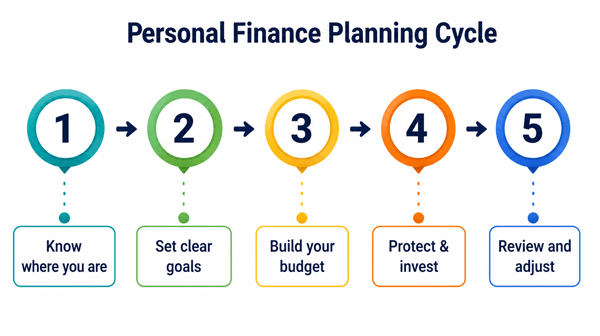
Figure: A simple personal finance plan is a cycle. You review your current position, set goals, create a budget, protect and grow your money, then adjust as life changes.
Step 1: Review Your Current Financial Situation
Before you create a plan, you need a clear picture of where you stand today. This step is not about judging yourself. It is about collecting facts so you can make better decisions.
Helpful documents to collect include recent pay slips, bank statements, credit card statements, loan balances, insurance details, and any tax or retirement account information that applies in your country.
List your income
Write down all regular income sources after tax, such as salary, freelance income, business income, rental income, benefits, or side income. Use your monthly take-home income, because that is the money you can actually spend or save.
Track your expenses
Look at your bank statements, cash spending, payment apps, and credit card statements for the last one to three months. Group your spending into categories.
For better accuracy, separate fixed expenses from variable expenses. Fixed expenses are usually predictable, while variable expenses are the areas where small changes can quickly improve cash flow.
| Expense Category | Examples | Why It Matters |
|---|---|---|
| Needs | Rent, utilities, groceries, transport, basic phone plan. | These must be paid first because they keep your life stable. |
| Debt payments | Credit cards, student loans, personal loans, car loans. | Debt affects cash flow and may limit your ability to save. |
| Savings and investments | Emergency fund, retirement account, investment account. | This is money for future security and goals. |
| Wants | Dining out, entertainment, subscriptions, upgrades. | These are flexible areas where savings may be found. |
| Irregular expenses | Car repairs, gifts, medical costs, annual fees. | These often break budgets if not planned for. |
Calculate your net worth
Net worth is what you own minus what you owe. It is a useful snapshot, but it does not define your value as a person. It simply shows your financial starting point.
| Assets: What You Own | Liabilities: What You Owe |
|---|---|
| Cash, savings, and checking account balances. | Credit card balances. |
| Retirement and investment accounts. | Personal loans. |
| Home equity, if you own property. | Student loans. |
| Vehicle resale value, if relevant. | Car loans or mortgage balance. |
| Business assets, if relevant. | Unpaid taxes or other obligations. |
Example: If you have $3,000 in savings, $12,000 in investments, and a car worth $8,000, your total assets are $23,000. If you owe $5,000 on a credit card and $6,000 on a car loan, your liabilities are $11,000. Your net worth is $12,000.
Step 2: Set Clear Financial Goals
A budget without goals can feel restrictive. Goals give your plan meaning. Instead of saying, “I need to spend less,” you can say, “I am saving $1,000 for emergencies so one unexpected bill does not create debt.”
| Goal Type | Timeline | Examples |
|---|---|---|
| Short-term goals | 0 to 12 months | Build a starter emergency fund, pay a small credit card balance, save for school supplies or car maintenance. |
| Medium-term goals | 1 to 5 years | Save for a home deposit, replace a vehicle, pay off major debt, build a full emergency fund. |
| Long-term goals | 5+ years | Retirement, children's education, financial independence, buying property, long-term investing. |
Use the SMART goal method
A useful financial goal is specific, measurable, achievable, relevant, and time-based.
| Weak Goal | Better Goal |
|---|---|
| I want to save money. | I will save $1,200 in 12 months by setting aside $100 each month. |
| I want less debt. | I will pay an extra $150 per month toward my highest-interest credit card until it is paid off. |
| I want to invest someday. | After my emergency fund reaches one month of expenses, I will start investing $50 per month. |
Step 3: Build a Realistic Monthly Budget
A budget is not a punishment. It is a plan for your income. The best budget is one you can actually follow.
A strong beginner budget should also include a small buffer for price changes, family needs, and irregular costs so the plan does not fail after one unexpected expense.
Choose a budgeting method
| Budget Method | How It Works | Best For | Possible Limitation |
|---|---|---|---|
| 50/30/20 budget | About 50% for needs, 30% for wants, and 20% for savings and debt repayment. | Beginners who want a simple framework. | May not fit low-income, high-rent, or high-debt situations. |
| Zero-based budget | Every dollar is assigned to a category before the month begins. | People who want strong control over cash flow. | Requires more tracking and discipline. |
| Pay-yourself-first budget | Savings are moved first, then the remaining money is used for expenses. | People who struggle to save consistently. | Can fail if required bills are underestimated. |
| Envelope system | Money is divided into spending categories, physically or digitally. | People who overspend in flexible categories. | Less convenient for complex online spending. |
Beginner tip: Start with a simple version. For the first month, aim to track spending accurately. You can improve the budget later.
Sample beginner budget
| Category | Monthly Amount | Notes |
|---|---|---|
| Take-home income | $3,000 | Use income after taxes and payroll deductions. |
| Housing | $950 | Rent or mortgage plus basic housing costs. |
| Utilities and phone | $250 | Electricity, gas, water, internet, and phone. |
| Groceries | $450 | Separate groceries from restaurant spending. |
| Transport | $300 | Fuel, public transport, parking, and maintenance. |
| Minimum debt payments | $250 | Required payments first. |
| Emergency savings | $200 | Automatic transfer after payday. |
| Extra debt payoff | $150 | Focused on one debt at a time. |
| Insurance and medical | $200 | Premiums, prescriptions, and routine care. |
| Personal and family spending | $200 | Clothing, childcare items, and basic personal care. |
| Fun and dining out | $150 | Planned enjoyment helps avoid burnout. |
| Irregular expenses fund | $100 | Gifts, repairs, and annual renewals. |
Step 4: Build an Emergency Fund
An emergency fund is money set aside for unexpected expenses, not planned shopping. It protects you from turning every surprise into debt.
- Starter goal: save $500 to $1,000 as quickly as possible if you have no emergency savings.
- Next goal: save one month of essential expenses.
- Longer-term goal: build three to six months of essential expenses, especially if your income is irregular or you support dependents.
Keep emergency money somewhere safe and easy to access, such as a separate savings account. Avoid investing your emergency fund in risky assets because you may need the money when markets are down.
If possible, automate emergency savings after payday. Even a small recurring transfer can make the habit easier and help you build financial stability over time.
Step 5: Create a Debt Payoff Strategy
Debt is not always the same. A mortgage at a reasonable rate is different from high-interest credit card debt. Your plan should identify which debts are most urgent.
| Debt Strategy | How It Works | Main Benefit | Best For |
|---|---|---|---|
| Debt avalanche | Pay extra toward the highest-interest debt first while making minimum payments on all other debts. | Usually saves the most interest. | People motivated by math and long-term savings. |
| Debt snowball | Pay extra toward the smallest balance first while making minimum payments on all other debts. | Builds confidence with quick wins. | People who need motivation and momentum. |
| Debt consolidation | Combine debts into one payment, ideally at a lower interest rate. | Can simplify payments and reduce interest. | People with good terms and the discipline not to create new debt. |
Practical rule: If you have high-interest consumer debt, prioritize it before aggressive investing. Paying off a credit card with a very high interest rate can be one of the most reliable ways to improve your financial situation.
If you are unsure which debt to pay first, list each balance, interest rate, minimum payment, and due date. This makes it easier to compare the avalanche and snowball methods fairly.
Step 6: Plan Your Savings by Purpose
Savings work best when each account has a purpose. Mixing rent money, vacation money, emergency savings, and tax money in one account can lead to confusion.
Naming each savings bucket can improve follow-through because the money is linked to a clear purpose, such as “car repairs,” “school fees,” “taxes,” or “home deposit.”
| Savings Bucket | Purpose | Where to Keep It |
|---|---|---|
| Emergency fund | Unexpected necessary expenses. | Separate savings account with easy access. |
| Sinking funds | Known irregular costs such as car repairs, holidays, and insurance renewals. | Separate savings account or budget sub-accounts. |
| Short-term goals | Money needed within 1 to 3 years. | Cash or low-risk savings options. |
| Long-term goals | Retirement or goals more than 5 years away. | Investment accounts, depending on risk tolerance and local rules. |
Step 7: Start Investing Carefully
Investing is using money to buy assets that may grow over time, such as diversified funds, bonds, property, or retirement investments. Investing can help you build wealth, but it involves risk. Prices can rise and fall, and returns are not guaranteed.
Before choosing investments, compare your time horizon, risk tolerance, fees, tax rules, and local account options. The right choice can vary by country and personal situation.
Before investing, check these basics
- You can pay your essential bills on time.
- You have at least a starter emergency fund.
- You understand the difference between saving and investing.
- You are not using money you need for short-term bills or emergency needs.
- You are willing to learn about fees, risk, diversification, and time horizon.
Beginner investing principles
- Diversify instead of putting all your money into one stock or asset.
- Invest regularly rather than trying to guess the perfect day to buy.
- Match risk to timeline: short-term money should usually be safer; long-term money can usually accept more ups and downs.
- Watch fees because high costs can reduce long-term returns.
- Do not invest based only on hype, social media, or fear of missing out.
Step 8: Protect Your Financial Plan
A personal finance plan is not complete if one illness, accident, job loss, or family emergency can destroy it. Protection is the defensive side of financial planning.
Keep important financial documents in a secure place and make sure a trusted family member knows how to find essential information in an emergency.
| Protection Area | Why It Matters | Beginner Action Step |
|---|---|---|
| Insurance | Helps reduce the financial impact of major risks. | Review health, auto, home/renter, disability, and life insurance needs. |
| Estate basics | Helps ensure your wishes are followed if something happens to you. | Consider a will, beneficiary updates, and emergency contact information. |
| Identity protection | Fraud can damage your credit and cash flow. | Use strong passwords, monitor accounts, and avoid sharing sensitive information. |
| Income protection | Your income is often your biggest financial asset. | Build skills, maintain emergency savings, and consider disability coverage if appropriate. |
Step 9: Create a Simple Financial Calendar
A plan becomes useful when you review it. You do not need to check everything every day. A simple schedule is enough.
| How Often | What to Review |
|---|---|
| Weekly | Check account balances, upcoming bills, and spending in flexible categories. |
| Monthly | Update your budget, record savings progress, review debt payoff, and plan irregular expenses. |
| Quarterly | Review goals, insurance needs, subscriptions, credit report items, and investment contributions. |
| Yearly | Update your net worth, tax planning, retirement progress, major life changes, beneficiaries, and long-term goals. |
■ A Complete Personal Finance Plan Template
Use this simple template to build your own plan. You can copy it into a notebook, spreadsheet, or budgeting app.
| Planning Area | Your Answer |
|---|---|
| Monthly take-home income | ____________________________ |
| Essential monthly expenses | ____________________________ |
| Current savings balance | ____________________________ |
| Total debt balance | ____________________________ |
| Highest-interest debt | ____________________________ |
| Starter emergency fund goal | ____________________________ |
| Top short-term goal | ____________________________ |
| Top medium-term goal | ____________________________ |
| Top long-term goal | ____________________________ |
| Monthly savings amount | ____________________________ |
| Monthly extra debt payment | ____________________________ |
| Next review date | ____________________________ |
3. Example: Personal Finance Plan for a Beginner
Here is a realistic example of how a beginner might put the pieces together.
| Profile | Details |
|---|---|
| Income | $2,800 per month after tax. |
| Main challenge | Credit card balance and no emergency fund. |
| Debt | $3,200 credit card at high interest; $7,000 car loan. |
| Goal 1 | Save $1,000 for an emergency fund within 5 months. |
| Goal 2 | Pay off the credit card within 18 months. |
| Budget action | Reduce dining out and subscriptions by $180 per month. |
| Savings action | Set up an automatic $200 monthly transfer to an emergency fund. |
| Debt action | Pay the minimum on all debts plus an extra $150 toward the credit card. |
| Review schedule | Check the budget weekly and update net worth monthly. |
This plan is not perfect, but it is clear. The person knows what to do next: save a starter emergency fund, prevent new debt, and attack the highest-impact debt.
4. Common Personal Finance Planning Mistakes
| Mistake | Why It Hurts | What to Do Instead |
|---|---|---|
| Creating a budget that is too strict | It leads to frustration and quitting. | Leave room for realistic personal spending. |
| Ignoring irregular expenses | Annual bills and repairs create "surprises." | Create sinking funds for predictable non-monthly costs. |
| Saving without a purpose | Money may get spent because it has no clear job. | Name savings accounts by goal. |
| Investing before building stability | You may need to sell investments during an emergency. | Build at least a starter emergency fund first. |
| Only making minimum debt payments | High-interest debt can remain for years. | Add a focused extra payment whenever possible. |
| Never reviewing the plan | Life changes can make the plan outdated. | Schedule monthly and annual reviews. |
5. Pros and Cons of Having a Personal Finance Plan
| Benefits | Limitations |
|---|---|
| Creates clarity and direction. | Takes time to set up and maintain. |
| Reduces financial stress by making decisions more organized. | Cannot prevent every emergency or market downturn. |
| Helps you balance spending today with saving for tomorrow. | Requires honest tracking and occasional trade-offs. |
| Makes goals measurable and easier to review. | May require professional advice for complex tax, legal, or investment issues. |
6. When to Consider Professional Financial Advice
Many people can create a basic personal finance plan on their own. However, professional guidance may be useful if your situation is complex or high-stakes.
- You are dealing with major debt, bankruptcy questions, or legal issues.
- You own a business or have irregular income and tax complications.
- You are planning for retirement, inheritance, divorce, or caring for dependents.
- You need investment advice tailored to your risk tolerance, country, tax rules, and goals.
- You feel overwhelmed and need accountability or a second opinion.
Look for qualified, ethical professionals who explain fees clearly and act in your best interest. Avoid anyone who pressures you to buy a product you do not understand.
■ Personal Finance Plan Checklist
- Write down your monthly take-home income.
- Track at least one month of spending.
- Calculate your net worth.
- List all debts with balances, minimum payments, and interest rates.
- Set one short-term, one medium-term, and one long-term goal.
- Choose a budgeting method you can maintain.
- Start or grow your emergency fund.
- Choose a debt payoff strategy.
- Create savings buckets for irregular and future expenses.
- Learn investing basics before taking unnecessary risk.
- Review insurance and basic financial protection.
- Schedule a monthly money review.
■ FAQs About Creating a Personal Finance Plan
1. What is the first step in creating a personal finance plan?
The first step is understanding your current financial situation. List your income, expenses, savings, debts, and net worth. Without this starting point, it is hard to set realistic goals.
2. Do I need a high income to have a financial plan?
No. A financial plan is useful at any income level. In fact, planning is especially important when money is limited because every decision matters more.
3. How much should I save each month?
A common target is 10% to 20% of income, but the right amount depends on your income, expenses, debt, and goals. If that is not possible, start with a smaller amount and increase it over time.
4. Should I pay off debt or save first?
Usually, build a small emergency fund first so you do not rely on more debt for every surprise. Then focus on high-interest debt while continuing basic savings if possible.
5. How often should I update my personal finance plan?
Review your budget monthly and your full financial plan at least once a year. Update it sooner after major life changes such as a new job, marriage, child, move, illness, or income change.
6. What is the difference between saving and investing?
Saving is for safety and short-term access. Investing is for long-term growth and involves risk. Money needed soon should usually be saved, while long-term money may be invested according to your risk tolerance.
7. Can I create a personal finance plan without a spreadsheet?
Yes. You can use a notebook, budgeting app, printable worksheet, or bank tools. The method matters less than consistency and honesty.
8. What if my expenses are higher than my income?
Start by separating essential expenses from flexible spending. Look for immediate reductions, negotiate bills where possible, avoid new debt, and explore ways to increase income. If debt is unmanageable, seek qualified help early.
A simple one-page plan is enough to begin: write your income, essential expenses, debts, savings goals, next action step, and review date. You can make it more detailed as your confidence grows.
■ Final Thoughts: Make the Plan Simple Enough to Use
A personal finance plan does not need to be perfect. It needs to be clear, realistic, and reviewed regularly. Start with the basics: know your numbers, set a few meaningful goals, create a budget, build emergency savings, manage debt, and protect your income. As your confidence grows, you can improve the plan with investing, tax planning, retirement planning, and professional advice when needed.
The best financial plan is not the one that looks impressive on paper. It is the one you can actually follow, adjust, and use to make better money decisions over time.
Reader Advice: This article is for educational and information purposes only and should not be taken as personal financial, tax, legal, or investment advice. Please check the latest details from official sources or a qualified professional, as rules, information, and policies can change over time.