Essential Personal Finance Skills Everyone Should Learn
Personal finance is not only about earning more money. It is about making better decisions with the money you already have, protecting yourself from avoidable financial stress, and building a life that matches your priorities. Many people work hard for years but still feel stuck because they were never taught basic money skills at school or at home.
The good news is that personal finance is a learnable skill set. You do not need to be rich, good at math, or an expert investor to start. You need a clear understanding of how money flows into and out of your life, how to plan ahead, how to avoid harmful debt, and how to make steady progress over time.
This guide explains the essential personal finance skills everyone should learn, especially beginners. Each skill includes practical examples, common mistakes, simple rules of thumb, and action steps you can apply immediately.
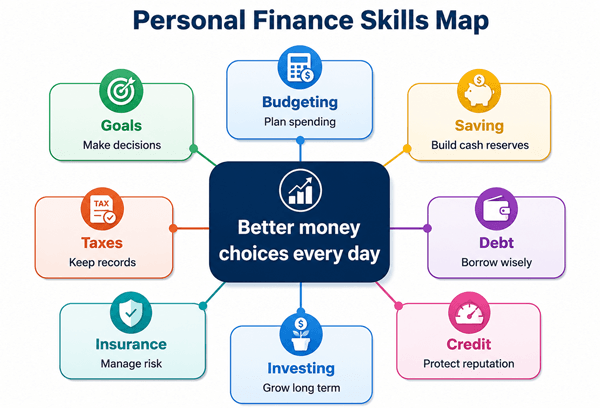
Diagram: Flowchart showing budgeting, saving, debt management, credit, banking, investing, insurance, taxes, consumer skills, and goal setting as connected parts of personal money management.
■ Quick Answer: The Most Important Personal Finance Skills
| Skill | What it helps you do | Beginner action step |
|---|---|---|
| Budgeting | Control spending and avoid running out of money. | Track income and expenses for 30 days. |
| Saving | Prepare for emergencies and goals. | Automate a small transfer after payday. |
| Debt management | Reduce interest costs and stress. | List every debt, interest rate, and minimum payment. |
| Credit management | Qualify for better borrowing terms. | Pay bills on time and keep balances low. |
| Investing | Build long-term wealth. | Learn index funds, diversification, and risk before investing. |
| Insurance and risk planning | Protect against major financial shocks. | Review health, life, auto, property, and disability needs. |
| Tax and record keeping | Avoid penalties and understand your real income. | Keep income, expense, and deduction records organized. |
| Goal setting | Make money decisions with purpose. | Write one short-term, one medium-term, and one long-term goal. |
1. Budgeting: Learning Where Your Money Goes
What budgeting means
Budgeting is the skill of giving your money a job before it disappears. A budget shows how much money comes in, how much goes out, and whether your spending supports your needs, goals, and values.
How budgeting works in real life
Imagine you earn $2,500 per month after tax. Your rent is $900, groceries are $350, utilities are $180, transport is $220, debt payments are $200, subscriptions are $70, and eating out is $300. Without a budget, you may only notice that money feels tight. With a budget, you can see exactly where adjustments are possible.
Practical budgeting methods
The 50/30/20 method is a simple starting point: 50% of income for needs, 30% for wants, and 20% for savings and debt repayment. A zero-based budget assigns every dollar to a category until income minus planned spending equals zero. The envelope method divides money into spending categories and stops spending when the category is empty.
Best practices
Start with your actual spending, not your ideal spending. Use categories that are easy to understand. Review your budget weekly at first. Leave room for irregular expenses such as car repairs, medical bills, school fees, gifts, or annual subscriptions.
Common mistakes
Many beginners make a budget that is too strict, forget irregular expenses, ignore small purchases, or quit after one bad month. A budget is not a test of perfection. It is a feedback tool.
Note: A beginner budget should be realistic enough to survive normal life. A flexible budget that covers essentials, allows small wants, and leaves room for savings is usually more useful than a perfect budget that fails after one unexpected bill.
2. Tracking Expenses: Building Financial Awareness
Why expense tracking matters
You cannot manage what you do not measure. Expense tracking helps you identify leaks, habits, and patterns. It often reveals that the problem is not one large purchase but many small unplanned purchases.
How to track expenses
Use a notebook, spreadsheet, bank app, budgeting app, or digital wallet history. The tool matters less than consistency. Track every purchase for at least 30 days, then group spending into categories such as housing, food, transport, debt, entertainment, subscriptions, giving, savings, and miscellaneous.
Example
If you spend $6 on coffee five days a week, that is about $120 per month. This does not mean coffee is wrong. It means you should choose it knowingly instead of being surprised by it.
Best practice
Review your spending once a week. Ask: Which expenses were necessary? Which ones brought real value? Which ones were automatic, emotional, or forgotten?
Beginner action step: At the end of each week, circle one expense to reduce, one expense to keep because it supports your values, and one recurring charge to review. This keeps expense tracking practical instead of overwhelming.
3. Saving Money: Paying Your Future Self First
What saving means
Saving is setting aside money for future needs before spending it elsewhere. It gives you flexibility, reduces dependence on debt, and helps you handle surprises without panic.
Emergency savings
An emergency fund is money reserved for urgent, necessary, and unexpected expenses. Common examples include medical costs, urgent travel, car repairs, temporary job loss, or home repairs. Beginners can start with a small starter fund, such as $500 or one month of essential expenses, then build toward three to six months of necessary expenses over time.
How to save when income is limited
Start small. Saving $5 or $10 regularly builds the habit. Automate savings soon after payday. Save windfalls, refunds, bonuses, or overtime income before lifestyle spending absorbs them.
Where to keep savings
Emergency savings should usually be kept in a safe, liquid place such as a bank savings account. Money needed soon should not be exposed to high investment risk.
Important clarification: The exact emergency fund target depends on your country, income stability, family support, health needs, and job security. A single person with stable income may need less than a household with dependents or irregular income.
Common mistake
Do not save only what is left at the end of the month. Often, nothing is left. Treat saving as a planned expense.
4. Needs vs Wants: Making Better Spending Choices
The difference
Needs are expenses required for basic living and important obligations: housing, food, utilities, basic transport, essential healthcare, debt minimums, and necessary insurance. Wants improve comfort, enjoyment, or convenience but can be reduced, delayed, or replaced.
The gray area
Some expenses can be both. A phone may be a need, but the most expensive phone is usually a want. Clothing is a need, but designer clothing may be a want. Eating is a need, but frequent restaurant meals may be a want.
Practical decision rule
Before buying, ask: Do I need this now? Is there a cheaper option? Will I still value this next month? What goal am I delaying by buying this?
Misconception
Personal finance is not about removing every want. A realistic money plan includes some enjoyment, but it makes sure wants do not destroy financial stability.
Practical balance: The goal is not to feel guilty about every enjoyable purchase. The goal is to make sure essential bills, emergency savings, debt payments, and long-term goals are protected before wants take over the budget.
5. Debt Management: Using Borrowing Carefully
What debt management means
Debt management is the skill of borrowing only when necessary, understanding the true cost of debt, making payments on time, and creating a plan to reduce expensive balances.
Good debt vs bad debt
Debt is not automatically good or bad. A student loan used carefully for a valuable qualification may increase future earning ability. A mortgage can help buy a home. But high-interest credit card debt, payday loans, and borrowing for routine lifestyle spending can become dangerous quickly.
Debt snowball and debt avalanche
The debt snowball method pays off the smallest balance first for motivation. The debt avalanche method pays off the highest interest rate first to save more money. The best method is the one you can follow consistently.
Example
If one credit card charges 28% interest and another loan charges 8%, the avalanche method usually targets the 28% card first because it is growing faster.
Warning signs
You may have a debt problem if you use new debt to pay old debt, pay only minimums for months, miss bills, hide debt from family, or feel anxious opening statements.
Responsible borrowing reminder: Always compare the annual percentage rate, fees, repayment period, penalties, and total amount repayable before borrowing. A low monthly payment can still be expensive if the loan lasts too long or includes high fees.
6. Credit Management: Protecting Your Financial Reputation
What credit management means
Credit management is the ability to use credit responsibly so lenders, landlords, insurers, and sometimes employers can see that you handle obligations reliably.
Key credit habits
Pay every bill on time. Keep credit card balances low compared with credit limits. Avoid applying for too many new accounts at once. Review credit reports where available. Correct errors quickly.
Why credit matters
Good credit can help you qualify for loans, rental housing, lower interest rates, and better financial options. Poor credit can make borrowing expensive or difficult.
Common misconception
Having no missed payments is important, but it is not the only factor. High balances, too many applications, and a short credit history can also affect creditworthiness.
Country-specific note: Credit scoring systems and credit reports differ by country. Where credit bureaus are available, checking your report for errors can help protect your financial reputation. Where formal credit scores are less common, payment history with banks, lenders, landlords, and service providers may still matter.
7. Banking Skills: Managing Accounts Safely
Basic banking skills
Everyone should know how to read a bank statement, check account balances, use online banking safely, understand fees, set up automatic payments carefully, and reconcile transactions.
Avoiding fees
Common fees include overdraft fees, late payment fees, account maintenance fees, ATM fees, and transfer fees. Many are avoidable with alerts, minimum balance awareness, and choosing suitable accounts.
Safety practices
Use strong passwords, enable two-factor authentication, avoid public Wi-Fi for banking, monitor transactions, and contact your bank quickly if you notice unauthorized activity.
Practical tip
Set alerts for low balances, large withdrawals, card-not-present transactions, and upcoming bill due dates.
Security tip: If you receive a message claiming to be from your bank, avoid clicking links inside the message. Use the bank's official app, website, phone number, or branch to verify urgent requests.
8. Financial Goal Setting: Turning Wishes Into Plans
What financial goals are
A financial goal is a specific money outcome with a deadline and a plan. Goals make budgeting and saving easier because they give your choices a clear reason.
Types of goals
Short-term goals may include building a starter emergency fund or paying a bill due next month. Medium-term goals may include buying a car, funding education, or saving for a wedding. Long-term goals include retirement, buying a home, or financial independence.
SMART goals
A strong goal is specific, measurable, achievable, relevant, and time-bound. Instead of saying, “I want to save money,” say, “I will save $1,200 for emergencies within 12 months by saving $100 per month.”
Best practice
Break large goals into monthly or weekly targets. Progress feels easier when the next step is small and clear.
Example: A strong personal finance goal connects an amount, deadline, and action. For example, “I will save $600 in six months by automatically transferring $100 each month after payday.”
9. Income Skills: Increasing and Protecting What You Earn
Why income skills matter
Cutting expenses has limits. Increasing income can speed up debt repayment, savings, and investing. Income skills include career planning, negotiation, learning marketable skills, side income evaluation, and protecting your ability to work.
Practical ways to improve income
Track your achievements at work, ask for feedback, learn skills that match market demand, update your resume regularly, build professional relationships, and prepare for salary negotiations with evidence.
Side income caution
A side hustle can help, but it should be evaluated like a small business. Consider time, taxes, costs, risk, and whether it distracts from your main career.
Best practice
Do not rely on one income source without an emergency plan. Even a small backup fund and updated resume can reduce financial stress.
Career finance note: Protecting income also means protecting documents, skills, professional relationships, and health. A current resume, updated portfolio, emergency fund, and basic insurance can reduce the financial impact of job loss or reduced working hours.
10. Investing Basics: Growing Wealth Over Time
What investing means
Investing means putting money into assets such as stocks, bonds, funds, property, or retirement accounts with the goal of long-term growth. Unlike savings, investments can rise and fall in value.
Why beginners should learn investing
Saving protects you in the short term, but investing can help money grow over many years. Inflation reduces purchasing power over time, so long-term goals often need growth assets.
Core investing principles
Start with clear goals. Understand risk. Diversify instead of putting all money into one investment. Keep costs low where possible. Avoid investing money you need soon. Think in years, not days.
Example
If you are saving for rent due in three months, that money belongs in a safe account. If you are investing for retirement decades away, short-term market swings may matter less than consistent contributions and diversification.
Common mistakes
Beginners often chase hype, invest without an emergency fund, panic during downturns, ignore fees, or put too much money into one stock, coin, or trend.
Beginner investor warning: Be careful with any investment promoted as guaranteed, risk-free, or urgent. Long-term investing is usually built on suitable time horizons, diversification, cost control, and discipline, not pressure or speculation.
11. Risk Management and Insurance: Protecting Your Progress
What risk management means
Risk management is planning for events that could damage your finances. Insurance is one tool for transferring large risks you cannot comfortably pay for yourself.
Types of insurance to understand
Health insurance helps with medical costs. Auto insurance protects against vehicle-related risks. Homeowners or renters insurance protects property. Life insurance may protect dependents. Disability insurance can protect income if illness or injury prevents work.
How to think about insurance
Insure against events that would seriously damage your finances. Do not buy coverage only because of fear, and do not skip important coverage only to save a small premium.
Best practice
Review deductibles, coverage limits, exclusions, waiting periods, and beneficiary details. Cheapest is not always best if coverage is weak.
Insurance needs change after marriage, children, property purchases, business ownership, relocation, or changes in income. Review coverage after major life events, not only when the policy renews.
12. Tax Awareness and Record Keeping
Why tax awareness matters
Taxes affect your real income, investment returns, business profits, and major financial decisions. You do not need to become a tax expert, but you should understand basic obligations and keep good records.
Records to keep
Keep income statements, receipts for deductible expenses where applicable, investment statements, loan documents, insurance records, tax returns, property documents, and business records if self-employed.
Practical example
A freelancer who earns $2,000 from a project should not treat the full amount as spendable income. Some may need to be set aside for taxes, business costs, and future slow months.
Best practice
Create digital folders by year and category. Save important documents as PDFs. Back them up securely.
Tax accuracy tip: Keep records before you need them. Organized records can make tax filing easier, support deductions where allowed, and help you answer questions from tax authorities, lenders, insurers, or employers.
13. Consumer Skills: Buying Wisely and Avoiding Scams
What consumer skills include
Consumer skills help you compare prices, read contracts, understand warranties, identify manipulative sales tactics, and avoid scams.
Before major purchases
Compare total cost, not only monthly payment. Read the fine print. Understand cancellation terms. Check whether fees, interest, shipping, maintenance, insurance, or subscriptions are included.
Scam warning signs
Be careful with guaranteed high returns, pressure to act immediately, requests for secrecy, upfront fees for prizes, fake customer support, suspicious links, and anyone asking for passwords or verification codes.
Best practice
Pause before spending under pressure. A real opportunity usually allows time to think, verify, and compare.
Scam prevention rule: Verify before you trust. Do not share passwords, PINs, one-time codes, recovery phrases, or remote access to your device with anyone who contacts you unexpectedly.
14. Financial Communication: Talking About Money Clearly
Why communication matters
Money problems often become worse when people avoid conversations. Couples, families, roommates, business partners, and caregivers all benefit from clear financial communication.
What to discuss
Discuss shared bills, debt, savings goals, spending expectations, support for family members, financial responsibilities, and what happens during emergencies.
Practical rule
Use numbers instead of vague words. “We need to reduce eating out by $150 this month” is clearer than “We spend too much.”
Best practice
Schedule calm money check-ins. Avoid starting money discussions during stress, blame, or crisis.
Communication tip: A useful money conversation should end with one clear next step, such as paying one bill, cancelling one subscription, updating one budget category, or setting one savings transfer.
■ Comparison Table: Budgeting Methods for Beginners
Use the comparison tables below as quick decision tools. They are designed for readers who want practical guidance without needing advanced financial knowledge or complex formulas.
| Method | Best for | Pros | Limitations |
|---|---|---|---|
| 50/30/20 budget | Beginners who want a simple structure | Easy to understand; flexible | May not work for very high debt or very low income |
| Zero-based budget | People who want detailed control | Every dollar has a job | Requires more tracking |
| Envelope method | People who overspend in specific categories | Creates clear limits | Can feel restrictive |
| Pay-yourself-first budget | People focused on saving | Savings happen automatically | Needs enough income stability |
■ Comparison Table: Saving, Paying Debt, and Investing
| Financial move | Main purpose | When it is usually useful | Main risk or limitation |
|---|---|---|---|
| Saving | Safety and short-term goals | Emergency fund, upcoming bills, purchases within 1-3 years | Returns may be low. |
| Paying high-interest debt | Reduce interest and stress | Credit cards, payday loans, expensive personal loans | May require lifestyle changes. |
| Investing | Long-term growth | Retirement, wealth building, long-term goals | Value can fall in the short term. |
■ A 30-Day Plan to Build Personal Finance Skills
This 30-day personal finance plan turns the article into action. The goal is not to fix every money problem in one month, but to build awareness, organize your financial life, and create habits you can repeat.
| Time period | Action |
|---|---|
| Days 1-3 | List income, bills, debts, account balances, and due dates. |
| Days 4-7 | Track every expense and identify your top spending categories. |
| Days 8-10 | Create a simple budget based on real numbers. |
| Days 11-14 | Start or strengthen an emergency fund, even with a small amount. |
| Days 15-18 | List debts by balance, interest rate, and minimum payment. |
| Days 19-21 | Review subscriptions, fees, and unnecessary recurring expenses. |
| Days 22-24 | Check insurance coverage and important documents. |
| Days 25-27 | Write three financial goals with amounts and deadlines. |
| Days 28-30 | Set automatic savings, bill reminders, and a weekly money review time. |
■ Common Personal Finance Mistakes to Avoid
- Making a budget based on guesses instead of real spending.
- Saving only after spending instead of saving first.
- Using credit cards to maintain a lifestyle you cannot afford.
- Ignoring small recurring subscriptions.
- Investing before building basic emergency savings.
- Taking financial advice from unverified social media claims.
- Avoiding money conversations until there is a crisis.
- Failing to review insurance, taxes, and important documents.
- Co-signing loans or sharing financial obligations without understanding the legal and repayment responsibility.
- Confusing income with wealth; earning more helps, but net worth grows only when money is saved, invested, or used to reduce debt.
- Ignoring inflation, fees, and taxes when comparing savings accounts, investments, or long-term financial plans.
■ Best Practices That Make Money Management Easier
- Automate savings and bill reminders.
- Keep one simple financial dashboard or spreadsheet.
- Review money weekly, not only when something goes wrong.
- Separate emergency savings from everyday spending money.
- Use debt carefully and understand interest before borrowing.
- Increase financial knowledge gradually; one skill at a time is enough.
- Make decisions based on goals, not pressure or comparison.
- Track net worth periodically by comparing what you own with what you owe.
- Use official sources for tax rules, consumer protection guidance, and financial product disclosures.
- Review your money system after major life changes such as a new job, marriage, relocation, a child, or a large purchase.
■ Frequently Asked Questions
1. What is the most important personal finance skill?
Budgeting is often the best starting skill because it shows where your money goes. However, budgeting works best when combined with saving, debt management, and clear goals.
2. How can I improve my finances if I live paycheck to paycheck?
Start by tracking expenses, protecting essential bills, reducing avoidable fees, building a small emergency fund, and looking for ways to increase income. Progress may be slow at first, but even small changes can reduce stress.
3. Should I save money or pay off debt first?
It depends on the debt and your emergency savings. Many beginners benefit from a small emergency fund first, then focusing on high-interest debt, while still making all minimum payments.
4. How much emergency savings do I need?
A starter emergency fund can be small. Over time, many people aim for three to six months of essential expenses. The right amount depends on job stability, dependents, health needs, and access to support.
5. Do I need a financial advisor?
Not everyone needs an advisor for basic budgeting and saving. An advisor may be useful for complex investing, taxes, retirement planning, business finances, inheritance, or major life changes. Choose a qualified professional who explains fees clearly.
6. Is investing risky for beginners?
Investing always involves risk, but risk can be managed through education, diversification, suitable time horizons, and avoiding speculation. Beginners should avoid investing money needed for short-term expenses.
7. How often should I review my personal finances?
A weekly review works well for beginners. A monthly review is useful for budgets, goals, debt progress, and net worth. Insurance, taxes, and long-term plans can be reviewed annually or after major life changes.
8. What personal finance skill should I learn first?
Start with tracking spending for 30 days. It gives you the information needed for budgeting, saving, debt repayment, and better financial decisions.
9. What are the five basics of personal finance?
The five basics are earning, spending, saving, borrowing, and investing. A complete money plan also includes insurance, taxes, record keeping, and fraud prevention.10. What is the easiest way to start managing money?
Start by writing down your income, required bills, debts, and spending for one month. This simple step gives you the information needed to build a realistic budget.11. Why do personal finance skills matter for beginners?
They help beginners make informed decisions before money problems become serious. Good money habits can reduce stress, improve stability, and create more options over time.■ Conclusion: Personal Finance Is a Skill, Not a Personality Trait
Personal finance skills are not only for accountants, investors, or wealthy people. They are everyday life skills that help you make better choices with income, expenses, savings, debt, and risk.
The best place to start is simple: track your money, build a realistic budget, save something regularly, understand your debts, and set clear goals. As your confidence grows, add credit management, investing, insurance, taxes, and long-term planning.
Small, consistent actions matter more than perfect plans. When you learn these essential personal finance skills, you give yourself more control, more options, and a stronger foundation for the future.
For beginners, the strongest financial system is usually simple: know your numbers, spend with intention, save before spending, borrow carefully, protect against major risks, and learn before investing. These habits compound over time just like money can.
Reader Advice: This article is for educational and informational purposes only and should not be taken as financial, investment, tax, legal, or professional advice. Personal financial decisions depend on your income, location, debts, taxes, family responsibilities, risk tolerance, and goals. Rules, products, and policies can change over time, so please verify the latest information from official sources and consider speaking with a qualified professional for advice specific to your situation.