Personal Finance Tips for Beginners: Budgeting, Saving, Debt & Investing Guide
Personal finance can feel confusing when you are just starting out. You may hear words like budgeting, credit score, emergency fund, debt repayment, investing, retirement planning, and net worth, but it is not always clear what to do first. The good news is that personal finance is not about being perfect with money. It is about making better decisions step by step, with a simple plan you can actually follow.
This guide explains the most important personal finance tips for beginners in simple language. You will learn how money management works, how to create a beginner budget, how to save even with a small income, how to handle debt, how credit works, and how to start building long-term financial security without feeling overwhelmed.
The goal is not to make you feel guilty about past mistakes. The goal is to help you understand your money, take control of daily decisions, avoid common beginner mistakes, and build habits that make your future easier.
1. What Personal Finance Means
Personal finance means how you manage your own money. It includes how you earn, spend, save, borrow, invest, protect, and plan your money. In simple terms, personal finance is the system you use to make your money support your life instead of controlling your life.
For beginners, personal finance usually starts with five basic areas:
- Income: money you receive from salary, business, freelancing, side work, gifts, or other sources.
- Spending: money you use for bills, food, transport, shopping, entertainment, subscriptions, and lifestyle.
- Saving: money you keep for emergencies, short-term goals, and future needs.
- Debt and credit: borrowed money, credit cards, loans, repayment plans, and credit history.
- Investing and wealth building: using money to buy assets that may grow over time, such as retirement accounts, index funds, property, or a business.
2. Why Personal Finance Matters for Beginners
Good personal finance habits can reduce stress, improve decision-making, and help you prepare for expected and unexpected expenses. You do not need to be rich to manage money well. In fact, personal finance is most useful when money feels limited because it helps you decide what matters most and avoid decisions that create long-term pressure.
| Benefit | What It Means in Real Life |
|---|---|
| Less money stress | You know which bills are due and how much you can safely spend. |
| Better financial control | You make intentional spending decisions instead of wondering where your money went. |
| Fewer financial emergencies | Savings help you handle car repairs, medical bills, job loss, and other unexpected expenses. |
| Lower debt pressure | A financial plan helps you pay off high-interest debt faster and avoid unnecessary borrowing. |
| More future opportunities | You can confidently save and invest for goals such as education, travel, homeownership, retirement, or financial independence. |
■ The First 7 Money Moves for Beginners
If you do not know where to begin, start with these seven steps. You can complete the first three in one afternoon and build the rest over time.
- Write down your monthly income after tax and deductions.
- List your fixed bills, such as rent, utilities, insurance, loan payments, and phone bills.
- Review the last 30 days of spending to see where your money went.
- Create a simple monthly budget before the next month begins.
- Save a small starter emergency fund, even if it is only a little at a time.
- Pay at least the minimum on every debt and focus extra money on high-interest debt first.
- Avoid lifestyle upgrades until your savings and debt situation are stable.
Diagram: A simple beginner roadmap for managing personal finances.
Tip 1: Understand Your Current Money Situation
Before you can improve your finances, you need a clear picture of where you are. Many beginners skip this step because they feel embarrassed, afraid, or overwhelmed. But numbers are not there to judge you. They are there to guide you and show which small changes can make the biggest difference.
Calculate your monthly income
Use your take-home pay, not your gross salary. Take-home pay is the money that actually reaches your bank account after taxes, deductions, and required contributions.
List your monthly expenses
Divide your expenses into fixed, variable, and irregular expenses.
| Expense Type | Examples | Beginner Action |
|---|---|---|
| Fixed expenses | Rent, loan payments, insurance, internet | Review each expense regularly to see whether it is still necessary or can be reduced. |
| Variable expenses | Groceries, fuel, electricity, dining out | Set realistic monthly spending limits and track your expenses throughout the month. |
| Irregular expenses | Car repairs, gifts, annual fees, medical costs | Build sinking funds by saving a small amount each month for predictable non-monthly expenses. |
Know your net worth
Net worth is what you own minus what you owe. It is a simple financial snapshot, not a measure of your value as a person.
| Assets: What You Own | Liabilities: What You Owe |
|---|---|
| Cash in bank | Credit card balance |
| Savings | Personal loan |
| Investments | Student loan |
| Vehicle or property value | Car loan or mortgage |
Example: If you have $2,000 in savings, $1,000 in investments, and $4,000 in debt, your net worth is $3,000 minus $4,000, which equals -$1,000. That is not a failure. It is your starting point. |
Tip 2: Create a Beginner Budget
A budget is a plan for your money before you spend it. It does not mean you cannot enjoy life. A good budget gives you permission to spend on what matters after your important needs are covered.
Use a simple budget method
Beginners often fail because they choose a budgeting system that is too complicated. Start with a simple method and improve it later.
| Budget method | How it works | Best for | Limitation |
|---|---|---|---|
| 50/30/20 budget | 50% needs, 30% wants, 20% savings and debt repayment | Beginners who want a simple structure | May not work if housing or debt is very high. |
| Zero-based budget | Every dollar is assigned a job before the month begins | People who want strong control | Requires more tracking and planning. |
| Envelope method | Money is divided into spending categories or separate accounts | People who overspend in certain categories | Can feel restrictive if not updated regularly. |
| Pay-yourself-first budget | Savings are moved first, then remaining money is spent | People who struggle to save consistently | Needs enough cash flow to avoid overdrafts. |
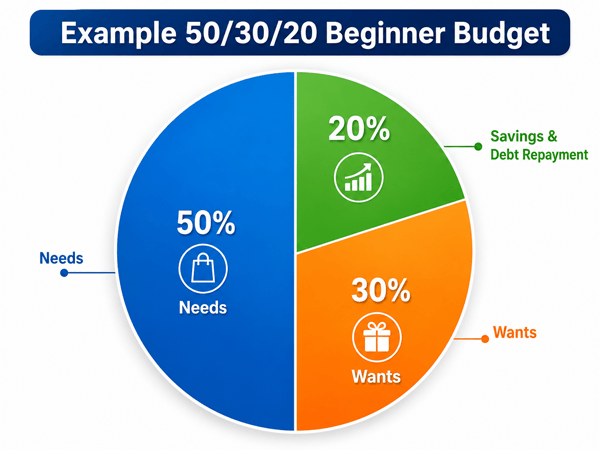
Chart: Example allocation using the 50/30/20 budgeting rule.
Beginner budget example
Suppose your monthly take-home income is $2,000. A simple budget may look like this:
| Category | Monthly amount | Notes |
|---|---|---|
| Needs | $1,000 | Rent, utilities, groceries, transport, minimum debt payments. |
| Wants | $600 | Eating out, entertainment, shopping, subscriptions. |
| Savings and extra debt repayment | $400 | Emergency fund, extra loan payments, investing when ready. |
This is only a starting point. If your rent is high, you may need a 70/20/10 budget temporarily. If your income is irregular, base the budget on your lowest normal month and treat extra income as savings, debt repayment, or goal money. The best budget is the one that is realistic enough to follow and strong enough to move you forward.
Tip 3: Track Spending Without Overcomplicating It
Tracking spending means recording where your money goes. You do not need to track forever in extreme detail, but tracking for at least 30 to 90 days can reveal habits that are hard to notice otherwise. For beginners, awareness often improves spending even before major cuts are made.
Simple ways to track spending
- Use a notes app and write each purchase immediately.
- Download bank and card statements once a week and categorize spending.
- Use a spreadsheet with columns for date, category, amount, and notes.
- Use separate bank accounts for bills, spending, and savings.
- Use budgeting apps if they are available and safe in your country.
What to look for
Look for spending leaks, not just big purchases. A spending leak is a small repeated cost that quietly weakens your budget. Examples include unused subscriptions, frequent delivery fees, impulse snacks, ATM fees, interest charges, and small online purchases.
Tip 4: Build an Emergency Fund
An emergency fund is money set aside for unexpected necessary expenses. It is one of the most important personal finance tips for beginners because it protects you from turning every surprise into debt.
How much should a beginner save?
Start with a small starter emergency fund. Even $100, $250, or $500 can help. After that, aim for one month of essential expenses, then three to six months over time. The exact amount depends on your job stability, family responsibilities, health needs, debt level, and how quickly you could replace income if it stopped.
| Stage | Target | Purpose |
|---|---|---|
| Starter fund | $100 to $500 | Covers small surprises without using a credit card. |
| Basic safety fund | 1 month of essential expenses | Helps if income is delayed or a major bill appears. |
| Strong emergency fund | 3 to 6 months of essential expenses | Protects against job loss, illness, or larger disruptions. |
Where to keep emergency savings
Keep emergency money somewhere safe, easy to access, and separate from daily spending. Avoid putting emergency savings into risky investments because you may need the money when markets are down. Also check local bank protection rules and account fees in your country so emergency savings stay secure and accessible.
Tip 5: Spend Less Than You Earn
Spending less than you earn is the foundation of personal finance. It sounds simple, but it can be hard because expenses rise easily, advertising encourages constant buying, and lifestyle pressure can make ordinary spending feel like a need.
Practical ways to create breathing room
- Review your largest expenses first: housing, transportation, food, insurance, and debt payments.
- Cancel or pause subscriptions you do not use weekly.
- Plan meals before grocery shopping to reduce waste and impulse purchases.
- Use a 24-hour rule before non-essential purchases.
- Compare prices for recurring bills once or twice a year.
- Automate savings on payday so money is moved before you spend it.
Tip 6: Pay Down High-Interest Debt
Debt is not always bad, but high-interest debt can become expensive very quickly. Credit card debt, payday loans, and personal loans with high rates can keep beginners stuck because a large part of each payment goes to interest instead of reducing the balance. Always compare the total repayment cost, not only the monthly payment.
Two popular debt payoff methods
Method |
How it works |
Best for |
Possible downside |
Debt snowball |
Pay the smallest balance first while making minimum payments on others. |
People who need motivation and quick wins. |
May cost more interest if larger debts have higher rates. |
Debt avalanche |
Pay the highest-interest debt first while making minimum payments on others. |
People who want to reduce total interest cost. |
Progress may feel slower if the highest-rate debt has a large balance. |
Beginner debt payoff example
Imagine you have three debts: a $300 store card, a $1,500 credit card, and a $5,000 personal loan. With the snowball method, you attack the $300 store card first for motivation. With the avalanche method, you attack whichever debt has the highest interest rate first. Both methods can work. The best method is the one you will follow consistently.
Tip 7: Use Credit Carefully
Credit allows you to borrow money or access services based on trust that you will repay. Good credit habits can help with loans, rentals, insurance, and sometimes employment checks, depending on the country and situation. Poor credit habits can make borrowing more expensive and stressful, so beginners should treat credit as a tool, not extra income.
Beginner credit rules
- Pay every bill on time. Payment history is one of the most important credit habits.
- Keep credit card balances low compared with your limits.
- Avoid applying for many credit products in a short time.
- Read fees, interest rates, and repayment terms before borrowing.
- Do not use credit to support a lifestyle your income cannot afford.
- Check your credit report when available, correct errors, and use official credit bureau or regulator sources for your country.
Tip 8: Save for Short-Term and Long-Term Goals
Saving becomes easier when every saved dollar has a purpose. Instead of saying “I need to save more,” name the goal, amount, and deadline.
| Goal type | Examples | Where the money usually belongs |
|---|---|---|
| Short-term goals | Holiday, phone, school fees, car repair, moving costs | Savings account or cash-like account. |
| Medium-term goals | Home deposit, business start-up money, education fund | Savings, deposits, or low-risk options depending on timeline. |
| Long-term goals | Retirement, wealth building, financial independence | Investments suited to risk tolerance and time horizon. |
Use sinking funds
A sinking fund is money saved gradually for a known future cost. For example, if car insurance costs $600 once a year, save $50 per month. When the bill arrives, it is no longer a crisis because the money has already been planned.
Tip 9: Start Investing When the Foundation Is Ready
Investing means putting money into assets that may grow over time. Beginners should not rush into investing before building basic financial stability. A good order is: cover essential bills, save a starter emergency fund, manage high-interest debt, then begin investing small amounts consistently. Before investing, understand fees, taxes, risk, and whether the provider is properly regulated in your country.
Beginner investing principles
- Invest for long-term goals, not next month’s bills.
- Understand the risk before investing money.
- Diversification can reduce the impact of one bad investment.
- Low-cost broad investments are often easier for beginners than picking individual stocks.
- Do not invest emergency savings in risky assets.
- Avoid get-rich-quick schemes, guaranteed profit claims, and pressure-based investment offers.
Investing versus saving
| Saving | Investing |
|---|---|
| Best for short-term needs and emergencies. | Best for long-term growth goals. |
| Lower risk and easier access. | Higher risk but higher growth potential over long periods. |
| Money is usually kept in cash or bank accounts. | Money may be in funds, stocks, bonds, retirement accounts, property, or business assets. |
Tip 10: Protect Yourself Financially
Personal finance is not only about growing money. It is also about protecting what you already have. A single unexpected event, scam, data breach, or uninsured loss can damage years of progress if you are not prepared.
Basic financial protection steps
- Keep important documents organized, such as IDs, tax records, insurance papers, loan documents, and contracts.
- Use strong passwords and two-factor authentication for financial accounts.
- Be careful with scams, fake investment offers, phishing messages, and pressure to send money quickly.
- Use insurance where appropriate, such as health, vehicle, home, disability, or life insurance depending on your situation.
- Discuss money expectations clearly with family members, partners, or anyone sharing expenses.
■ Common Money Mistakes Beginners Should Avoid
| Mistake | Why it hurts | Better habit |
|---|---|---|
| Budgeting only in your head | It is easy to forget small expenses and upcoming bills. | Write the budget down or use a simple tracker. |
| Saving whatever is left | Usually nothing is left at the end of the month. | Save first, then spend what remains. |
| Ignoring small debts | Fees and interest can grow quietly. | List every debt and make a payoff plan. |
| Using credit for wants | Lifestyle debt becomes expensive. | Use credit only when repayment is clear and affordable. |
| Comparing your life to others | Comparison causes pressure and overspending. | Measure progress against your own starting point. |
| Investing before learning basics | Beginners may buy risky products they do not understand. | Learn risk, fees, time horizon, and diversification first. |
| No emergency fund | Unexpected costs lead to more debt. | Build a starter fund before chasing every other goal. |
■ Beginner Personal Finance Checklist
Use this checklist as a practical starting point. You do not need to complete everything in one week. Focus on steady progress.
- Calculate monthly take-home income.
- List all fixed, variable, and irregular expenses.
- Make a written monthly budget.
- Track spending for at least 30 days.
- Save a starter emergency fund.
- Pay all bills on time.
- List every debt with balance, minimum payment, and interest rate.
- Choose a debt payoff method.
- Set one short-term and one long-term savings goal.
- Review bank fees, subscriptions, and recurring charges.
- Learn basic investing before risking money.
- Review progress once a month.
■ A Simple Monthly Money Routine
A routine makes personal finance easier because you repeat the same small actions instead of making decisions from zero every time. Put these checks on your calendar so they become a habit rather than another task to remember.
| When | What to do | Time needed |
|---|---|---|
| Payday | Move money to savings, pay priority bills, update budget. | 15 to 30 minutes |
| Weekly | Check spending, upcoming bills, and account balances. | 10 to 15 minutes |
| Monthly | Review budget, debt progress, savings, and goals. | 30 to 60 minutes |
| Yearly | Review insurance, taxes, subscriptions, career income, and long-term goals. | Half day or less |
■ Frequently Asked Questions
1. What is the best personal finance tip for beginners?
The best tip is to spend less than you earn and give every dollar a purpose. This usually starts with a simple written budget, tracking expenses, and saving a small emergency fund.
2. How much money should a beginner save each month?
Save any amount you can do consistently. A common goal is 10% to 20% of income, but beginners can start with a smaller amount. Saving $10 or $25 regularly is better than waiting until you can save a large amount. Increase the amount gradually when income rises or debt payments decrease.
3. Should I pay debt or save first?
Do both at a basic level. Save a small starter emergency fund first, keep making minimum debt payments, then focus extra money on high-interest debt. After expensive debt is controlled, build a larger emergency fund and invest for long-term goals.
4. Is budgeting only for people with low income?
No. Budgeting is useful at every income level because it helps people control spending, avoid waste, plan goals, and make better decisions. Higher income does not automatically create financial security.
5. What is the easiest budget for beginners?
The 50/30/20 budget is often the easiest starting point because it divides income into needs, wants, and savings or debt repayment. If your expenses do not fit those percentages, adjust them to your reality and improve gradually.
6. When should beginners start investing?
Beginners can start investing after they understand the basics, have a small emergency fund, can pay essential bills, and have a plan for high-interest debt. Investing works best for long-term goals, not short-term emergencies.
7. How can I stop impulse spending?
Use a waiting period before non-essential purchases, unsubscribe from marketing emails, keep a shopping list, set a weekly fun-money limit, and remove saved card details from shopping apps if they encourage quick buying.
8. How often should I review my finances?
A quick weekly check and a deeper monthly review are enough for most beginners. The weekly check catches overspending early, while the monthly review helps adjust goals and budget categories.
9. Conclusion: Start Small, Stay Consistent
Personal finance for beginners is not about mastering everything at once. It is about building a simple system that helps you earn, spend, save, borrow, protect, and invest more wisely. Start by understanding your income and expenses. Create a realistic budget. Save a small emergency fund. Pay bills on time. Reduce high-interest debt. Learn before investing. Review your progress regularly.
Small habits repeated consistently can create major financial improvement over time. You do not need a perfect plan to begin. You need a clear first step, reliable information, and the willingness to keep going.
Reader Advice: This article is for educational and informational purposes only and should not be taken as personal financial, legal, tax, or investment advice. Please check the latest information from official sources and qualified professionals, as rules, policies, rates, and personal circumstances can change over time.