How to Manage Your Personal Finances Effectively
Quick Answer: What Does Managing Personal Finances Mean?
Managing your personal finances means making clear decisions about how you earn, spend, save, borrow, protect, and invest your money. It is not only about cutting expenses. It is about building a simple system that helps you pay your bills on time, prepare for emergencies, avoid harmful debt, grow your savings, and use money in a way that supports your life goals.
For a beginner, the best approach is to start with five basics: know your income and expenses, create a realistic budget, build an emergency fund, manage debt carefully, and save or invest consistently for future goals.
In simple terms, effective money management means creating a repeatable routine: plan before spending, save before emergencies happen, reduce costly debt, and review your progress regularly.
1. Why Personal Finance Management Matters
Money affects daily choices, stress levels, family decisions, career freedom, and future security. Even people with good incomes can struggle financially if they do not track spending, plan for irregular expenses, or control debt. On the other hand, people with modest incomes can improve their situation by using clear habits and consistent planning.
- It helps you understand where your money is going instead of guessing.
- It reduces the chance of relying on credit cards or high-cost loans during emergencies.
- It gives every rupee, dollar, pound, or other currency a purpose before it disappears into unplanned spending.
- It supports bigger goals such as buying a home, starting a business, funding education, retiring comfortably, or becoming debt-free.
- It can reduce financial stress because you have a plan instead of reacting to every bill.
■ The Personal Finance System: How It Works
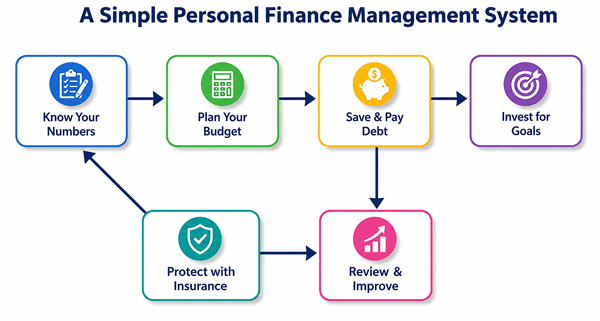
Figure: A simple personal finance system starts with knowing your numbers and keeps improving through regular reviews.
Think of personal finance as a system, not a one-time task. You collect information, make a plan, act on the plan, and review the results. If something changes, such as income, prices, family needs, or interest rates, you adjust the plan rather than abandoning it.Step 1: Know Your Current Financial Situation
You cannot manage what you cannot see. The first step is to create a simple snapshot of your money. This does not have to be perfect. It only has to be honest.
Calculate your monthly income
Write down your reliable take-home income after taxes and deductions. If your income changes each month, use a conservative average or the lowest typical monthly income. Avoid building a budget around overtime, bonuses, or uncertain side income unless it is dependable.
List your monthly expenses
Separate your expenses into fixed, variable, occasional, and debt payments. This helps you see which costs are essential, which can be adjusted, and which need planning before they surprise you.
Expense Type |
Examples |
How to Manage It |
Fixed expenses |
Rent, mortgage, insurance, school fees, subscriptions |
Review once or twice a year; negotiate or cancel what no longer adds value. |
Variable expenses |
Groceries, transport, utilities, fuel, mobile data |
Track weekly; set realistic spending limits. |
Occasional expenses |
Car maintenance, annual fees, holidays, gifts, medical visits |
Create sinking funds by saving a small amount monthly. |
Debt payments |
Credit cards, personal loans, student loans, buy-now-pay-later |
Pay at least the minimum on every debt and target high-interest balances first. |
Calculate your net worth
Net worth is what you own minus what you owe. It is a simple scorecard, not a judgment of your value as a person. Track it every month or quarter to see whether your financial position is improving.
Assets |
Minus Liabilities |
Equals Net Worth |
Cash, savings, investments, property, retirement accounts, valuable items |
Credit cards, loans, mortgage, unpaid bills |
Your financial position today |
Step 2: Set Clear Financial Goals
A budget without goals can feel like restriction. Goals turn budgeting into a tool for progress. Good financial goals are specific, realistic, and connected to a deadline.
Goal Type |
Examples |
Suggested Planning Method |
Short-term goals |
Build a starter emergency fund, pay a small bill, save for school supplies |
Set a monthly savings target and automate it. |
Medium-term goals |
Buy a car, move home, pay off credit card debt, start a business fund |
Break the goal into monthly milestones. |
Long-term goals |
Retirement, children’s education, financial independence, home ownership |
Invest consistently and review annually. |
Example: Instead of saying, “I want to save more money,” say, “I will save 60,000 in 12 months by setting aside 5,000 every month.” This makes the goal measurable and easier to track.
Step 3: Create a Budget That You Can Actually Follow
A budget is a plan for your money before you spend it. It should not be so strict that you quit after two weeks. The best budget is the one you can follow consistently.
Popular budgeting methods compared
Budgeting Method |
How It Works |
Best For |
Possible Limitation |
50/30/20 budget |
Use about 50% for needs, 30% for wants, and 20% for savings and debt repayment. |
Beginners who want a simple structure. |
May not fit low-income households or high-cost cities. |
Zero-based budget |
Assign every unit of income to a category until income minus planned spending equals zero. |
People who want detailed control. |
Requires more tracking and discipline. |
Envelope method |
Set spending limits by category using cash envelopes or digital categories. |
People who overspend in a few categories. |
Can feel restrictive if categories are unrealistic. |
Pay-yourself-first budget |
Save or invest first, then spend what remains. |
People who struggle to save after spending. |
Needs enough cash flow to cover bills safely. |
A beginner-friendly monthly budget example
Category |
Example Monthly Amount |
Notes |
Take-home income |
100,000 |
Use your after-tax income. |
Needs |
55,000 |
Housing, food, utilities, transport, basic healthcare. |
Debt payments |
10,000 |
Minimums plus extra on target debt. |
Emergency savings |
10,000 |
Automate this near payday. |
Future goals/investing |
10,000 |
Retirement, education, home deposit, long-term wealth. |
Wants and lifestyle |
15,000 |
Eating out, entertainment, hobbies, non-essential shopping. |
The exact percentages are less important than the habit of planning. If your needs are currently 70% of income, do not feel that you have failed. Start where you are, reduce waste, increase income where possible, and improve gradually. Tthe best personal budget is based on your real take-home income, local prices, family responsibilities, and financial goals.
Step 4: Track Spending Without Making It Complicated
Tracking shows the difference between what you think you spend and what you actually spend. Many people discover that small purchases, convenience fees, delivery charges, subscriptions, and impulse shopping create the biggest leaks.
- Track every expense for 30 days using a notebook, spreadsheet, banking app, or budgeting app.
- Group expenses into simple categories such as food, transport, bills, debt, savings, and lifestyle.
- Review your spending once a week, not only at month-end.
- Look for patterns: emotional spending, weekend overspending, subscription waste, or frequent small purchases.
- Choose one or two categories to improve first instead of trying to fix everything at once.
Step 5: Build an Emergency Fund
An emergency fund is cash set aside for unplanned expenses or financial emergencies such as car repairs, medical costs, urgent home repairs, or loss of income. Consumer finance agencies describe it as money reserved specifically for unexpected expenses, not routine monthly spending.
How much should you save?
A practical beginner approach is to build your emergency fund in stages:
Stage |
Target |
Purpose |
Starter fund |
One small emergency amount, such as 500 to 1,000 in your currency or one week of expenses |
Helps avoid borrowing for small shocks. |
Basic fund |
One month of essential expenses |
Gives breathing room if income or expenses change. |
Full fund |
Three to six months of essential expenses |
Useful for job loss, illness, business slowdowns, or family emergencies. |
Keep emergency money safe, liquid, and separate from daily spending. A savings account or money market-style account can work better than cash mixed with your normal account. Avoid investing your emergency fund in risky assets because you may need it when markets are down.
The sample emergency fund amounts are starting points, not fixed rules. Adjust them to your currency, job stability, family size, healthcare access, and the normal cost of urgent repairs or medical care in your country.
Step 6: Manage Debt Strategically
Debt is not always bad, but unmanaged debt can damage your financial life. The goal is to use debt carefully, pay expensive debt quickly, and avoid borrowing for lifestyle spending that does not improve your future.
Good debt vs. risky debt
Type of Debt |
Potential Use |
Main Risk |
Education loan |
May increase earning potential if the program is worthwhile. |
Borrowing too much for a low-return qualification. |
Mortgage |
Can help buy a home over time. |
Large long-term commitment; payments must fit income. |
Business loan |
Can support income growth. |
Business failure or unstable cash flow. |
Credit card debt |
Convenient payment tool if paid in full. |
High interest when balances carry over. |
Payday or very high-cost loans |
Short-term cash access. |
Can trap borrowers in repeated fees and interest. |
Debt repayment methods
Method |
How It Works |
Best For |
Debt avalanche |
Pay minimums on all debts, then put extra money toward the highest-interest debt first. |
Saving the most interest mathematically. |
Debt snowball |
Pay minimums on all debts, then put extra money toward the smallest balance first. |
Building motivation through quick wins. |
Practical rule: never miss minimum payments, then choose one target debt for extra payments. If a debt has very high interest, prioritize it before investing aggressively. Strategic debt management supports other goals such as saving and investing because less money is lost to interest over time.
Step 7: Save for Irregular Expenses With Sinking Funds
Many “surprise” expenses are not truly surprising. Car registration, school fees, annual insurance, holidays, weddings, repairs, and festival spending often happen every year. A sinking fund spreads these costs across months.
Example: If annual car insurance is 60,000, save 5,000 each month. When the bill arrives, it is already funded. This protects your emergency fund and reduces credit card use.
Step 8: Start Investing After Your Foundation Is Stable
Saving protects your present. Investing helps build your future. Investing involves risk, but avoiding investing completely can also be risky because inflation may reduce the buying power of cash over time. Before investing, make sure your emergency fund is in progress, high-interest debt is under control, and you understand what you are buying.
Beginner investing principles
- Invest for specific goals and time horizons, not because something is trending.
- Understand risk: money needed within the next year or two usually should not be in volatile investments.
- Diversify instead of putting all your money into one stock, coin, property, or business idea.
- Keep costs and fees low because they reduce long-term returns.
- Use compound growth by investing regularly and staying consistent over many years.
- Avoid any investment promising guaranteed high returns with little or no risk.
Compound growth means you may earn returns on both your original money and previous returns. This is powerful over long periods, but it requires patience, realistic expectations, and discipline.
Before buying any investment product, read the official documents, understand fees and risks, and check whether the provider is licensed or regulated in your country. This is especially important for personal finance content because rules, taxes, and investment protections differ by location.
Step 9: Protect Your Finances With Insurance and Risk Planning
Financial management is not only about growth. It is also about protection. One accident, illness, theft, disability, lawsuit, or death in the family can damage years of progress if there is no protection plan.
A simple protection review can include beneficiary details, emergency contacts, account access instructions, policy renewal dates, and copies of important financial documents stored securely.
Protection Area |
Why It Matters |
Beginner Action |
Health coverage |
Medical costs can be financially disruptive. |
Understand what is covered, excluded, and how claims work. |
Life insurance |
Protects dependents if income stops due to death. |
Consider term life insurance if others rely on your income. |
Disability or income protection |
Income loss can be more damaging than many expenses. |
Check employer benefits or private options. |
Property and vehicle coverage |
Protects major assets and legal liability. |
Review deductibles, coverage limits, and exclusions. |
Fraud protection |
Scams can cause direct losses. |
Use strong passwords, two-factor authentication, and verify financial offers. |
Step 10: Review Your Finances Regularly
A financial plan becomes useful when you review it. Your income, family needs, prices, goals, and risks will change. Reviewing helps you correct small problems before they become expensive.
Review Frequency |
What to Check |
Weekly |
Spending categories, upcoming bills, cash balance. |
Monthly |
Budget results, savings progress, debt balances, subscriptions. |
Quarterly |
Net worth, goal progress, insurance gaps, irregular expenses. |
Yearly |
Income growth, tax planning, retirement contributions, investment allocation, major life goals. |
■ Common Personal Finance Mistakes to Avoid
- Budgeting based on gross income instead of take-home income.
- Ignoring small daily expenses because each one seems harmless.
- Saving only whatever is left at the end of the month instead of paying yourself first.
- Using credit cards as extra income.
- Investing before building basic savings or understanding the risks.
- Keeping all savings in one account and accidentally spending money meant for bills or goals.
- Comparing your financial life with others on social media.
- Avoiding money conversations with a spouse, partner, or family member who shares expenses.
- Not reading loan terms, fees, insurance exclusions, or investment documents.
- Giving up after one bad month instead of adjusting the plan.
■ Real-World Scenarios: What Effective Money Management Looks Like
Scenario 1: A beginner with irregular income
A freelancer earns different amounts each month. Instead of spending based on the best month, they budget using a conservative baseline income. In good months, extra money goes first to taxes, emergency savings, and slower months. This reduces stress when income drops.
Scenario 2: A family living paycheck to paycheck
The family tracks spending for 30 days and discovers frequent food delivery, unused subscriptions, and unplanned school-related expenses. They create weekly grocery limits, cancel unused subscriptions, and start a school expense sinking fund. The first goal is not investing; it is building a one-month buffer.
Scenario 3: A young professional with credit card debt
The professional pays minimums on all accounts and attacks the highest-interest credit card using the debt avalanche method. They temporarily reduce lifestyle spending and stop using the card for new purchases. Once the balance is cleared, the same monthly payment is redirected to emergency savings and retirement investing.
■ Personal Finance Checklist for Beginners
- Write down your take-home income.
- List all fixed, variable, occasional, and debt expenses.
- Calculate your net worth.
- Choose three financial goals: one short-term, one medium-term, and one long-term.
- Choose a budgeting method and follow it for one full month.
- Track spending weekly.
- Build a starter emergency fund.
- Create a debt repayment plan.
- Open separate savings buckets for irregular expenses.
- Start learning about investing before putting money at risk.
- Review insurance and basic financial protection.
- Repeat a monthly review and improve one habit at a time.
■ Frequently Asked Questions
1. What is the first step in managing personal finances?
The first step is to understand your current situation. Write down your income, expenses, debts, savings, and net worth. Once you know your numbers, you can make realistic decisions instead of guessing.
2. How much of my income should I save?
A common beginner target is 10% to 20% of take-home income, but the right amount depends on your income, expenses, debts, and goals. If you cannot save that much yet, start with a small automatic amount and increase it gradually.
3. Is budgeting only for people with low income?
No. Budgeting is useful at every income level. Higher income does not automatically create financial security if spending, debt, and lifestyle inflation grow just as fast.
4. Should I pay off debt or save first?
Do both at a basic level: keep making minimum debt payments and build a small emergency fund. After that, prioritize high-interest debt while continuing small savings. Once expensive debt is controlled, increase emergency savings and investing.
5. How often should I review my budget?
Review spending weekly and do a fuller budget review monthly. Weekly reviews catch problems early, while monthly reviews help you adjust goals and categories.
6. What is the best budgeting method?
There is no single best method for everyone. The 50/30/20 budget is simple, zero-based budgeting gives detailed control, the envelope method helps control overspending, and pay-yourself-first works well for people who struggle to save.
7. When should I start investing?
Start investing after you understand the basics, have at least a starter emergency fund, and have a plan for high-interest debt. Invest only in products you understand and match investments to your time horizon and risk tolerance.
8. How can I stop overspending?
Track spending, identify your biggest triggers, use category limits, separate savings from spending money, delay non-essential purchases for 24 to 72 hours, and remove easy temptations such as saved card details on shopping apps.
10. What is the safest way to manage money as a beginner?
The safest beginner approach is to keep the system simple: track income and expenses, pay bills on time, keep emergency savings separate, avoid high-cost debt, and invest only after learning the risks.9. What are the most important personal finance habits?
The most important habits are spending less than you earn, saving automatically, avoiding unnecessary debt, reviewing your budget, protecting against major risks, and making decisions based on written goals instead of pressure or trends.■ Final Thoughts: Keep It Simple and Consistent
Managing your personal finances effectively does not require perfection, a high income, or complex financial knowledge. It requires awareness, planning, consistency, and regular improvement. Start by knowing your numbers, then create a practical budget, build emergency savings, reduce harmful debt, protect yourself from major risks, and invest steadily for long-term goals.
The most important habit is not choosing the perfect spreadsheet or app. It is reviewing your money regularly and making small decisions that move you in the right direction month after month.
Sources and Further Reading
- FINRA - Personal Finance: guidance on goals, cash flow, spending, debt, saving, and investing. https://www.finra.org/investors/personal-finance
- FINRA - Financial Foundations: debt management and emergency fund planning. https://www.finra.org/investors/investing/investing-basics/financial-foundations
- Consumer Financial Protection Bureau - Emergency fund guidance. https://www.consumerfinance.gov/an-essential-guide-to-building-an-emergency-fund/
- Investor.gov - Compound Interest Calculator and investing education. https://www.investor.gov/financial-tools-calculators/calculators/compound-interest-calculator
- Investor.gov - Introduction to Investing. https://www.investor.gov/introduction-investing
- Financial Consumer Agency of Canada - Setting up an emergency fund. https://www.canada.ca/en/financial-consumer-agency/services/savings-investments/setting-up-emergency-funds.html
Reader Advice: This article is for educational and informational purposes only and should not be taken as personal financial, investment, tax, legal, or insurance advice. Please check the latest information from official sources or a qualified professional, as rules, policies, costs, and financial products can change over time.