Best Ways to Save Money Fast Without Feeling Deprived
1. Introduction: Saving Money Fast Does Not Have to Feel Like Punishment
Many people think saving money means giving up everything enjoyable: no coffee, no eating out, no entertainment, and no small treats. That approach may work for a few days, but it usually fails because it feels restrictive. A better approach is to save money fast by cutting waste, improving habits, using smarter systems, and choosing what matters most.
The best ways to save money fast without feeling deprived focus on small changes that reduce financial leaks while protecting your quality of life. You are not trying to become cheap. You are trying to become intentional.
This guide is written for beginners. It explains what fast saving means, how to do it safely, where to start, what mistakes to avoid, and how to keep saving without burnout.
It is also designed to match common search intent: quick savings, low-income saving tips, no-spend challenges, bill reduction, emergency fund basics, and realistic ways to cut expenses without losing comfort.
2. What Does It Mean to Save Money Fast?
Saving money fast means increasing the amount of cash you keep within a short period, usually a few days to a few months. It does not always mean making huge lifestyle sacrifices. Often, fast savings come from stopping unnecessary spending, renegotiating bills, delaying nonessential purchases, and redirecting money before it disappears.
For example, if you cancel unused subscriptions, plan meals before shopping, use a 24-hour pause before buying, and move money to savings on payday, you may see results within the first month.
| Fast saving method | How quickly it can work | Why it does not feel depriving |
|---|---|---|
| Cancel unused subscriptions | Same day to next billing cycle | You remove things you were not using anyway |
| Meal plan for one week | Within 7 days | You still eat well, but waste less food |
| Use a spending pause on impulse buys | Immediately | You delay, not ban, purchases |
| Negotiate bills or switch plans | Within days or weeks | You keep the service but lower the cost |
| Automate savings on payday | Next paycheck | Money is saved before you mentally spend it |
3. Before You Start: Choose a Clear Savings Goal
A clear goal makes saving easier because it gives your effort a purpose. Without a goal, saving can feel like random self-denial. With a goal, each decision becomes a step toward something useful.
Good beginner goals include:
- Build a small starter emergency fund.
- Save for rent, school fees, a car repair, medical costs, or travel.
- Pay down a high-interest debt faster.
- Create breathing room before the next paycheck.
- Stop relying on credit cards for everyday expenses.
A useful goal is specific: “Save $500 in 60 days” is stronger than “save more money.” If your income is low or irregular, start with a smaller target such as $50, $100, or one week of basic expenses.
Before choosing a target, protect essentials such as housing, food, medicine, minimum debt payments, insurance, and transport to work or school.
4. The 3-Step Framework: Keep, Cut, Redirect
The simplest way to save money fast without feeling deprived is to sort your spending into three groups.
| Step | Question to ask | Example |
|---|---|---|
| Keep | What spending truly improves my life? | A gym membership you use, reliable internet, family meals |
| Cut | What spending gives little value or is forgotten? | Unused apps, impulse snacks, duplicate services |
| Redirect | Where should the saved money go immediately? | Emergency fund, debt payoff, short-term savings goal |
This method works because it does not treat all spending as bad. It protects your priorities while removing waste.
■ Best Ways to Save Money Fast Without Feeling Deprived
1. Start With a 30-Minute Spending Audit
A spending audit means reviewing where your money went recently. You do not need a perfect budget to start. Open your bank app, wallet, receipts, or credit card statement and review the last 30 days.
Look for quick wins:
- Subscriptions you forgot about.
- Food delivery or takeout that was more habit than enjoyment.
- Small daily purchases that added up.
- Fees, late charges, or avoidable overdrafts.
- Duplicate services, such as two music apps or multiple cloud storage plans.
Example: If you find one unused $12 subscription, two $8 impulse purchases per week, and $20 in avoidable fees, you may free up more than $90 in a month without giving up anything important.
2. Cancel, Pause, or Downgrade Subscriptions
Subscriptions are one of the easiest places to save fast because they renew automatically. Many people pay for services they rarely use because the charges are small and easy to ignore.
Use this simple test for every subscription:
- Did I use this in the last 30 days?
- Would I sign up again today at the same price?
- Is there a free or cheaper option?
- Can I pause it for one month instead of canceling forever?
Beginner tip: Canceling does not have to be permanent. You can rotate entertainment subscriptions: keep one this month, cancel the rest, and switch later if needed.
3. Use the “Pause Before Purchase” Rule
Impulse buying often happens because the purchase feels urgent in the moment. A pause rule gives your brain time to decide whether the item is truly worth it.
| Purchase amount | Pause period | What to do during the pause |
|---|---|---|
| $0–$20 | 10 minutes | Ask: Do I need it, or am I bored, tired, or stressed? |
| $20–$100 | 24 hours | Compare prices and check whether it fits your savings goal |
| $100+ | 7 days | Research alternatives and decide if it is still worth it |
This method does not ban spending. It simply prevents emotional spending from controlling your money.
4. Plan Meals Around What You Already Have
Food is a powerful savings category because small changes can work quickly. The goal is not to eat boring meals. The goal is to stop wasting food, reduce last-minute takeout, and shop with a plan.
Try this weekly routine:
- Check your fridge, freezer, and pantry before shopping.
- Choose 3 to 5 simple meals using what you already have.
- Make a short grocery list for missing ingredients only.
- Prepare one easy backup meal for busy nights, such as eggs, rice bowls, soup, pasta, or frozen vegetables with protein.
- Use leftovers for lunch before buying more food.
Example: Instead of ordering dinner because you are tired, keep a low-effort meal ready. A $4 homemade meal replacing a $15 delivery order saves $11 in one night.
5. Lower Bills Without Lowering Your Lifestyle
You can often save money without canceling important services. Review phone, internet, insurance, utilities, and banking costs. Many people are on plans that no longer match their needs.
Fast bill-saving actions include:
- Ask your provider whether a cheaper plan is available.
- Remove add-ons you do not use.
- Compare competitors before renewal dates.
- Bundle only if the bundle is truly cheaper and useful.
- Increase deductibles only if you can afford the risk.
- Avoid late fees by setting reminders or automatic minimum payments.
Use caution when reducing insurance. Saving a small monthly amount is not worth exposing yourself to a large financial loss you cannot handle.
6. Try a No-Spend Challenge With Rules That Feel Realistic
A no-spend challenge is a short period where you buy only essentials. The key is to define essentials clearly and keep the challenge temporary. A realistic challenge can help you reset habits without feeling trapped.
| Challenge type | Best for | Rule |
|---|---|---|
| 3-day reset | Beginners | Buy only groceries, transport, medicine, and required bills |
| 7-day challenge | Quick cash boost | No takeout, no online shopping, and no paid entertainment |
| 30-day category freeze | Targeted saving | Freeze one category such as clothes, gadgets, or delivery apps |
To avoid deprivation, plan free enjoyable activities during the challenge: walks, home movie nights, library books, free community events, or cooking with friends.
7. Automate Savings on Payday
Automation helps because it removes the need for repeated willpower. When money moves to savings automatically, you are less likely to spend it by accident. The FDIC notes that automatic transfers can help people build emergency savings or save for the future; for example, saving $20 every two weeks adds up to $520 a year before interest.
Start small if money is tight. Even $5 or $10 per paycheck builds the habit. Increase the amount when your income rises or expenses fall.
For better results, name the transfer in your account notes, such as “subscription savings” or “takeout savings.” This makes progress visible and helps you repeat the habit next payday.
8. Use Separate Accounts for Bills, Spending, and Savings
When all your money sits in one account, it is easy to overspend because you cannot clearly see what is already reserved for bills. Separating money creates boundaries.
| Account or envelope | Purpose | Beginner example |
|---|---|---|
| Bills | Rent, utilities, loan payments, insurance | Move fixed monthly costs here after payday |
| Everyday spending | Groceries, transport, small personal spending | Use a weekly spending limit |
| Savings | Emergency fund and goals | Keep this separate from daily spending |
You can do this with separate bank accounts, digital wallets, cash envelopes, or a spreadsheet. Use whatever system you will actually maintain.
9. Replace Expensive Habits With Cheaper Versions
Feeling deprived usually happens when you remove joy without replacing it. Instead of cutting everything, downgrade the cost while keeping the benefit.
| Instead of... | Try this cheaper version | Why it works |
|---|---|---|
| Daily cafe coffee | Cafe coffee twice a week and home coffee other days | Keeps the treat but cuts frequency |
| Frequent food delivery | Homemade "fakeaway" meal night | Same comfort, lower cost |
| Paid movie night out | Home movie night with snacks | Still relaxing and social |
| Buying new clothes often | One-in, one-out rule or thrift shopping | Adds control without banning style |
| Gym you do not use | Free workouts, walking, or a cheaper local option | Keeps fitness without wasted fees |
10. Shop With a List and a Waiting List
A shopping list is for things you need now. A waiting list is for things you might want later. When you want to buy something nonessential, put it on the waiting list with the date and price. Revisit it after your pause period.
This simple habit reduces regret purchases and makes planned spending feel guilt-free.
11. Use Comparison Shopping and Coupons Carefully
Comparison shopping can save money, especially for planned purchases. The FTC recommends comparing product details such as model number, size, color, shipping fees, and total cost when shopping online, and looking for coupon codes or price alerts.
The danger is buying something just because it is discounted. A 40% discount still costs money if the item was not needed or valued.
12. Sell Unused Items for a Quick Cash Boost
Selling unused items can help you save fast without cutting your lifestyle because the items are already not serving you. Start with easy categories: clothes, electronics, furniture, books, tools, kitchen appliances, toys, or sports equipment.
Use the money for a specific goal right away. Otherwise, it may disappear into everyday spending.
13. Reduce Energy and Transport Waste
Small utility and transport changes can add up without changing your quality of life. Examples include using natural light, turning off unused devices, washing full loads, planning errands in one trip, carpooling when practical, walking short distances, or using public transport when cheaper and safe.
These changes are not glamorous, but they are low-pain ways to reduce waste.
14. Make Saving Social, Not Lonely
Saving can feel depriving if your social life depends on spending. Talk honestly with friends or family and suggest lower-cost alternatives: potluck meals, game nights, free events, walks, home workouts, shared streaming nights, or budget-friendly cafes.
You do not need to explain every detail of your finances. A simple “I am trying to save this month. Can we do something low-cost?” is enough.
■ Simple Diagram: The Fast-Saving Loop
Use this loop whenever you want to save money quickly without feeling restricted:
| Step 1 | Step 2 | Step 3 | Step 4 |
|---|---|---|---|
| Find money leaks | Choose low-pain cuts | Move money to savings immediately | Keep one or two meaningful treats |
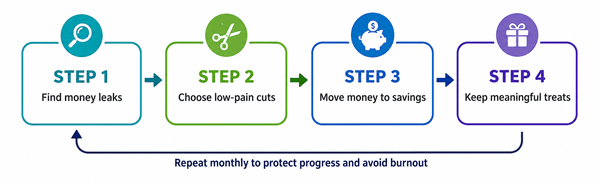
Diagram: The Fast-Saving Loop
The loop matters because cutting expenses is only half the job. You must redirect the saved money before it gets spent somewhere else.5. Chart: Example Monthly Savings From Small Changes
The chart below shows how modest changes can add up. Your actual savings will depend on your income, location, household size, and current spending habits.
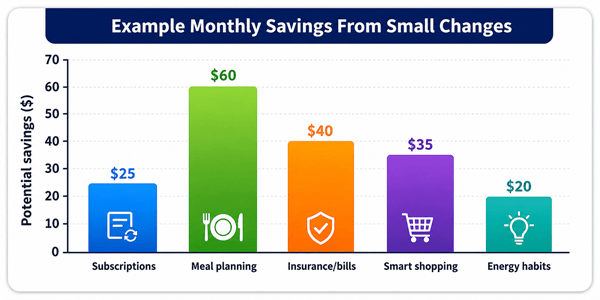
Example: monthly savings from subscriptions, meal planning, insurance or bills, smart shopping, and energy habits.
6. Quick-Start 7-Day Plan to Save Money Fast
| Day | Action | Expected result |
|---|---|---|
| Day 1 | Review last 30 days of spending | Find obvious leaks |
| Day 2 | Cancel or pause unused subscriptions | Lower recurring costs |
| Day 3 | Plan meals from pantry and freezer | Reduce grocery and takeout spending |
| Day 4 | Set a 24-hour rule for nonessential buys | Stop impulse spending |
| Day 5 | Call or compare one bill provider | Potential bill reduction |
| Day 6 | Sell or list one unused item | Create quick cash |
| Day 7 | Move saved money to a separate savings account | Lock in progress |
7. How Much Can You Realistically Save Fast?
The answer depends on your income and spending. Someone with many subscriptions, frequent delivery orders, or expensive plans may save hundreds in a month. Someone already living very lean may save less and may need to focus on income, benefits, debt relief, or community support instead of extreme cuts.
A realistic beginner target is to save 5% to 10% of take-home income for one month if your basic needs are covered. If that is not possible, start smaller. Saving $20 consistently is better than planning to save $500 and giving up.
| Monthly take-home income | 5% savings target | 10% savings target |
|---|---|---|
| $1,500 | $75 | $150 |
| $2,500 | $125 | $250 |
| $4,000 | $200 | $400 |
| $6,000 | $300 | $600 |
8. What to Do With the Money You Save
Do not leave saved money sitting in your everyday spending account. Give it a job immediately.
- Build a starter emergency fund first if you do not have one.
- Pay overdue essential bills to avoid fees or service disruption.
- Pay down high-interest debt if the interest is hurting your progress.
- Save for a planned expense so you do not need to borrow later.
- Keep a small guilt-free fun amount so saving does not feel miserable.
The Consumer Financial Protection Bureau defines an emergency fund as a cash reserve set aside for unplanned expenses or financial emergencies, such as car repairs, home repairs, medical bills, or loss of income. That is why even a small emergency fund can reduce stress and prevent debt.
If you use a savings account, choose one that is easy to access for emergencies, separate from everyday spending, and offered by a reputable financial institution in your country.
■ How to Save Money Without Feeling Deprived
The emotional side of saving matters. A plan that looks perfect on paper will fail if it makes daily life feel joyless.
1. Use the “Values First” Rule
Spend on what you genuinely value, cut what you barely notice. For example, if fitness matters to you and you use your gym, keep it. But if you rarely watch three streaming services, cancel two.
2. Keep a Small Fun Budget
A fun budget prevents rebellion spending. Even a small amount can help you feel in control. The point is not to remove joy; it is to choose joy intentionally.
3. Avoid All-or-Nothing Thinking
You do not have to cook every meal, never buy coffee, or stop seeing friends. Reducing a habit by half can still produce meaningful savings.
■ Common Mistakes to Avoid
| Mistake | Why it hurts | Better approach |
|---|---|---|
| Cutting everything enjoyable | Creates burnout and binge spending | Keep one or two meaningful treats |
| Saving what is left at the end | Often nothing is left | Save first, even a small amount |
| Ignoring small recurring charges | They quietly add up | Review subscriptions monthly |
| Buying because of discounts | Discounts can trigger unnecessary spending | Use a waiting list |
| Reducing important insurance too much | Can create major financial risk | Compare carefully and keep needed protection |
| Not moving saved money | Savings gets re-spent | Transfer it immediately |
■ Pros and Cons of Fast Money-Saving Strategies
| Pros | Cons or limits |
|---|---|
| Can create quick breathing room | May not solve a long-term income shortage |
| Builds awareness of spending habits | Requires honest review of money habits |
| Can reduce stress when tied to a clear goal | Extreme cuts can feel restrictive |
| Often works without needing extra income | Some bills cannot be reduced quickly |
| Helps build savings momentum | Must be maintained with a simple system |
■ When Cutting Expenses Is Not Enough
Sometimes the problem is not wasteful spending. The problem may be low income, high rent, medical costs, debt, family obligations, or unstable work. In that case, saving tips can help, but they may not be enough on their own.
Consider additional steps:
- Look for local assistance programs, food support, or utility relief if needed.
- Ask creditors or service providers about hardship options before missing payments.
- Review whether a safer income increase is possible, such as extra hours, freelancing, or selling a skill.
- Talk to a qualified nonprofit credit counselor if debt payments are unmanageable.
- Avoid payday loans or high-cost borrowing unless you fully understand the cost and risks.
■ Beginner-Friendly Money-Saving Checklist
- Set one clear savings goal.
- Review the last 30 days of spending.
- Cancel or pause unused subscriptions.
- Plan meals for the week before grocery shopping.
- Use a 24-hour rule for nonessential purchases.
- Call or compare one major bill provider.
- Move saved money to a separate account immediately.
- Keep a small fun budget to avoid feeling deprived.
- Repeat the process every month.
At the end of each week, write down the exact amount saved. Measuring the result turns small changes into visible progress.
■ Frequently Asked Questions
1. What is the fastest way to save money?
The fastest way is usually to stop money leaks immediately: cancel unused subscriptions, pause impulse purchases, meal plan from food you already have, negotiate one bill, and transfer the saved amount to a separate account right away.
2. How can I save money fast on a low income?
Start with small, low-risk actions. Track spending for one week, protect essential bills, reduce waste, use community resources when needed, and save a small fixed amount on payday. If your income does not cover basic needs, expense cuts alone may not be enough.
3. Do I have to stop eating out to save money?
No. You can reduce the frequency instead of stopping completely. For example, choose one planned meal out each week and replace unplanned takeout with simple home meals.
4. Is a no-spend challenge a good idea?
Yes, if it is short, realistic, and clearly defined. It should reset habits, not punish you. Keep essentials and one or two free enjoyable activities in the plan.
5. How do I save money without feeling miserable?
Keep spending that matches your values, cut low-value spending, use cheaper alternatives, and include a small fun budget. Saving should feel intentional, not like punishment.
6. Should I save money or pay off debt first?
It depends on your situation. Many beginners benefit from a small emergency fund first, then focusing on high-interest debt while continuing small savings. If debt is urgent or overdue, consider professional guidance.
7. How much should I keep in an emergency fund?
A common long-term goal is several months of essential expenses, but beginners can start with a smaller starter fund such as $100, $500, or one month of basic bills. The first goal is to create a buffer.
8. Are budgeting apps necessary?
No. Apps can help, but you can save money with a notebook, spreadsheet, bank app, or envelope system. The best system is the one you will actually use.
9. What is the easiest low-pain way to start today?
Start with one 30-minute audit, cancel one unused payment, plan one simple meal from food you already have, and transfer even a small amount to savings. This gives you a quick win without changing your whole lifestyle.■ Final Thoughts: Save Fast by Being Intentional, Not Miserable
The best ways to save money fast without feeling deprived are not about removing every pleasure from your life. They are about noticing where money is leaking, protecting what matters, cutting what does not, and moving saved money toward a clear goal.
Start small today. Review your spending, choose one quick win, and transfer the savings before it disappears. Momentum matters more than perfection.
Sources Consulted
- Consumer Financial Protection Bureau: An essential guide to building an emergency fund - https://www.consumerfinance.gov/an-essential-guide-to-building-an-emergency-fund/
- FDIC Consumer Resource Center: Saving for the Unexpected and Your Future - https://www.fdic.gov/consumer-resource-center/2025-01/saving-unexpected-and-your-future
- Federal Trade Commission Consumer Advice: Online Shopping - https://consumer.ftc.gov/articles/online-shopping
- FDIC Money Smart: Money Smart for Young People - https://www.fdic.gov/consumer-resource-center/money-smart-young-people
Reader Advice: This article is for educational and informational purposes only and should not be taken as personalized financial, legal, tax, or investment advice. Please check the latest information from official sources or a qualified professional, as rules, costs, programs, and policies can change over time.