No-Spend Challenge: Rules, Benefits & Tips for Beginners
1. Quick Answer: What Is a No-Spend Challenge?
A no-spend challenge is a temporary period when you stop spending money on non-essential items. You still pay for true needs, such as housing, utilities, groceries, transportation, debt payments, and basic health needs. The goal is not to punish yourself. The goal is to pause impulse buying, understand your spending habits, and redirect money toward savings, debt repayment, or another financial goal.
For beginners, the best no-spend challenge is usually short, specific, and realistic. A weekend, one week, or 30 days is easier to complete than an extreme challenge with unclear rules.
A simple way to think about it is this: essentials stay, impulse spending pauses, and the money saved is assigned to a clear purpose. This makes the guide useful for readers searching for no-spend challenge rules, a 7-day reset, a 30-day no-spend challenge, or a practical tracker.
2. No-Spend Challenge at a Glance
| Question | Simple Answer |
|---|---|
| Main idea | Avoid non-essential spending for a set time. |
| Best for | People who want to save quickly, stop impulse buys, reset habits, or get back on budget. |
| Common length | 1 day, weekend, 7 days, 14 days, or 30 days. |
| Allowed spending | Needs, bills, groceries, medicine, work transport, debt payments, and planned essentials. |
| Not allowed | Impulse purchases, takeout, new clothes, entertainment purchases, random online shopping, and upgrades. |
| Success measure | Money saved, fewer impulse buys, better awareness, and a clearer budget. |
3. Why People Try a No-Spend Challenge
Most people do not overspend because they are careless. They overspend because modern life makes spending easy. One-click shopping, delivery apps, social media trends, sale emails, and “small treats” can quietly drain money before you notice. A no-spend challenge gives you a clean break from that cycle.
During the challenge, you remove optional spending for a short period. This creates space to see where your money usually goes and whether those purchases actually improve your life. It can also help you save for an emergency fund, catch up on bills, pay down debt, or prepare for a large planned expense.
4. How a No-Spend Challenge Works
A no-spend challenge works by separating needs from wants for a fixed period. You choose the dates, define your allowed expenses, list what is not allowed, and decide what to do with the money you save. The challenge is easier when you write the rules before you start.
The basic process
- Choose a time frame, such as a weekend, 7 days, or 30 days.
- Pick your goal, such as saving $300, reducing takeout, or paying extra toward debt.
- Define allowed essential spending before the challenge begins.
- Create a “not allowed” list for non-essential purchases.
- Plan meals, transportation, entertainment, and social activities in advance.
- Track urges to spend and review what triggered them.
- Move the saved money to a specific savings, debt, or bill account.
5. No-Spend Challenge Rules: What Counts and What Does Not
There is no single official rulebook. The best rules are the ones that are clear, honest, and realistic for your life. The key is to avoid optional spending, not to ignore important responsibilities.
(a) Allowed expenses
- Housing payments, such as rent or mortgage.
- Utilities, internet, and phone bills if they are necessary for home, work, school, or safety.
- Basic groceries and household essentials you genuinely need.
- Medicine, medical care, hygiene products, and health-related needs.
- Fuel, public transport, or commuting costs needed for work, school, caregiving, or essential errands.
- Debt payments, insurance, taxes, childcare, and other required bills.
- Pet food and basic pet care.
- Pre-planned obligations that cannot reasonably be cancelled, such as a necessary repair or school fee.
(b) Not allowed expenses
- Takeout, restaurant meals, coffee shop drinks, and delivery unless you define an exception in advance.
- New clothes, shoes, accessories, cosmetics, gadgets, home decor, or hobby supplies that are not urgent needs.
- Impulse online shopping, sale purchases, and “just because” items.
- Paid entertainment, movie tickets, subscriptions you do not need, and in-app purchases.
- Convenience spending, such as buying lunch because you did not plan ahead.
- Upgrades, duplicates, and replacements for items that still work.
(c) Gray-area expenses
Some purchases are not clearly good or bad. For example, groceries are allowed, but expensive snack runs may become a loophole. Transportation may be allowed, but unnecessary rideshares may not be. The solution is to define gray areas before the challenge starts.
| Expense | Usually allowed? | Possible rule | Example |
|---|---|---|---|
| Groceries | Yes | Buy planned basics only | Rice, eggs, vegetables, milk, pantry staples |
| Coffee | Usually no | Make it at home | Skip daily coffee shop visits |
| Eating out | Usually no | Allow only pre-planned special event | Family birthday dinner already planned |
| Fuel or transport | Yes if necessary | Use only for essential trips | Work commute or medical appointment |
| Gifts | Depends | Set a small budget or use what you have | Homemade gift or already purchased gift |
| Repairs | Yes if urgent | Fix safety or work-related issues | Flat tire, broken work laptop charger |
| Subscriptions | Depends | Keep necessary, pause optional | Keep phone plan, cancel unused streaming |
6. Types of No-Spend Challenges
You can design the challenge around your personality, budget, and current financial pressure. A short challenge is better than an unrealistic one you quit after three days.
| Challenge type | Best for | How it works | Difficulty |
|---|---|---|---|
| No-spend day | Complete beginners | Avoid non-essential spending for one day | Easy |
| No-spend weekend | People who overspend socially | Plan free weekend meals and activities | Easy to medium |
| No-spend week | Testing habits | Avoid optional spending for 7 days | Medium |
| No-spend month | Strong reset | Follow written rules for 30 days | Medium to hard |
| Category challenge | Specific problem area | No clothing, no takeout, no online shopping, etc. | Flexible |
| Low-spend challenge | Families or variable income | Reduce spending instead of eliminating all wants | Flexible |
■ Benefits of a No-Spend Challenge
1. You can save money quickly
The most obvious benefit is extra cash. Even small daily purchases add up. If you usually spend $8 on coffee and snacks five days a week, skipping those purchases for four weeks could free up about $160. If takeout costs $30 twice a week, cutting it for a month could free up about $240. Your exact savings depend on your habits, but the principle is simple: fewer optional purchases means more money available for priorities.
2. You discover spending triggers
A challenge helps you notice why you spend. You may buy things when you are bored, stressed, tired, lonely, influenced by social media, or trying to reward yourself after a hard day. Once you know your triggers, you can build better routines.
3. You use what you already own
Many people have food in the pantry, clothes in the closet, books on the shelf, subscriptions they forgot about, and supplies they bought but never used. A no-spend challenge encourages you to use those resources before buying more.
4. You reduce impulse buying
Impulse buying often happens quickly. The challenge creates a pause. Instead of buying immediately, you write the item down and wait. Many wants become less urgent after a few days.
5. You build confidence with money
Completing a challenge can prove that you have more control than you thought. It also gives you useful information for your normal budget after the challenge ends.
■ Risks, Limitations and When Not to Do It
A no-spend challenge can be useful, but it is not a complete financial plan. It will not fix low income, high housing costs, medical debt, predatory loans, or long-term budgeting problems by itself. It is a short-term tool, not a permanent lifestyle rule.
For financial safety, the challenge should never stop necessary spending on food, housing, medicine, transport, childcare, insurance, taxes, or required bills. Readers with debt, irregular income, or urgent financial stress should consider trusted local guidance before making major money decisions.
Potential downsides
- You may feel deprived if the rules are too strict.
- You may overspend after the challenge if you treat it like a crash diet.
- You may delay necessary purchases and create bigger costs later.
- You may become too focused on small spending while ignoring larger budget issues.
- Family members may feel frustrated if the challenge affects them without discussion.
Avoid a strict challenge if
- You need to buy medication, food, transport, or safety-related items.
- You are already under extreme stress and the challenge would make life harder.
- You share finances with someone and have not agreed on rules.
- You have a history of unhealthy restriction around money or basic needs.
- You are using it to punish yourself instead of improving your financial habits.
■ How to Prepare for a Successful No-Spend Challenge
Step 1: Pick one clear goal
A clear goal makes the challenge meaningful. Instead of saying, “I want to spend less,” try, “I want to save $300 for my emergency fund,” or “I want to stop buying takeout for 30 days.”
For stronger results, make the goal specific and measurable: “save $100 this week,” “avoid takeout for 14 days,” or “transfer all avoided coffee and delivery spending to my emergency fund.”
Step 2: Choose a realistic time frame
If you are new, start with a weekend or one week. If that goes well, try 14 or 30 days. You do not need to prove anything by starting with the hardest version.
Step 3: Write your rules
Write down what is allowed, what is not allowed, and what counts as an exception. This prevents decision fatigue and loopholes later.
Step 4: Plan your meals
Food is one of the easiest categories to overspend in during a no-spend challenge. Check your pantry, freezer, and fridge. Build simple meals around what you already have. Keep backup meals ready for busy days.
Step 5: Remove temptation
- Unsubscribe from sale emails.
- Remove shopping apps from your phone during the challenge.
- Unfollow or mute accounts that trigger unnecessary purchases.
- Put a sticky note on your wallet or card that says, “Is this allowed?”
- Avoid browsing stores for entertainment.
Step 6: Create a free activity list
A no-spend challenge is easier when you know what to do instead of shopping or paid entertainment. Make a list before you start.
- Cook a new meal from pantry ingredients.
- Go for a walk, hike, or bike ride.
- Visit a free museum day, library, park, or community event.
- Watch movies you already have access to.
- Read books you own or borrow from the library.
- Do a home declutter and sell or donate unused items.
- Host a potluck, game night, or tea night at home.
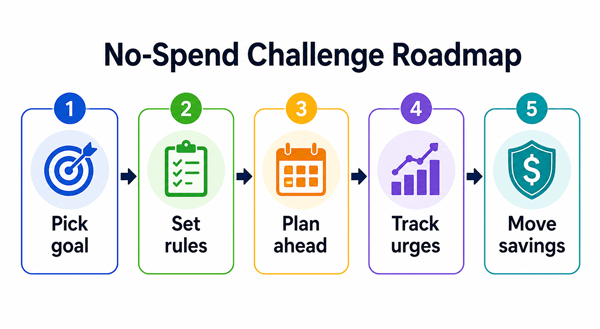
■ No-Spend Challenge Diagram: Simple 5-Step Flow
Use this simple process as your challenge roadmap:
Pick goal -> Set rules -> Plan ahead -> Track urges -> Move savings
Figure: No-Spend Challenge 5-Step Flow
■ Practical Examples
Example 1: The takeout reset
A person spends $25 on takeout three times a week. They start a 30-day no-takeout challenge. They prepare simple meals, keep frozen backup meals, and allow one planned family dinner. By the end of the month, they may save several hundred dollars and learn which days are most likely to trigger takeout spending.
Example 2: The online shopping pause
Someone often buys small items from online sales. Their rule is no non-essential online shopping for 14 days. When they want something, they add it to a wish list instead of checking out. After two weeks, they delete several items they no longer want.
Example 3: The emergency fund booster
A beginner wants to build a $1,000 starter emergency fund. They try four no-spend weekends in a row. They cook at home, choose free activities, and transfer the money they would have spent into savings every Sunday night.
■ Common Mistakes to Avoid
- Making rules too strict and quitting early.
- Forgetting to plan meals and then relying on expensive convenience food.
- Not telling family or friends, then feeling pressured to spend socially.
- Using gift cards or credit cards as loopholes if your goal is behavior change.
- Delaying necessary purchases, such as medicine or car repairs.
- Not moving the saved money, which makes it easy to spend later.
- Binge spending right after the challenge ends.
■ Tips to Make the Challenge Easier
1. Use a wish list instead of buying immediately
When you want something, write it down with the date and price. At the end of the challenge, review the list. Buy only what still feels useful and fits your budget.
2. Give every saved dollar a job
Decide where the saved money goes: emergency fund, debt payment, bill catch-up, sinking fund, or another priority. If saved money stays mixed with daily spending money, it may disappear.
3. Allow planned exceptions
A realistic exception is not failure. For example, if you have a wedding, medical appointment, school requirement, or essential repair during the challenge, include it in your rules.
4. Track emotions, not just money
Write down moments when you wanted to spend. What were you feeling? What time was it? What triggered the urge? This information can be more valuable than the amount saved.
5. Use the “replace, do not remove” rule
Replace spending habits with free or lower-cost alternatives. Replace takeout with a meal plan. Replace shopping with a walk. Replace paid entertainment with a library book, home movie night, or free community activity.
■ No-Spend Challenge Tracker Template
| Day | Spending urge | Trigger | What I did instead | Money saved |
|---|---|---|---|---|
| 1 | $ | |||
| 2 | $ | |||
| 3 | $ | |||
| 4 | $ | |||
| 5 | $ | |||
| 6 | $ | |||
| 7 | $ |
Tip: Print or copy this table for a 7-day challenge. For a 30-day challenge, repeat the same format for each week.
■ What to Do After the Challenge Ends
The end of a no-spend challenge is where many people lose the benefit. Do not immediately reward yourself with a shopping spree. Instead, review what you learned and decide which habits you want to keep.
- Calculate how much money you saved or avoided spending.
- Transfer that money to your chosen goal.
- Review your wish list and delete items you no longer want.
- Identify your top three spending triggers.
- Add realistic limits to your regular budget.
- Keep one or two habits, such as bringing lunch or waiting 48 hours before online purchases.
■ No-Spend Challenge vs. Budgeting: What Is the Difference?
| Feature | No-spend challenge | Regular budget |
|---|---|---|
| Purpose | Short-term spending reset | Ongoing money plan |
| Time frame | Temporary | Monthly or continuous |
| Focus | Pause non-essential spending | Plan income, bills, savings, debt, and spending |
| Best use | Breaking habits and saving quickly | Managing everyday finances |
| Limitation | Can be too restrictive if overused | Requires regular tracking and adjustment |
A no-spend challenge works best when it supports your budget. The challenge helps you reset habits; the budget helps you maintain progress.
■ Frequently Asked Questions
These answers cover common beginner questions about no-spend challenge rules, groceries, accidental spending, family participation, and what to do with the money saved.
1. What is a no-spend challenge?
A no-spend challenge is a set period when you avoid non-essential purchases while continuing to pay for true needs and required bills.
2. How long should a no-spend challenge last?
Beginners can start with one day, a weekend, or one week. A 30-day challenge can work well after you have clear rules and some planning experience.
3. Can I buy groceries during a no-spend challenge?
Yes. Groceries are usually allowed because food is essential. To avoid loopholes, plan meals and limit grocery trips to basic needs.
4. Is a no-spend challenge the same as a no-buy challenge?
They are similar. A no-buy challenge often focuses on stopping purchases in one category, such as clothes, beauty products, books, or online shopping. A no-spend challenge usually covers all non-essential spending.
5. What if I accidentally spend money?
Do not quit. Write down what happened, adjust your plan if needed, and continue. One mistake does not erase the value of the challenge.
6. Should I use cash or cards?
Use whichever helps you follow your rules. Some people prefer cash because it creates a physical limit. Others use cards for tracking but remove saved card details from shopping sites.
7. Can families do a no-spend challenge?
Yes, but everyone affected should understand the rules. Families often do better with a low-spend or category-based challenge instead of a strict ban on all optional spending.
8. How much money can I save?
It depends on your current habits. People who spend frequently on takeout, coffee, entertainment, or online shopping may see quick savings. The bigger benefit is often awareness and habit change.
9. What should I do with the money I save?
Move it immediately to a specific goal, such as an emergency fund, debt payment, rent buffer, school costs, or a planned purchase fund.
10. Is a no-spend challenge healthy?
It can be healthy when it is realistic, temporary, and focused on awareness. It becomes unhealthy if it causes shame, extreme restriction, or avoidance of necessary spending.
■ Final Thoughts
A no-spend challenge is not about never enjoying your money. It is about taking a short pause from automatic spending so you can make more intentional choices. Start small, write clear rules, plan ahead, and focus on learning rather than perfection. When used wisely, a no-spend challenge can help you save money, reduce impulse buying, and build a healthier relationship with your budget.
Reader Advice: This article is for educational and informational purposes only and should not be taken as personal financial, legal, tax, or professional advice. Please check the latest information from official sources or a qualified professional, as rules, policies, prices, and personal circumstances can change over time.