How to Save Money on Transportation Costs
Transportation is one of the largest everyday expenses for many households. It includes more than the cost of gas or a bus ticket. A full transportation budget can include car payments, insurance, fuel or electricity, maintenance, repairs, parking, tolls, registration, depreciation, rideshares, public transit, bicycles, and occasional travel.
The good news is that transportation costs are flexible. You may not be able to stop traveling to work, school, appointments, or the grocery store, but you can often lower the cost of each trip and reduce unnecessary trips. Small changes, such as combining errands, driving more smoothly, using public transit once or twice a week, checking tire pressure, or shopping for insurance, can add up over time.
This guide explains how transportation costs work, how to calculate your own spending, and the best practical ways to save money without making daily life harder.
Current benchmark: In recent U.S. consumer spending data, transportation remained one of the largest household expense categories. Average figures are useful for context, but your real savings depend on your location, commute, vehicle, insurance profile, fuel or electricity prices, and available alternatives.
-
The biggest savings usually come from reducing car ownership costs, not just saving a few cents per gallon on fuel.
-
Use a simple cost-per-trip mindset: compare driving, transit, carpooling, biking, walking, rideshare, and occasional rentals by total cost, time, safety, and reliability.
-
Track your total monthly transportation spending before choosing a strategy.
-
Driving less, sharing rides, using transit, biking, walking, and working remotely can reduce both variable and fixed costs.
-
Efficient driving, proper tire pressure, regular maintenance, and route planning can lower fuel and repair costs.
-
Before buying a car, compare the total cost of ownership: purchase price, financing, depreciation, insurance, fuel, maintenance, taxes, and fees.
1. What Are Transportation Costs?
Transportation costs are all the expenses you pay to move yourself, your family, or your goods from one place to another. Many beginners only think about fuel, but fuel is usually just one part of the total cost.
| Cost Type | Examples | Why It Matters |
|---|---|---|
| Fixed costs | Car payment, insurance, registration, license fees, depreciation | You often pay these even if you drive very little. |
| Variable costs | Fuel, charging, maintenance, tires, repairs, tolls, parking | These usually rise as you drive more. |
| Alternative transport costs | Bus passes, train tickets, rideshares, bike maintenance, scooter rentals | These may replace or reduce car costs. |
| Time-related costs | Long commute, waiting time, traffic delays | Time is not a bill, but it affects work, family, stress, and productivity. |
2. Why Transportation Gets Expensive
Transportation becomes expensive when small recurring costs are combined with large ownership costs. A car can feel affordable when you only look at the monthly payment, but the real cost includes many hidden or delayed expenses.
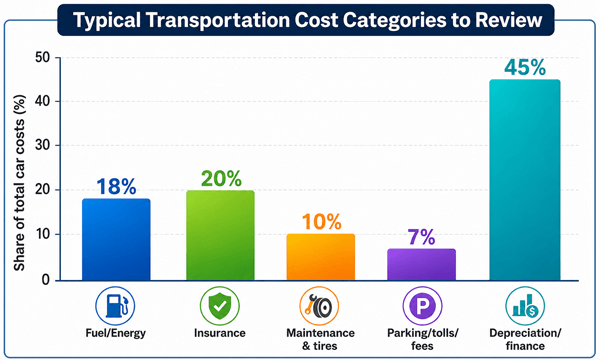
Chart: Transportation savings often come from reviewing several categories together instead of focusing only on fuel.
Useful context: AAA estimated that the average annual cost to own and operate a new vehicle was $12,297 in 2024 and $11,577 in 2025. The U.S. Department of Energy says aggressive driving can lower gas mileage by about 15% to 30% at highway speeds and 10% to 40% in stop-and-go traffic, while proper tire inflation can improve gas mileage by about 0.6% on average and up to 3% in some cases. U.S. household data also shows transportation is commonly one of the largest expense categories after housing. These numbers are averages, not guarantees, but they show why behavior, maintenance, vehicle choice, and local alternatives matter.
Step 1: Calculate Your Current Transportation Spending
Before cutting costs, write down what you currently spend. Use one full month as a starting point. If your costs vary, review three months and take an average.
| Category | What to Include | Monthly Amount |
|---|---|---|
| Car payment or lease | Loan, lease, or rent-to-own payment | $____ |
| Insurance | Auto insurance, motorcycle insurance, roadside assistance | $____ |
| Fuel or charging | Gasoline, diesel, EV charging, home charging estimate | $____ |
| Maintenance and repairs | Oil changes, tires, inspections, repairs, car wash | $____ |
| Parking and tolls | Work parking, meter parking, toll roads, airport parking | $____ |
| Public transit | Bus, train, subway, passes, reload cards | $____ |
| Rideshare and taxis | Uber, Lyft, taxis, delivery pickup trips | $____ |
| Other | Registration, license, bike repairs, scooter rentals | $____ |
| Total | Add all categories | $____ |
Once you know your total, divide it by your monthly take-home income. This shows how much of your income is going toward transportation. For example, if you take home $3,000 per month and spend $600 on transportation, transportation takes 20% of your take-home pay.
Helpful formula: Monthly transportation cost = fixed costs + variable costs + alternative transport costs. Cost per mile = total monthly driving costs divided by miles driven. Cost per trip = total trip cost divided by number of useful trips completed.
Step 2: Identify Your Biggest Savings Opportunity
The right strategy depends on your situation. A city worker with a train nearby may save most by using transit. A rural driver may save more by improving fuel efficiency, reducing trips, and maintaining the car properly.
Before making a major change, test it for one week. A small trial helps you measure savings without risking your job schedule, family routine, safety, or reliability.
| Situation | Best First Move | Why |
|---|---|---|
| You have a high car payment | Consider refinancing, buying a cheaper car next time, or selling if practical | The payment is often the largest fixed cost. |
| You drive many short trips | Combine errands and plan routes | Short, repeated trips waste time and fuel. |
| You commute alone daily | Try carpooling, transit, biking, or hybrid work | Even one or two fewer solo drives per week can reduce costs. |
| You pay high insurance | Compare quotes and review coverage | Insurance prices can vary widely by company and driver profile. |
| You live near transit | Compare monthly pass cost with car costs | Transit may replace parking, fuel, and some maintenance. |
| You use rideshare often | Set a rideshare budget and use transit for routine trips | Convenience trips can become expensive fast. |
■ Best Ways to Save Money on Transportation Costs
1. Drive Less Without Making Life Harder
-
Combine errands into one route instead of making several separate trips.
-
Choose one “no-drive” day each week when possible.
-
Use delivery or pickup strategically only when the fee is lower than the cost and time of driving.
-
Ask whether appointments can be virtual when an in-person visit is not necessary.
-
Plan grocery, pharmacy, school, and work trips together when locations are close.
Example: If you normally make five separate 4-mile round trips each week for small errands, combining them into two trips can reduce mileage, fuel use, and wear on your vehicle.
2. Use Public Transportation When It Makes Financial Sense
-
Check whether your city offers off-peak fares, employer commuter benefits, student passes, senior discounts, or low-income fare programs.
-
Compare the cost of a daily ticket with a weekly or monthly pass.
-
Add parking, tolls, fuel, and vehicle wear when comparing transit with driving.
-
Use transit for predictable trips, such as commuting, school, or downtown visits.
-
Keep a backup plan for late-night travel, bad weather, or emergencies.
Practical note: Transit is not always faster, but it can be cheaper when parking is expensive or when your commute is consistent.
3. Try Carpooling or Ride Sharing With People You Trust
-
Share fuel and parking costs with coworkers, classmates, or neighbors.
-
Set clear pickup times, backup plans, and payment expectations.
-
Rotate driving if multiple people own cars.
-
Use employer carpool programs if available.
Practical note: Carpooling works best for regular routes and similar schedules. It may not work well if your job hours change often.
4. Bike or Walk for Short Trips
-
Use walking for very short errands instead of starting the car.
-
Consider biking for commutes under a comfortable distance.
-
Budget for safety gear, lights, a lock, helmet, maintenance, and weather protection.
-
Choose safe routes over the shortest route.
Practical note: Walking and biking can reduce costs and improve health, but safety, weather, distance, and local infrastructure matter.
5. Improve Fuel Efficiency With Better Driving Habits
-
Keep windows, roof racks, and cargo boxes in mind at highway speeds because extra drag can reduce efficiency.
-
Accelerate smoothly and brake gradually when traffic allows.
-
Avoid speeding, especially on highways.
-
Remove unnecessary weight from your trunk.
-
Use cruise control on safe, steady highways.
-
Avoid excessive idling.
Practical note: Fuel-efficient driving is one of the fastest changes because it requires no major purchase.
6. Maintain Your Vehicle Before Small Problems Become Expensive
-
Keep receipts and a maintenance log; a documented service history can support resale value and warranty discussions.
-
Check tire pressure monthly and before long trips.
-
Follow the maintenance schedule in your owner’s manual.
-
Replace dirty air filters when recommended for your vehicle.
-
Fix warning lights early instead of waiting for breakdowns.
-
Rotate tires and keep wheels aligned when needed.
Practical note: Preventive maintenance costs money, but neglect often costs more. Proper maintenance can also support safety and reliability.
7. Shop Around for Car Insurance
-
Ask about usage-based or low-mileage programs only if you are comfortable with the tracking rules and privacy terms.
-
Compare quotes at least once a year or after major life changes.
-
Ask about safe-driver, low-mileage, student, multi-policy, and anti-theft discounts.
-
Review deductibles carefully; a higher deductible may lower premiums but increases out-of-pocket risk.
-
Drop optional coverage only after understanding the risk and your vehicle’s value.
Practical note: The cheapest policy is not always the best. Look for the best value: adequate coverage at a fair price.
8. Reduce Parking, Tolls, and Fees
-
Look for monthly parking discounts if you park often.
-
Use park-and-ride lots when they are safe and convenient.
-
Plan routes to avoid unnecessary tolls when the time trade-off is reasonable.
-
Use parking apps carefully and compare total fees before booking.
-
Do not ignore tickets; late fees can make a small ticket much more expensive.
Practical note: Parking and tolls are easy to overlook because they may be paid in small amounts.
9. Reconsider the Car You Own or Plan to Buy
-
Compare new, used, hybrid, electric, and smaller vehicle options by five-year total cost, not by monthly payment alone.
-
Choose a reliable vehicle with reasonable insurance and maintenance costs.
-
Compare fuel economy before buying.
-
Consider total cost of ownership, not only the purchase price.
-
Be cautious with large loans, long loan terms, and luxury features you do not need.
-
Research repair costs and parts availability.
Practical note: A cheaper vehicle is not always cheaper to own if it breaks often, uses lots of fuel, or has high insurance costs.
10. Use Rideshare and Taxis Strategically
-
Set a monthly limit for rideshare spending.
-
Use rideshare for occasional gaps, not every routine trip.
-
Compare rideshare with public transit plus a short walk.
-
Avoid surge pricing when possible.
-
Share rides only when safe and appropriate.
Practical note: Rideshare can be cheaper than owning a car for some low-mileage city residents, but it can become expensive when used daily.
11. Ask About Employer, School, or Community Benefits
-
Also check local government, nonprofit, and community programs for paratransit, shuttle, or reduced-fare options when eligible.
-
Check for commuter benefits or pre-tax transit programs.
-
Ask whether your workplace offers parking subsidies, carpool matching, or shuttle service.
-
Students should check for discounted transit passes.
-
Seniors, veterans, and people with disabilities may qualify for local transportation discounts.
Practical note: Many people miss transportation benefits simply because they never ask.
■ Car Ownership vs. Alternatives: Simple Comparison
Use this comparison as a decision tool, not a rule. The cheapest option on paper may not be the best choice if it creates safety problems, unreliable commuting, missed work, or excessive travel time.
| Option | Best For | Possible Savings | Main Limitations |
|---|---|---|---|
| Owning a car | People with long commutes, rural areas, family needs, limited transit | Can be optimized with maintenance, insurance shopping, and fuel-efficient driving | High fixed costs even when usage is low |
| Public transit | City commuters, students, predictable routes | Can reduce fuel, parking, and wear-and-tear | May be slower or unavailable in some areas |
| Carpooling | Coworkers or classmates with similar schedules | Splits fuel and parking costs | Less flexibility and requires coordination |
| Biking/walking | Short trips and safe routes | Very low cost after basic equipment | Weather, safety, distance, and physical ability matter |
| Rideshare/taxi | Occasional trips, nights out, airport rides, people who drive rarely | May be cheaper than car ownership for very low use | Expensive if used often; prices vary |
| Car sharing/rental | Occasional errands or weekend trips | Avoids full-time ownership costs | Availability, mileage limits, and fees can apply |
■ How to Save Money on Commuting
Commuting is often the most predictable transportation expense, which makes it one of the easiest areas to improve.
-
Calculate the true cost of your commute, including parking, tolls, fuel, and time.
-
Try a cheaper commute one or two days per week before changing everything.
-
Ask about remote work, compressed workweeks, or flexible hours to avoid peak traffic.
-
Keep work clothes, lunch, and essentials ready so you are less likely to buy convenience services on the way.
-
If moving homes or changing jobs, include commute cost in your decision. A cheaper rent can become expensive if it adds a long daily drive.
■ How to Save on Fuel or EV Charging
-
Use a fuel-price app, but do not drive far out of your way just to save a tiny amount per gallon.
-
Fill up before you are desperate so you can choose a cheaper station.
-
Use the fuel grade recommended in your owner’s manual; premium fuel is usually unnecessary unless required.
-
For EVs, compare home charging, workplace charging, and public fast charging costs.
-
Keep tires properly inflated and remove roof racks or cargo boxes when not needed because drag can reduce efficiency.
■ Mistakes to Avoid When Cutting Transportation Costs
| Mistake | Why It Can Backfire | Better Approach |
|---|---|---|
| Buying the cheapest car you can find | It may need expensive repairs or have poor safety features | Look for reliable, affordable total ownership cost |
| Skipping maintenance | Small issues can become major repairs | Follow the maintenance schedule and fix problems early |
| Dropping insurance coverage blindly | One accident can create a large financial loss | Review coverage with your risk and savings in mind |
| Driving far for cheaper gas | The extra miles may erase the savings | Compare total trip cost, not just price per gallon |
| Using rideshare for routine trips | Small rides can become a major monthly expense | Reserve rideshare for occasional or high-value situations |
| Ignoring time and safety | The cheapest route may not be worth it | Balance cost, safety, reliability, and time |
■ A Simple 30-Day Transportation Savings Plan
-
Days 1-3: Track every transportation cost, including parking, tolls, transit, and rideshare.
-
Days 4-7: Identify your top two cost categories. Do not try to fix everything at once.
-
Week 2: Combine errands, check tire pressure, remove extra weight, and plan routes before driving.
-
Week 3: Test one alternative commute, such as transit, carpooling, biking, walking, or remote work.
-
Week 4: Compare insurance quotes, review subscriptions or passes, and decide what changes are realistic long term.
■ Real-World Examples
Example 1: The Daily Solo Commuter
Sara drives 30 miles round trip to work five days a week. She starts carpooling two days a week and combines grocery shopping with her commute. She still drives, but she reduces weekly mileage, fuel use, and parking costs. This approach works because it does not require her to give up her car completely.
Example 2: The City Resident Who Rarely Drives
James owns a car but mostly works from home and lives near transit. After adding insurance, parking, registration, maintenance, and depreciation, he realizes the car costs far more than occasional rideshare and car rental. Selling the car may be realistic for him, but it would not be realistic for someone with limited transit or daily family transportation needs.
Example 3: The Family With Multiple Vehicles
A family with two cars reviews usage and finds that one car sits unused most weekdays. They keep the more reliable vehicle, use transit and school carpooling more often, and rent a larger vehicle only for occasional trips. This can reduce insurance, registration, maintenance, and depreciation costs.
■ When Spending More on Transportation Can Be Worth It
Saving money is important, but the cheapest option is not always the best option. It can be reasonable to spend more when it improves safety, protects your job, saves significant time, supports health needs, or prevents larger repair costs. For example, replacing unsafe tires is not an area to cut corners. Paying for reliable transportation to keep a stable job may also be worth it.
■ Quick Checklist: How to Lower Transportation Costs This Week
-
Track every trip and cost for seven days.
-
Check tire pressure.
-
Remove unnecessary items from your vehicle.
-
Plan errands in one route.
-
Compare one transit or carpool option.
-
Review insurance discounts.
-
Avoid aggressive driving.
-
Set a rideshare spending limit.
-
Look for cheaper parking options.
-
Schedule overdue maintenance.
■ Frequently Asked Questions
1. What is the fastest way to save money on transportation?
The fastest way is usually to reduce unnecessary driving, combine errands, avoid aggressive driving, check tire pressure, and limit rideshare use. These steps can be started immediately without buying anything.
2. Is public transportation always cheaper than driving?
Not always. Public transportation is often cheaper when parking, tolls, and fuel are high, but it may not be practical if routes are limited, schedules are unreliable, or travel time becomes too long.
3. How much should I spend on transportation each month?
There is no single perfect number. A useful goal is to keep transportation affordable relative to your income while still meeting work, family, and safety needs. If transportation is crowding out rent, food, savings, or debt payments, it is worth reviewing.
4. Does driving slower really save gas?
Driving at reasonable speeds and avoiding rapid acceleration and braking can improve fuel efficiency. The savings vary by vehicle, road conditions, and driving habits.
5. Should I sell my car to save money?
Selling a car can save a lot if you rarely drive and have reliable alternatives. It may not make sense if you need the car for work, caregiving, school, or areas with limited transit.
6. Are electric vehicles cheaper to own?
Sometimes, but not always. EVs may reduce fuel and some maintenance costs, but purchase price, insurance, charging costs, depreciation, incentives, and local electricity prices all matter.
7. How can families save on transportation?
Families can save by coordinating schedules, carpooling, choosing reliable used vehicles, reducing duplicate trips, using school or community transit options, and avoiding unnecessary second or third vehicles.
8. How do I know whether a transportation change is worth it?
Compare total cost, time, safety, reliability, and convenience. A change that saves money but makes you late to work or creates safety concerns may not be worth it.
■ Final Thoughts
Saving money on transportation is not about making life inconvenient. It is about understanding your real costs and choosing smarter ways to move. Start with one or two changes that fit your lifestyle, such as combining errands, driving more efficiently, checking tire pressure, comparing insurance, or using transit once a week. Over time, the best results come from reducing both small daily costs and large fixed costs like car payments, insurance, and depreciation.
Sources and Notes
-
U.S. Department of Energy, Energy Saver: Driving More Efficiently. Used for estimates on aggressive driving and fuel economy.
-
U.S. Department of Energy / Alternative Fuels Data Center: Gas-Saving Tips. Used for tire pressure and fuel economy estimates.
-
AAA Your Driving Costs 2025 fact sheet and newsroom release for average annual new-vehicle ownership cost estimates. Actual costs vary by driver, vehicle, financing, location, insurance profile, and fuel prices.
-
U.S. Bureau of Labor Statistics Consumer Expenditure data and U.S. Department of Transportation / Bureau of Transportation Statistics resources for transportation spending context and cost categories.
Reader Advice: This article is for educational and informational purposes only and should not be taken as personal financial, insurance, legal, tax, or transportation advice. Please check the latest prices, rules, benefits, and policies from official sources, because they can change over time.