What Is Frugal Living? Meaning, Benefits & Practical Tips
1. Quick Answer: What Is Frugal Living?
Frugal living means using your money intentionally so more of it goes toward what truly matters to you. It is not about being cheap, miserable, or saying no to everything. A frugal person looks for value, avoids waste, plans ahead, and spends less on low-priority things so they can afford higher-priority goals such as financial security, debt freedom, travel, education, family needs, or early retirement.
In this guide, you will learn:
- What frugal living means in simple terms
- How frugal living works in daily life
- The difference between being frugal and being cheap
- Main benefits, risks, and limitations
- Practical tips for food, housing, transport, utilities, shopping, entertainment, and family life
- A simple starter plan and FAQs for beginners
2. What Does Frugal Living Mean?
Frugal living is the habit of making careful, thoughtful choices with money. It asks a simple question before spending: “Does this purchase give me enough value for the money, time, and energy it costs?”
A frugal lifestyle does not look the same for everyone. One person may cook at home to afford international travel. Another may drive an older car to pay off debt faster. A family may buy secondhand furniture so they can build an emergency fund. The common idea is not deprivation; it is alignment. Your spending should match your real priorities instead of your habits, social pressure, or advertising.
3. Frugal Living vs. Being Cheap
Many beginners confuse frugal living with being cheap. They are not the same. Frugality focuses on value. Cheapness focuses only on the lowest price, even when the choice creates stress, waste, poor quality, or unfairness to others.
| Topic | Frugal living | Being cheap |
|---|---|---|
| Main goal | Get the best value for money | Spend the least amount possible |
| Quality | Pays for quality when it saves money or improves life | Avoids quality even when it costs more later |
| Impact on others | Respects people, time, and relationships | May shift costs or inconvenience onto others |
| Example | Buying durable shoes on sale because they last longer | Buying the cheapest shoes repeatedly as they fall apart |
| Mindset | Intentional, balanced, practical | Fear-based, restrictive, often stressful |
4. How Frugal Living Works
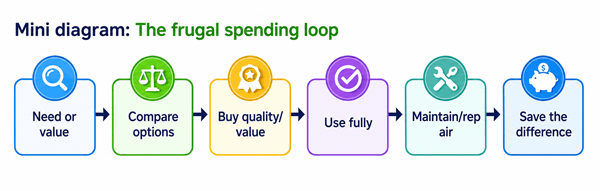
Frugal living works through small repeatable decisions. You identify what matters, reduce waste, plan purchases, compare options, and avoid unnecessary costs. Over time, these decisions free up money that can be used for savings, debt repayment, investing, or meaningful experiences.
| Step | What it means | Example |
|---|---|---|
| 1. Know your priorities | Decide what your money should support first. | Rent, groceries, emergency savings, debt payments, and education come before impulse shopping. |
| 2. Track spending | Notice where money actually goes. | Review the last 30 days of bank or wallet spending. |
| 3. Cut waste | Remove costs that do not improve your life. | Cancel subscriptions you rarely use. |
| 4. Buy value | Compare price, quality, durability, and usefulness. | Choose a reliable used phone instead of a new premium model. |
| 5. Automate progress | Make saving or debt repayment happen before spending. | Transfer a fixed amount to savings on payday. |
5. Simple Frugal Living Decision Filter
Use this quick decision filter before non-essential purchases:
| Question | Yes | No |
|---|---|---|
| Do I need it or truly value it? | Continue | Pause or skip |
| Can I afford it without debt or stress? | Continue | Wait and save first |
| Is there a lower-cost way to get the same value? | Compare options | Buy only if the value is clear |
| Will I still be glad I bought it next week? | Consider buying | Delay 24 to 72 hours |
■ Benefits of Frugal Living
Frugal living can improve your finances and reduce money stress, especially when it is realistic and flexible. The main benefits include:
1. More Money Left Over Each Month
When you stop paying for things you do not use or value, your cash flow improves. Even small changes can add up. For example, reducing food waste, cutting unused subscriptions, and planning transport can free up money without requiring a higher income.
2. Faster Debt Repayment
Frugal habits can help you pay extra toward credit cards, personal loans, student loans, or car loans. The key is to direct the money you save toward debt instead of letting it disappear into other spending.
3. A Stronger Emergency Fund
An emergency fund protects you from surprise expenses such as medical bills, car repairs, job loss, or urgent travel. Frugal living can help you build this safety net by lowering everyday costs and making saving a normal habit. Even a small starter fund can reduce reliance on high-interest debt while you build toward a larger cushion.
4. Less Financial Stress
Frugality gives you more control. When you know where your money goes and have a plan, you are less likely to feel surprised by bills or pressured by every sale, trend, or social expectation.
5. More Freedom and Flexibility
Spending less on low-value things can create freedom to change jobs, start a business, study, travel, spend more time with family, or handle difficult seasons with less panic.
■ Possible Downsides and Limitations
Frugal living is helpful, but it is not a magic solution. Some financial problems are caused by low income, medical costs, housing costs, debt, or family responsibilities that cannot be fixed by cutting small expenses alone.
| Risk or limitation | What it looks like | How to avoid it |
|---|---|---|
| Extreme restriction | You never enjoy your money and feel guilty about basic comfort. | Set a small guilt-free spending amount. |
| Wasting time to save tiny amounts | Spending two hours to save a very small amount. | Compare savings with time and energy cost. |
| Ignoring income growth | Only cutting expenses while income stays too low. | Also explore raises, skills, side income, or better jobs. |
| Buying poor quality | Choosing the cheapest option that breaks quickly. | Consider cost per use and durability. |
| Relationship strain | Always refusing social plans or making others uncomfortable. | Suggest lower-cost alternatives instead of simply saying no. |
■ Practical Frugal Living Tips for Beginners
1. Start With a Simple Spending Review
Before cutting anything, look at your spending for the last 30 days. Group expenses into needs, wants, savings, debt, and waste. Waste includes things you paid for but did not use, did not enjoy, or forgot about.
- Write down your income for the month.
- List your fixed bills: rent, utilities, insurance, loan payments, subscriptions.
- List variable spending: groceries, fuel, transport, eating out, shopping, entertainment.
- Mark anything that surprised you.
- Choose three changes for next month instead of trying to change everything at once.
Beginner rule
Do not start frugal living by cutting the things that bring the most value to your life. Start with waste, duplicates, impulse spending, fees, interest, and unused services.
2. Create a “Values-Based” Budget
A values-based budget is a spending plan that protects what matters most. It does not mean every category must be tiny. It means each category has a reason.
| Budget category | Frugal question to ask | Possible action |
|---|---|---|
| Housing | Is my home affordable compared with my income and goals? | Consider roommates, negotiation, downsizing, or avoiding unnecessary upgrades. |
| Food | Am I wasting food or buying without a plan? | Plan meals, use leftovers, and shop with a list. |
| Transport | Can I reduce trips, fuel, parking, or car costs? | Combine errands, use public transport, carpool, walk, or maintain your vehicle. |
| Utilities | Am I paying for energy, water, or internet I do not need? | Adjust usage, compare plans, fix leaks, and unplug energy drains. |
| Entertainment | Am I paying for fun I actually enjoy? | Keep high-value fun and cut low-value spending. |
3. Save Money on Food Without Feeling Deprived
Food is one of the easiest places to practice frugal living because small habits repeat every week.
- Plan meals around food you already have before buying more.
- Use a shopping list and avoid shopping when hungry.
- Build low-cost meals around rice, oats, beans, lentils, eggs, potatoes, seasonal vegetables, and bulk staples where appropriate.
- Cook once and use leftovers for lunch or another dinner.
- Compare unit prices, not only package prices.
- Reduce food waste by freezing leftovers and using older ingredients first.
- Keep a few quick meals at home to avoid expensive last-minute takeout.
4. Reduce Housing Costs Carefully
Housing is often the largest monthly expense. A small percentage reduction here can be more powerful than many tiny cuts. However, housing decisions affect safety, work, family, school, and transportation, so evaluate them carefully.
- Negotiate rent or compare similar rentals before renewing a lease.
- Consider a roommate only if it is safe and suitable for your lifestyle.
- Avoid upgrading your home simply because your income increased.
- Buy used furniture and home goods when quality is good.
- Maintain your home to prevent expensive repairs where you are responsible for them.
5. Lower Transportation Costs
Transportation costs include fuel, fares, parking, maintenance, insurance, repairs, depreciation, and time. The frugal choice is not always “never own a car.” It is choosing the lowest practical total cost for your situation.
| Option | Best for | Watch out for |
|---|---|---|
| Walking or cycling | Short distances and low-cost daily movement | Safety, weather, and time limits |
| Public transport | City travel and commuting routes with reliable service | Delays, schedule limits, and route coverage |
| Carpooling | Work commutes or school runs | Coordination and reliability |
| Keeping an older reliable car | People who need a car but want lower payments | Maintenance and repair planning |
| Buying a new car | High reliability needs and long-term ownership plans | High depreciation, insurance, and financing costs |
6. Cut Utility Bills With Small Habits
Utility savings often come from consistent habits rather than one big change.
- Turn off lights and appliances when not in use.
- Use efficient bulbs when replacing old ones.
- Fix leaks quickly if you are responsible for water costs.
- Wash full loads when practical.
- Use fans, curtains, insulation, or thermostat adjustments to reduce heating and cooling costs.
- Compare internet and mobile plans at least once or twice a year.
7. Shop More Intentionally
Frugal shopping is not about never buying. It is about buying fewer things that serve you better.
- Use a 24-hour rule for small wants and a 30-day rule for larger wants.
- Check what you already own before buying duplicates.
- Borrow, rent, or buy secondhand for items you will use rarely.
- Compare reviews and total cost, not only the sale price.
- Avoid “buy more to save more” offers unless you truly need the extra quantity.
- Unsubscribe from promotional emails that trigger impulse purchases.
8. Use Cost Per Use to Make Better Decisions
Cost per use helps you compare value. Divide the purchase price by the number of times you expect to use the item.
| Item | Price | Expected uses | Cost per use | Frugal insight |
|---|---|---|---|---|
| Cheap jacket | 40 | 20 | 2.00 | Low price, but poor value if it wears out quickly |
| Durable jacket | 120 | 120 | 1.00 | Higher price, better value if it fits your needs and lasts |
| Single-use gadget | 25 | 2 | 12.50 | Often not worth buying; borrow or skip |
| Library book | 0 | 1 | 0.00 | Free or low-cost alternative to buying every book |
9. Build Frugal Fun Into Your Life
A frugal lifestyle should still include joy. Cutting all fun usually leads to burnout and rebound spending.
- Host simple meals with friends instead of expensive outings.
- Use parks, libraries, community events, free classes, and local walking routes.
- Choose one paid entertainment service at a time instead of several.
- Create a monthly fun budget so enjoyment is planned, not accidental.
- Look for hobbies with low ongoing costs, such as reading, fitness, gardening, writing, cooking, or learning skills online.
10. Frugal Living for Families
Frugal living with children or family members works best when it is positive and shared. Avoid making money feel scary. Instead, teach value, planning, gratitude, and smart choices.
- Explain that the family is choosing priorities, not “being poor.”
- Plan low-cost traditions such as movie nights, cooking together, picnics, and game nights.
- Buy children’s clothes and toys secondhand when safe and clean.
- Rotate toys and books instead of constantly buying new ones.
- Involve older children in comparing prices and saving for goals.
■ Frugal Living When Your Income Is Low
If your income is low, frugal living can help, but it may not be enough by itself. Cutting expenses has a limit. You still need food, housing, transport, healthcare, communication, and basic dignity.
In this situation, focus on the highest-impact actions first: prevent fees, protect essential bills, apply for eligible benefits or assistance, avoid high-interest debt where possible, seek community resources, and look for realistic income improvements. Frugality should support survival and stability, not shame you for expenses you cannot avoid.
■ Common Frugal Living Mistakes to Avoid
| Mistake | Why it hurts | Better approach |
|---|---|---|
| Cutting everything at once | It feels punishing and usually does not last. | Start with three changes and build gradually. |
| Only focusing on tiny expenses | You may ignore bigger costs such as housing, transport, and debt interest. | Review large expenses first, then small leaks. |
| Buying in bulk without a plan | Food or products may expire or go unused. | Bulk-buy only items you use regularly. |
| Ignoring health and safety | Cheap choices can become expensive or harmful. | Spend appropriately on medicine, safety, nutrition, and reliable essentials. |
| Saving money but not assigning it | The savings get spent elsewhere. | Move saved money to savings, debt, or a clear goal. |
| Comparing your frugality to others | Different incomes, families, and locations change what is realistic. | Measure progress against your own goals. |
■ A Simple 30-Day Frugal Living Starter Plan
Use this plan to begin without becoming overwhelmed.
| Days | Focus | Action |
|---|---|---|
| 1-3 | Awareness | Track every expense and review bank statements. |
| 4-7 | Waste removal | Cancel or pause unused subscriptions, fees, and duplicates. |
| 8-12 | Food savings | Plan meals, shop with a list, and use leftovers. |
| 13-16 | Utilities and bills | Compare plans, reduce usage, and check for billing errors. |
| 17-20 | Shopping habits | Use waiting periods before non-essential purchases. |
| 21-24 | Transportation | Combine errands, review fuel and fare costs, and plan routes. |
| 25-27 | Savings system | Set up an automatic transfer, even if small. |
| 28-30 | Review and adjust | Keep what worked, remove what felt unrealistic, and choose next month’s goals. |
■ Real-World Examples of Frugal Living
Example 1: The Young Worker Paying Off Debt
A young worker earns a modest salary and has credit card debt. Instead of cutting every enjoyable expense, they cancel two unused subscriptions, take lunch to work four days a week, use public transport twice a week, and move the savings directly toward debt. This works because the saved money has a job.
Example 2: The Family Building an Emergency Fund
A family wants a basic emergency fund. They plan meals, buy children’s clothes secondhand, keep one streaming service instead of three, and create a weekly cash limit for small extras. They still enjoy family movie night and park outings, so the plan feels sustainable.
Example 3: The High Earner Who Still Feels Broke
A high earner has good income but no savings because lifestyle costs rose with income. Frugal living helps by creating limits on luxury spending, delaying upgrades, automating savings, and choosing which comforts are truly worth the cost.
■ Frugal Living Checklist
- I know my top three financial priorities.
- I track spending at least once a month.
- I have removed unused subscriptions and duplicate services.
- I plan meals before shopping for groceries.
- I compare total cost before major purchases.
- I avoid high-interest debt for non-essential purchases.
- I save or invest the money I free up instead of spending it unconsciously.
- I allow some guilt-free spending so the lifestyle is sustainable.
■ Frequently Asked Questions
1. Is frugal living the same as minimalism?
No. Minimalism focuses on owning fewer things. Frugal living focuses on using money wisely. A person can be frugal without being minimalist, and a minimalist can still spend a lot on a few expensive items.
2. Does frugal living mean I can never buy nice things?
No. Frugal living means buying nice things intentionally when they fit your values and budget. It often means buying fewer low-value items so you can afford better quality where it matters.
3. How much money can frugal living save?
It depends on your income, current spending, household size, and location. Some people save a small amount by removing waste. Others save much more by changing housing, transportation, food habits, or debt repayment behavior.
4. What is the easiest frugal habit to start with?
Start by tracking spending for 30 days and canceling unused services. This is simple, quick, and often reveals money leaks without requiring major lifestyle changes.
5. Can frugal living help me get out of debt?
Yes, if the money saved is used for debt repayment. Frugality alone does not reduce debt unless you direct the savings toward balances and avoid adding new debt.
6. Is it better to earn more or spend less?
Both matter. Spending less can create immediate breathing room, but income growth may be necessary if your basic expenses are already higher than your income. The best long-term plan often combines frugal habits with income improvement.
7. How do I stay frugal without feeling deprived?
Keep a small budget for fun, focus on your personal goals, cut waste before cutting joy, and choose low-cost alternatives instead of only saying no.
8. What should I not cut from my budget?
Be careful with health care, safety, essential nutrition, required insurance, reliable transportation for work, and anything that protects your ability to earn income or live safely.
■ Final Thoughts: Frugal Living Is About Freedom, Not Deprivation
Frugal living is not a competition to spend the least. It is a practical way to make your money serve your life instead of letting habits, pressure, and impulse control your money. The best frugal lifestyle is balanced: it cuts waste, protects essentials, allows joy, and moves you closer to your goals.
Start small. Review your spending, choose a few meaningful changes, and give every saved amount a purpose. Over time, these simple habits can build financial stability, reduce stress, and create more freedom in everyday life.
Reader Advice: This article is for educational and informational purposes only and should not be taken as personal financial, legal, tax, or professional advice. Please check the latest information from official sources or a qualified professional, because rules, policies, prices, and personal circumstances can change over time.