Common Saving Money Mistakes and How to Avoid Them
Saving money sounds simple: spend less than you earn and keep the difference. In real life, it is not always that easy. Bills change, prices rise, emergencies happen, emotions affect spending, and many people never learned a clear system for managing money. That is why even people with good intentions often make saving mistakes.
The goal of this guide is not to make you feel guilty. It is to help you spot the most common saving money mistakes early, understand why they happen, and replace them with practical habits that actually work. Whether you are starting from zero, rebuilding after a difficult period, or trying to save more consistently, the right approach can make saving feel simpler and less stressful.
Key takeaway Successful saving is less about willpower and more about having a realistic plan, clear priorities, and simple systems that make good decisions easier.
1. What Does It Mean to Save Money Well?
Saving money well means setting aside part of your income in a way that supports your real life. It is not about being cheap, avoiding all enjoyment, or saving every possible dollar. It means using your money intentionally so you can handle emergencies, reach goals, reduce stress, and avoid unnecessary debt.
A good savings plan usually includes three parts:
- An emergency fund for unexpected expenses such as medical bills, car repairs, job loss, or urgent home repairs.
- Short-term savings for planned expenses such as holidays, school fees, insurance premiums, gifts, or travel.
- Long-term savings and investing for major goals such as buying a home, retirement, or financial independence.
Many saving problems happen when people mix these categories together. For example, using emergency savings for shopping, or investing money that may be needed for rent next month, can create unnecessary risk.
For most beginners, a practical first step is to build a small starter emergency fund before moving on to larger goals. After that, many households aim for a larger emergency fund based on essential monthly expenses, income stability, debt level, and family responsibilities. The exact amount should be realistic for your situation, not copied from someone else.
2. Quick Comparison: Poor Saving Habits vs Better Saving Habits
| Poor Saving Habit | Why It Causes Problems | Better Habit |
|---|---|---|
| Saving whatever is left at the end of the month | There may be nothing left after bills and impulse spending. | Save first, even if the amount is small. |
| Having no emergency fund | A small surprise expense can turn into credit card debt or borrowing. | Build a starter emergency fund before chasing big goals. |
| Cutting every enjoyable expense | The plan feels miserable and is hard to maintain. | Keep a small guilt-free spending category. |
| Keeping all savings in one account | It becomes hard to know what money is for which goal. | Separate emergency, short-term, and long-term savings. |
| Ignoring irregular expenses | Annual bills feel like emergencies. | Create sinking funds for predictable costs. |
3. Common Saving Money Mistakes and How to Avoid Them
Mistake 1: Saving Only What Is Left Over
One of the biggest saving money mistakes is waiting until the end of the month to save. The problem is that money without a job often disappears. You may spend on small convenience purchases, subscriptions, food delivery, or impulse buys without noticing how quickly they add up.
How to avoid it:
- Decide on a savings amount before the month begins.
- Set up an automatic transfer to savings soon after income arrives.
- Start with an amount you can repeat, such as 5% of income or a small fixed amount.
- Increase the amount gradually when your income rises or expenses fall.
Example: If you earn $2,000 per month and try to save whatever is left, you may save $0 in some months. If you transfer $100 to savings on payday, you have already made progress before spending decisions begin.
Mistake 2: Setting Unrealistic Savings Goals
Ambitious goals can be motivating, but unrealistic goals often backfire. If your plan requires extreme sacrifice, you may follow it for a few weeks and then give up completely. A savings goal should challenge you, but it must still fit your income, bills, family responsibilities, and lifestyle.
How to avoid it:
- Review your average monthly income and essential expenses.
- Choose a savings target that leaves room for basic needs and modest enjoyment.
- Use milestones, such as saving the first $100, then $500, then $1,000.
- Adjust the goal when life changes instead of quitting.
Example: Saving 50% of income may be realistic for someone living rent-free, but impossible for someone supporting a family on a tight budget. A realistic 5% to 10% habit is often better than an extreme plan that fails.
Mistake 3: Not Having a Clear Reason for Saving
Saving without a purpose can feel boring and easy to ignore. When you know exactly why you are saving, it becomes easier to say no to spending that does not matter as much.
How to avoid it:
- Name each savings goal clearly, such as Emergency Fund, Car Repair Fund, House Deposit, or Travel Fund.
- Attach a target amount and a rough deadline.
- Write down what the money will protect or make possible.
- Keep the goal visible in your budgeting app, notebook, or bank account nickname.
Example: “Save more money” is vague. “Save $1,000 for a starter emergency fund in 10 months by saving $100 per month” is clear and actionable.
Mistake 4: Ignoring Small Expenses
Small purchases are not automatically bad. The mistake is ignoring them because they seem too small to matter. Daily snacks, paid apps, ATM fees, delivery fees, or unused subscriptions can quietly reduce your ability to save.
How to avoid it:
- Track small spending for 14 to 30 days.
- Look for patterns instead of blaming yourself for every purchase.
- Cancel subscriptions you do not use.
- Set a weekly limit for convenience spending.
Example: A $5 daily purchase during the workweek is about $100 per month. Cutting it in half could free up around $50 per month without removing it completely.
Mistake 5: Cutting Too Much Too Fast
Some people start saving by removing every enjoyable expense. This can work for a short emergency push, but it is rarely sustainable. A plan that feels like punishment often leads to burnout, frustration, or revenge spending.
How to avoid it:
- Keep a small personal spending category.
- Cut expenses in stages instead of all at once.
- Focus first on waste, unused services, and low-value spending.
- Use no-spend days for specific categories, not as a permanent lifestyle rule.
Example: Instead of banning all restaurant meals, limit them to one planned meal per week or set a monthly dining-out budget.
Mistake 6: Treating Savings as One Big Pile of Money
When all savings sit in one account, it becomes tempting to use emergency money for non-emergencies. You may also think you are doing better than you are because money for rent, insurance, gifts, and emergencies is mixed together.
How to avoid it:
- Use separate accounts or sub-accounts for different goals.
- Label each fund clearly.
- Keep emergency savings separate from spending money.
- Review balances monthly so each goal stays on track.
Example: If you have $1,500 in one savings account, it may feel available. But if $800 is for annual insurance, $400 is for car repairs, and $300 is for emergencies, you know what is truly flexible.
Mistake 7: Not Planning for Irregular Expenses
Many expenses are predictable but not monthly. Examples include insurance premiums, school costs, car maintenance, holiday gifts, annual memberships, tax bills, and home repairs. If you do not plan for them, they can feel like emergencies even though they happen regularly.
How to avoid it:
- List annual and irregular expenses from the past year.
- Estimate the yearly amount for each category.
- Divide the amount by 12 and save that monthly.
- Use sinking funds for these planned costs.
Example: If car insurance costs $600 every six months, save $100 per month. When the bill arrives, the money is already waiting.
Mistake 8: Using Debt While Trying to Save
It can be wise to save while paying debt, especially for a small emergency fund. But it becomes a problem when you save money in one account while repeatedly adding high-interest debt somewhere else. High-interest debt can grow faster than savings.
How to avoid it:
- Build a small emergency buffer first.
- Avoid adding new debt for non-essential purchases.
- Pay extra toward high-interest debt after your basic emergency fund is started.
- Compare interest rates and prioritize expensive debt.
Example: Keeping $5,000 in savings while carrying credit card debt at a high interest rate may cost more than it helps. A balanced approach may be to keep a basic emergency fund and use extra cash to reduce expensive debt.
Mistake 9: Chasing Discounts Instead of Real Savings
A discount only saves money if you were already going to buy the item and it fits your budget. Buying things because they are on sale can increase spending, not reduce it.
How to avoid it:
- Ask: Would I buy this at full price?
- Wait 24 hours before non-essential purchases.
- Use a shopping list.
- Track total spending, not just how much you saved on the receipt.
Example: Spending $80 on items marked down from $150 is still spending $80. The better question is whether those items were needed and planned.
Mistake 10: Keeping Savings Too Easy to Spend
If your savings are connected to your debit card or sitting beside your everyday spending money, it may be too easy to dip into them. Convenience is helpful for emergencies, but too much access can weaken your plan.
How to avoid it:
- Keep spending money and savings separate.
- Use a bank account without a debit card for emergency savings.
- Add a small delay between deciding and withdrawing savings.
- Create a rule for what counts as an emergency.
Example: A separate savings account can create a pause. That pause gives you time to decide whether the purchase is truly worth using savings.
Mistake 11: Not Adjusting Savings When Income Changes
When income rises, expenses often rise too. This is called lifestyle inflation. It is not wrong to improve your lifestyle, but if every raise becomes new spending, your savings may never grow.
How to avoid it:
- Save part of every raise, bonus, or extra income before spending the rest.
- Increase automatic transfers after income increases.
- Review your budget after job changes, new bills, marriage, children, or moving.
- Avoid making permanent commitments based on temporary income.
Example: If your income increases by $300 per month, you might save $150, use $100 for lifestyle improvements, and apply $50 to debt or future goals.
Mistake 12: Comparing Your Savings to Other People
Comparing your progress to friends, influencers, or online stories can make you feel behind. But people have different incomes, rent costs, family support, debt levels, health expenses, and responsibilities. A good savings plan is personal.
How to avoid it:
- Compare your current progress to your past progress.
- Use percentages and habits, not only dollar amounts.
- Ignore unrealistic online money advice that lacks context.
- Celebrate consistency, even when the amount is small.
Example: Saving $20 per month while building a habit is not failure. It is a starting point that can grow over time.
Mistake 13: Not Tracking Progress
If you do not track savings, it is hard to stay motivated or notice problems early. Tracking does not have to be complicated. A simple monthly check-in can show whether your plan is working.
How to avoid it:
- Record your savings balance once per month.
- Track how much you added and withdrew.
- Review why any withdrawals happened.
- Adjust next month based on what you learned.
Example: If you saved $200 but withdrew $150 for unplanned shopping, the issue may not be income. It may be that your spending plan needs clearer limits.
Mistake 14: Saving Without Protecting the Basics
Saving is important, but not at the cost of essential needs. Skipping medicine, insurance, necessary repairs, or minimum debt payments to save more can create bigger problems later.
How to avoid it:
- Cover housing, utilities, food, transportation, healthcare, and minimum debt payments first.
- Build savings at a pace that does not create new financial damage.
- Do not ignore necessary maintenance to make savings look higher.
- Use emergency savings for real emergencies when needed.
Example: Delaying a small car repair to keep money in savings may lead to a larger repair bill later. Sometimes using savings is the responsible choice.
Mistake 15: Waiting Until You Earn More to Start
A higher income can make saving easier, but waiting for the perfect income delays the habit. The habit is what matters first. Even small savings teach you to plan, prioritize, and separate money for the future.
How to avoid it:
- Start with a very small automatic transfer.
- Save coins, cash-back rewards, or a small percentage of side income.
- Increase the amount when your situation improves.
- Focus on consistency before size.
Example: Saving $10 per week becomes about $520 in a year. More importantly, it builds the identity of someone who saves regularly.
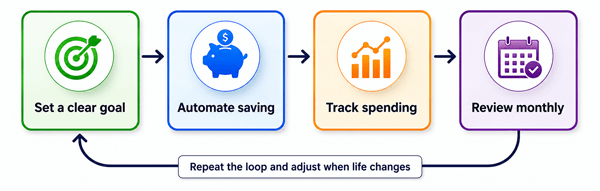
■ Simple Diagram: A Better Saving Money System
Use this simple loop to avoid most common saving mistakes. The goal is to make saving automatic, visible, and adjustable.
■ A Step-by-Step Plan to Avoid Saving Mistakes
- Write down your monthly take-home income. Use the amount you actually receive, not your gross salary before deductions.
- List your essential expenses, including rent or mortgage, utilities, food, transport, healthcare, insurance, childcare, and debt minimums.
- Choose one starter savings goal. For many beginners, a small emergency fund is the best first goal.
- Pick a realistic amount to save every payday. It can be small. Consistency matters more than perfection.
- Automate the transfer if possible. This reduces the need to rely on memory or motivation.
- Create sinking funds for irregular expenses. Divide yearly costs by 12 and save monthly.
- Review your spending once a week for 10 minutes. Look for patterns, not perfection.
- Review your full plan once a month. Adjust for income changes, bills, emergencies, and new goals.
■ Savings Mistake Checklist
| Question to Ask Yourself | What It May Reveal | Action to Take |
|---|---|---|
| Do I save before spending? | Whether savings depend on leftovers. | Automate savings on payday. |
| Do I know exactly what I am saving for? | Whether your goals are too vague. | Name each savings goal and set a target. |
| Do I have annual bills planned? | Whether irregular expenses may disrupt savings. | Create sinking funds. |
| Do I use savings for non-emergencies? | Whether savings are too easy to access. | Separate emergency savings from spending money. |
| Am I saving while adding expensive debt? | Whether debt interest is working against you. | Build a small buffer, then attack high-interest debt. |
| Is my savings plan too strict? | Whether burnout is likely. | Add a realistic personal spending allowance. |
4. Pros and Cons of Aggressive Saving
Some people try to save as much as possible in a short period. This can be useful, but it is not always the best approach.
| Potential Benefits | Potential Risks | Best Use Case |
|---|---|---|
| Builds emergency savings faster. | Can feel restrictive and cause burnout. | Short-term goal such as building a starter emergency fund. |
| Reduces unnecessary spending quickly. | May cut important needs or healthy enjoyment. | Temporary reset after overspending. |
| Can help pay off debt faster. | May create pressure on family or relationships. | When everyone affected agrees on the plan. |
| Creates strong financial momentum. | Can lead to guilt when normal spending resumes. | A planned challenge with a clear end date. |
5. Common Misconceptions About Saving Money
Misconception: You need a lot of income to save.
Income helps, but saving is also a habit. Many people start with small amounts and increase savings over time.
Misconception: Saving means never enjoying life.
A good savings plan includes room for reasonable enjoyment. The goal is intentional spending, not constant deprivation.
Misconception: All debt must be gone before saving.
A small emergency fund can prevent more debt. After that, it often makes sense to balance saving with debt repayment.
Misconception: A sale always saves money.
A sale saves money only when the purchase is needed, planned, and affordable.
Misconception: Budgeting and saving are the same thing.
Budgeting is the plan for your money. Saving is one result of that plan. You usually need both.
6. Real-World Examples
Example 1: The Beginner Who Has Never Saved Before
A person earns $1,800 per month and feels there is never anything left. Instead of trying to save $500 immediately, they start with $50 per month on payday. They also cancel two unused subscriptions worth $18 per month and reduce impulse snacks by $20 per month. Within a few months, they have built a small emergency cushion and proved they can save consistently.
Example 2: The Family With Irregular Expenses
A family often uses credit cards for school fees, car maintenance, and holiday spending. They list these predictable costs and estimate $2,400 per year. By saving $200 per month into sinking funds, they reduce surprise bills and protect their emergency fund.
Example 3: The Person With High-Interest Debt
Someone has credit card debt and no emergency savings. They first save a small emergency buffer so a minor problem does not create more debt. Then they focus extra money on the highest-interest debt while continuing a small automatic savings habit.
7. Beginner-Friendly Savings Rules That Work
- Save first, not last. Treat savings like a bill you pay to your future self.
- Make goals specific. A named goal is easier to protect than vague savings.
- Use separate buckets. Emergency money, annual bills, and long-term goals should not be mixed together.
- Plan for real life. Include occasional fun, repairs, gifts, and irregular costs.
- Review without shame. The purpose of tracking is to improve decisions, not punish yourself.
- Increase savings gradually. A stable habit that grows is better than an extreme plan that fails.
■ FAQs About Saving Money Mistakes
1. What is the biggest mistake people make when saving money?
The biggest mistake is often saving only what is left over. A better method is to save first, ideally through an automatic transfer soon after income arrives.
2. How much should a beginner save each month?
A beginner should save an amount they can repeat consistently. This might be 5% to 10% of income, or even a small fixed amount. The right amount depends on income, essential expenses, debt, and family responsibilities.
3. Should I save money or pay off debt first?
It often helps to build a small emergency fund first, then focus extra money on high-interest debt while keeping a basic savings habit. The best balance depends on your interest rates and risk of unexpected expenses.
4. Is it bad to use my savings?
No. Savings exist to support your life. It is appropriate to use emergency savings for real emergencies and sinking funds for planned expenses. The problem is using savings regularly for impulse spending.
5. How can I stop dipping into my savings?
Separate savings from everyday spending, remove easy debit card access, create clear rules for withdrawals, and use named savings goals so the money has a purpose.
6. What if I do not earn enough to save?
Start very small if possible and focus on building the habit. Also review expenses, benefits, debt payments, and income opportunities. If your income does not cover basic needs, the first priority is stability, not aggressive saving.
7. Are no-spend challenges a good idea?
They can be useful as a short-term reset, especially for discretionary spending. They are less useful if they are too strict or ignore real needs. A no-spend challenge should have clear rules and a clear end date.
8. How often should I review my savings plan?
A quick weekly spending check and a deeper monthly review work well for many beginners. Review sooner if your income, bills, or family situation changes.
■ Final Thoughts
Most saving money mistakes are not caused by laziness or lack of intelligence. They usually happen because there is no clear system. When you save first, set realistic goals, plan for irregular expenses, separate your savings, and review your progress, saving becomes much easier to manage.
Start with one change. Automate a small amount, name your first goal, or track your spending for two weeks. Small improvements repeated over time can create real financial progress.
Reader Advice: This article is for educational and informational purposes only and should not be taken as personal financial, legal, tax, or investment advice. Please check the latest information from official sources or a qualified professional, as rules, products, policies, and financial conditions can change over time.