How to Save Money: Complete Guide for Beginners
Saving money is one of the most important personal finance skills because it gives you choices. It can help you handle emergencies, avoid unnecessary debt, reach goals faster, and feel more confident about your future. But for beginners, saving can feel confusing, especially when income is limited, prices keep rising, or expenses seem to appear from nowhere.
The good news is that saving money does not require perfection, a high salary, or extreme sacrifice. It starts with understanding where your money goes, choosing a realistic savings goal, and making small repeatable changes. This guide explains how to save money in a simple, practical way so you can begin today and build habits that last.
This guide answers the beginner questions people commonly ask about how to save money, how to budget, how to build an emergency fund, how to reduce expenses, and how to save when income is limited.
1. What Does Saving Money Really Mean?
Saving money means setting aside part of your income instead of spending all of it. The money you save can be used for future needs, planned goals, unexpected expenses, or financial security. It is not just about cutting costs. It is about using your money intentionally so it supports what matters most to you.
For example, saving money may mean keeping $25 a week in a separate account, cooking at home three nights a week, canceling a subscription you no longer use, or comparing prices before buying insurance. Each action may look small, but together they create breathing room in your finances.
2. Why Saving Money Matters
Saving money matters because life is unpredictable. A broken phone, medical bill, car repair, job loss, school expense, or family emergency can create stress when there is no money set aside. Savings act as a financial buffer between you and debt.
Saving also helps you take advantage of opportunities. You may want to take a course, move to a better apartment, start a small business, travel, buy a home, or invest for the future. These goals are easier when you have a habit of setting money aside regularly.
Key benefits of saving money
- Less dependence on credit cards, loans, or borrowing from family and friends.
- More control over emergencies and irregular expenses.
- Lower financial stress because you have a cushion.
- Better ability to plan for goals such as education, travel, a home, retirement, or business needs.
- More confidence when making important life decisions.
3. The Beginner Saving Formula
A simple saving formula is: income minus necessary expenses minus planned savings equals flexible spending. Many beginners save only what is left at the end of the month. The problem is that there is often nothing left. A better approach is to decide a realistic saving amount first, then build your spending around it.
You do not need to start with a large amount. If saving $200 a month feels impossible, start with $20, $10, or even $5. The first goal is to build the habit. Once the habit is stable, you can increase the amount.
| Step | What to Do | Example |
|---|---|---|
| 1. Know your income | Write down your reliable monthly take-home income. | $2,000 after tax |
| 2. List essential expenses | Include rent, utilities, transport, food, insurance, debt payments, and basic needs. | $1,450 |
| 3. Choose a starter savings amount | Pick a realistic amount you can repeat. | $100 per month |
| 4. Plan flexible spending | Use the remaining money for wants and non-essentials. | $450 |
| 5. Review monthly | Adjust categories based on real spending. | Reduce dining out if grocery costs rise |
Step 1: Understand Where Your Money Goes
Before you can save more money, you need to see your spending clearly. Many people think they know where their money goes, but small purchases can add up quickly. Tracking your spending for 30 days is one of the fastest ways to find savings opportunities.
You can use a notebook, spreadsheet, banking app, budgeting app, or notes app. The tool is less important than consistency. Record every expense, including small purchases such as snacks, delivery fees, parking, tips, subscriptions, and impulse buys. This also helps you separate needs, wants, debt payments, and savings so your budget is based on real numbers rather than guesses.
Common spending categories to track
- Housing: rent, mortgage, maintenance, property fees.
- Utilities: electricity, water, gas, internet, phone.
- Food: groceries, restaurants, coffee, delivery.
- Transportation: fuel, fares, repairs, insurance, parking.
- Debt payments: credit cards, student loans, personal loans.
- Personal and family needs: clothing, school, childcare, medicine, toiletries.
- Entertainment and lifestyle: streaming, hobbies, events, apps, gifts.
- Savings and investments: emergency fund, sinking funds, retirement, education fund.
Step 2: Set Clear Savings Goals
Saving becomes easier when your money has a purpose. A vague goal such as “I want to save more” is easy to ignore. A specific goal such as “I want to save $600 for emergencies in six months” gives you direction.
Begin with one or two goals. Too many goals can feel overwhelming. Most beginners should start with a small emergency fund, then add other goals once the first cushion is in place. If your income changes from month to month, choose a minimum savings amount for slow months and add extra only when cash flow allows.
| Goal Type | Purpose | Beginner Example |
|---|---|---|
| Emergency fund | Covers unexpected costs without relying on debt. | Save $500 to $1,000 as a starter fund. |
| Sinking fund | Prepares for predictable irregular expenses. | Save monthly for car repairs, annual fees, school costs, holidays, or gifts. |
| Short-term goal | Pays for something within 12 months. | Phone replacement, course, travel, furniture. |
| Long-term goal | Builds future security and wealth. | Home down payment, retirement, children's education. |
Step 3: Build a Simple Budget
A budget is a plan for your money. It tells your income where to go before it disappears. Budgeting does not mean you cannot enjoy life. It means you choose what matters and reduce waste in areas that matter less.
Beginners should keep budgeting simple. A complicated budget with too many categories can become frustrating. Start with broad categories, then add detail only when needed.
Simple beginner budget example
| Category | Suggested Starting Point | Notes |
|---|---|---|
| Needs | 50% to 70% | Housing, food, transport, utilities, basic health, minimum debt payments. |
| Savings and debt payoff | 10% to 20% | Emergency fund, planned savings, extra debt payments. |
| Wants | 10% to 30% | Dining out, entertainment, shopping, hobbies, subscriptions. |
These percentages are only starting points. If your income is low or your housing costs are high, your needs may be more than 70%. That does not mean you have failed. It simply means your budget must be adjusted to your real life. The goal is progress, not perfection. In high-cost months, protect rent, food, utilities, transport, minimum debt payments, and a small emergency contribution before spending on wants.
| Situation | What to Prioritize | Simple Action |
|---|---|---|
| Low income or tight budget | Essentials, minimum debt payments, and a very small emergency fund | Start with $5 to $10 per payday and review recurring bills. |
| Irregular income | Cash-flow safety and flexible goals | Base your budget on a conservative month and save extra in higher-income months. |
| High-interest debt | Minimum payments plus extra toward expensive debt | Keep a starter emergency fund, then focus extra money on the highest-interest balance. |
Beginner budget adjustments by situation
Step 4: Pay Yourself First
Paying yourself first means saving before spending on non-essential items. As soon as your income arrives, move your planned savings amount to a separate account. This makes saving automatic and reduces the temptation to spend the money.
For example, if you are paid on the 1st of each month, schedule an automatic transfer to savings on the same day or the next day. If you are paid weekly, save a smaller amount each payday. Automation works because it removes the need to make the same decision again and again.
Pay-yourself-first example
| Income Schedule | Automatic Saving Plan | Monthly Result |
|---|---|---|
| Paid weekly | Save $15 each payday | About $60 per month |
| Paid every two weeks | Save $40 each payday | About $80 per month |
| Paid monthly | Save $100 when salary arrives | $100 per month |
Step 5: Reduce the Big Expenses First
Small savings matter, but the biggest results often come from the biggest expenses: housing, transportation, food, debt, and insurance. Cutting one major recurring expense can save more than skipping small treats occasionally.
1. Housing
Housing is often the largest expense. Not everyone can move quickly, but it is worth reviewing housing costs when your lease ends or when your life changes. Saving strategies may include getting a roommate, negotiating rent where possible, moving to a lower-cost area, refinancing a mortgage if it truly reduces total costs, or avoiding upgrades that stretch your budget too far.
2. Transportation
Transportation costs include more than fuel or fares. They may include maintenance, insurance, parking, registration, repairs, and loan payments. You can save by using public transport when practical, carpooling, maintaining your vehicle, comparing insurance quotes, planning errands together, or delaying a car upgrade.
3. Food
Food is one of the easiest categories to improve because small planning changes can make a big difference. Make a weekly meal plan, shop with a list, cook simple meals, use leftovers, compare unit prices, and reduce food delivery. You do not need gourmet meal prep. A few repeatable meals can lower stress and spending.
4. Debt
Debt can quietly reduce your ability to save. High-interest debt is especially expensive because interest charges consume money that could be used for goals. If you have debt, keep making minimum payments and consider using extra money to pay down the highest-interest debt first. This is often called the debt avalanche method. Another option is the debt snowball method, where you pay the smallest balance first to build motivation. Avoid taking new debt for non-essential purchases while you are trying to build your first savings cushion.
Step 6: Cut Waste Without Feeling Deprived
Saving money should not feel like punishment. If your plan is too strict, you may quit. A better approach is to remove low-value spending and keep some room for things you truly enjoy.
| Spending Area | Common Waste | Practical Saving Move |
|---|---|---|
| Subscriptions | Paying for apps, streaming, or services you rarely use. | Cancel or pause anything unused for 30 days. |
| Food delivery | Delivery fees, tips, and markups make meals much more expensive. | Choose one planned delivery day instead of ordering impulsively. |
| Groceries | Buying without a list or wasting food. | Plan meals around what you already have. |
| Shopping | Buying because of sales, ads, or boredom. | Use a 24-hour rule for non-essential purchases. |
| Bank fees | Overdraft fees, ATM fees, late fees. | Set reminders, use free ATMs, and keep a small buffer. |
| Utilities | Leaving devices, lights, heating, or cooling unmanaged. | Use efficient habits and review plans or providers when possible. |
Step 7: Use the 24-Hour Rule for Impulse Spending
Impulse spending is one of the biggest barriers to saving. The 24-hour rule is simple: when you want to buy something non-essential, wait at least 24 hours before purchasing. For bigger purchases, wait seven days or 30 days.
This rule works because many spending urges fade with time. If you still want the item later and it fits your budget, you can buy it without guilt. If you forget about it, you have saved money without feeling restricted.
Step 8: Separate Savings From Spending Money
Keeping savings in the same account as everyday spending makes it easy to spend accidentally. A separate savings account creates a mental boundary. You can also use separate accounts or sub-accounts for different goals. For short-term goals, prioritize safety, easy access, and low fees over risky returns.
Example savings buckets
- Emergency fund
- Car repair fund
- Annual bills fund
- Holiday and gift fund
- Education or career fund
- Home or moving fund
This system helps you avoid surprise expenses. For example, if your car insurance is due every six months, divide the bill by six and save that amount each month. When the bill arrives, the money is already waiting.
Step 9: Increase Income When Cutting Costs Is Not Enough
Sometimes the problem is not overspending. The problem is that income is too low for basic needs. In that case, cutting small expenses may help, but it will not solve everything. Look for safe, realistic ways to increase income.
■ Beginner-friendly income ideas
- Ask for extra hours, overtime, or a raise if appropriate.
- Sell items you no longer use.
- Offer a simple service such as tutoring, repairs, design, writing, cleaning, delivery, or administrative support.
- Use existing skills for freelance or part-time work.
- Improve career skills through affordable courses or certifications.
Be careful with side hustles that require large upfront costs, unclear earnings, or unrealistic promises. A good income idea should be simple to understand, legal, safe, and profitable after expenses.
Step 10: Protect Your Savings From Common Setbacks
Saving money is not only about adding money to an account. It is also about protecting that money. Many beginners save for a few months, then lose progress because they do not plan for irregular expenses or emotional spending triggers.
■ Common saving setbacks and how to prevent them
| Setback | Why It Happens | Prevention |
|---|---|---|
| Unexpected bill | No sinking fund for predictable irregular costs. | Save monthly for annual or seasonal expenses. |
| Emergency spending | No emergency fund or it is too small. | Build a starter emergency fund first. |
| Impulse shopping | Stress, boredom, ads, or social pressure. | Use the 24-hour rule and unsubscribe from tempting emails. |
| Budget burnout | Plan is too strict and leaves no room for enjoyment. | Include a small fun-money category. |
| Lifestyle creep | Spending rises when income rises. | Increase savings automatically when income increases. |
4. How Much Money Should You Save?
There is no single perfect amount for everyone. A common long-term target is to save 10% to 20% of income, but beginners should start with what is realistic. Saving $10 consistently is better than planning to save $300 and quitting after one month.
A practical beginner path is to first save a small emergency fund, then work toward one month of essential expenses, then three to six months if possible. The right amount depends on your job stability, family responsibilities, debt, health needs, and living costs.
Savings target roadmap
| Stage | Target | Why It Helps |
|---|---|---|
| Stage 1 | $100 to $500 | Gives a small cushion for minor surprises. |
| Stage 2 | $500 to $1,000 | Reduces dependence on credit for common emergencies. |
| Stage 3 | 1 month of essential expenses | Protects you during income delays or larger bills. |
| Stage 4 | 3 to 6 months of essential expenses | Creates stronger security for job loss, illness, or major disruptions. |
| Stage 5 | Goal-based savings and investing | Supports larger goals and long-term wealth building. |
5. Example: How a Beginner Can Start Saving This Month
Imagine Sara earns $2,000 per month after tax. She wants to save money but usually reaches the end of the month with very little left. She tracks her spending and finds three changes she can make without drastically changing her life.
| Change | Monthly Savings |
|---|---|
| Cancel two unused subscriptions | $24 |
| Cook at home two extra nights per week | $80 |
| Use a 24-hour rule to reduce impulse shopping | $50 |
| Total estimated savings | $154 |
Instead of hoping to save whatever remains, Sara sets an automatic transfer of $100 at the beginning of the month. She leaves the remaining $54 as extra breathing room. This gives her a realistic plan and avoids making the budget too tight.
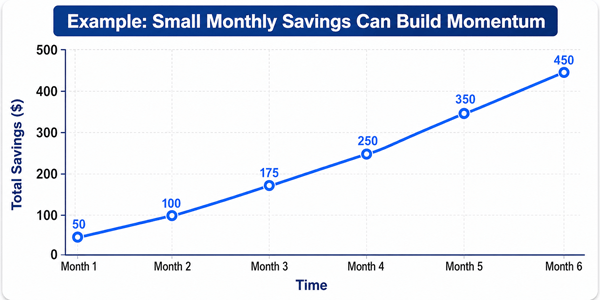
6. Visual Chart: Small Savings Add Up
The chart below shows how regular small savings can build momentum over time. The amounts are only examples, but the principle is important: consistency matters. The example assumes steady monthly deposits and does not include interest, fees, or investment returns.
7. Saving Money Methods: Which One Should You Use?
| Method | Best For | Pros | Cons |
|---|---|---|---|
| Pay yourself first | People who forget to save after spending. | Simple, automatic, builds discipline. | Requires enough cash flow timing to avoid overdrafts. |
| Cash envelope method | People who overspend in flexible categories. | Makes limits visible and practical. | Less convenient for online spending. |
| 50/30/20 rule | People who want a simple budget framework. | Easy to understand and adjust. | May not fit low income or high-cost areas. |
| Zero-based budget | People who want detailed control. | Every dollar has a job. | Can feel time-consuming for beginners. |
| No-spend challenge | People needing a short reset. | Quickly reveals habits and waste. | Not a complete long-term system by itself. |
8. Best Money-Saving Tips for Beginners
- Start with one savings goal, not ten. A small emergency fund is usually the best first goal.
- Automate savings on payday so you do not rely on willpower.
- Track spending for at least 30 days before making major changes.
- Use a shopping list and meal plan to reduce grocery waste.
- Compare recurring bills such as insurance, phone, internet, and subscriptions.
- Avoid buying something only because it is on sale. A discount is not savings if you did not need the item.
- Create sinking funds for predictable expenses such as car repairs, school costs, holidays, and annual fees.
- Keep a small fun-money category so the budget is realistic.
- Review your budget monthly and adjust it instead of giving up.
- Increase savings when income rises, even if only by a small amount.
9. Common Mistakes Beginners Make When Trying to Save Money
Mistake 1: Trying to save too much too quickly
A very aggressive savings plan may look good on paper but fail in real life. If your plan leaves no room for normal expenses, you may keep dipping into savings. Start with an amount you can repeat, then increase it gradually.
Mistake 2: Not tracking small expenses
Small purchases are easy to ignore, but they can become a large monthly cost. Coffee, snacks, delivery fees, in-app purchases, and impulse buys may be the difference between saving and not saving.
Mistake 3: Keeping savings too accessible
If your savings are in the same account as spending money, it is easy to use them casually. Keep savings separate and define what counts as a real reason to use them.
Mistake 4: Ignoring irregular expenses
Annual bills, birthdays, school costs, car repairs, and holidays are not emergencies if they happen regularly. Plan for them with sinking funds.
Mistake 5: Thinking saving is only for people with high income
Higher income can help, but saving is also a habit. Even a small amount saved consistently teaches discipline and builds momentum. At the same time, be honest: if income cannot cover basic needs, increasing income may be just as important as cutting expenses.
10. How to Stay Motivated While Saving Money
Motivation is easier when you can see progress. Name your savings account after your goal, such as “Emergency Fund” or “New Laptop Fund.” Track your balance monthly. Celebrate milestones in a low-cost way. For example, when you reach your first $100, acknowledge it. When you reach $500, review what helped you get there and repeat it.
Also remember that setbacks are normal. One difficult month does not erase your progress. If you need to use savings for a real emergency, that means your savings did their job. Rebuild when you can.
11. Beginner Saving Checklist
| Task | Done? |
|---|---|
| Track all spending for 30 days. | |
| Choose one clear savings goal. | |
| Open or use a separate savings account. | |
| Set an automatic transfer on payday. | |
| Cancel or pause unused subscriptions. | |
| Create a simple meal plan and shopping list. | |
| Use a 24-hour rule for non-essential purchases. | |
| Start a sinking fund for irregular expenses. | |
| Review your budget at the end of the month. |
■ Frequently Asked Questions
The answers below are written for beginners who want practical, low-risk steps before moving into advanced investing or complex financial products.
1. What is the easiest way to start saving money?
The easiest way is to choose a small amount and automate it on payday. Start with an amount you can repeat without creating stress, even if it is very small. Consistency is more important than size at the beginning.
2. How can I save money if I live paycheck to paycheck?
Start by tracking spending, protecting essential bills, and finding one small saving opportunity. Even $5 or $10 can begin the habit. Also look for ways to reduce recurring costs and increase income, because cutting expenses alone may not be enough if your income is too low for basic needs.
3. Should I save money or pay off debt first?
Many people benefit from doing both: build a small emergency fund first, keep making minimum debt payments, then focus extra money on high-interest debt. Once expensive debt is under control, increase savings for larger goals.
4. Where should I keep my savings?
Keep short-term savings in a safe, accessible account separate from everyday spending. Money needed soon should generally not be placed in risky investments because its value can go down when you need it.
5. How much emergency savings do I need?
A starter emergency fund of $500 to $1,000 can help with small emergencies. Over time, many people aim for three to six months of essential expenses. The right amount depends on your income stability, dependents, debt, and living costs.
6. Is it better to cut expenses or earn more money?
Both can help. Cutting waste gives quick results and builds discipline. Increasing income can create more room when basic expenses are already tight. The strongest plan often combines both approaches.
7. How do I stop spending my savings?
Separate savings from your spending account, name each savings goal, automate transfers, and define clear rules for when you can use the money. If you regularly use savings for normal bills, adjust your budget so it reflects your real expenses.
8. Can saving money make me wealthy?
Saving money is a foundation, but long-term wealth usually also involves earning, investing, managing debt, and protecting your finances. Savings give you stability and create the money you can later use for larger financial goals.
■ Final Thoughts
Learning how to save money is not about being perfect or never enjoying your income. It is about making your money more intentional. Start by tracking your spending, setting one clear goal, automating a small amount, and reducing low-value expenses. As your confidence grows, increase your savings and plan for bigger goals.
The best savings plan is the one you can actually follow. Start small, stay consistent, review often, and improve gradually. Over time, these simple habits can create real financial security.
Reader Advice: This article is for educational and information purposes only and should not be taken as financial, legal, tax, or investment advice. Please check the latest information from official sources or a qualified professional, because rules, fees, products, and policies can change over time.