How to Save Your First $1,000: Step-by-Step Guide
1. Introduction: Why Your First $1,000 Matters
Saving your first $1,000 is one of the most important early financial goals you can set. It may not solve every money problem, but it gives you breathing room. A small emergency fund can help you handle a car repair, medical bill, job gap, school expense, or urgent family need without immediately relying on credit cards, payday loans, or borrowing from friends.
This guide explains how to save your first $1,000 step by step. It is written for beginners, including people who have never budgeted before, feel behind, or think they do not earn enough to save. The goal is not perfection. The goal is to make saving simple, realistic, and repeatable.
Because this is a personal finance topic, the steps below are intentionally practical, conservative, and beginner-friendly. The article focuses on cash savings, avoiding unnecessary debt, and making decisions based on your own income, bills, and local banking rules.
2. What Does “Saving Your First $1,000” Mean?
Saving your first $1,000 means setting aside money that is not for regular bills, shopping, entertainment, or planned spending. It is money you protect for real financial emergencies or important short-term stability.
Think of this money as a starter emergency fund. It is not the same as retirement savings, investing money, or a vacation fund. It is your financial safety cushion. Once you reach $1,000, you can later work toward a larger emergency fund of three to six months of essential expenses, but $1,000 is a strong first milestone.
The phrase “first $1,000” does not mean everyone needs the same final emergency fund. It means building a first layer of protection before moving toward a larger safety net that fits your household, job stability, family responsibilities, and essential expenses.
| Money Type | Purpose | Example |
|---|---|---|
| Starter emergency fund | Covers unexpected urgent costs | Car repair, medical copay, urgent travel, lost wages |
| Regular checking account | Pays normal monthly bills | Rent, groceries, utilities, transport |
| Sinking fund | Pays predictable future costs | Holiday gifts, insurance premium, school fees |
| Investment account | Builds long-term wealth | Retirement, index funds, long-term goals |
3. The Simple Math: How Long Will It Take to Save $1,000?
The time it takes depends on how much you can save each week or month. Do not start by judging yourself. Start by choosing a target that is realistic enough to follow consistently.
| Savings Amount | Time to Reach $1,000 | Best For |
|---|---|---|
| $25 per week | About 40 weeks | Very tight budgets |
| $50 per week | About 20 weeks | Moderate budgets |
| $75 per week | About 14 weeks | People who can cut a few larger expenses |
| $100 per week | 10 weeks | A focused short-term challenge |
| $250 per month | 4 months | Monthly pay schedules |
| $500 per month | 2 months | Temporary aggressive savings push |
A helpful rule: choose the fastest plan that does not make you miss bills, skip essentials, or create new debt. A plan you can actually finish is better than an extreme plan you quit after two weeks.
Another simple way to think about the goal is daily progress: saving about $2.75 a day reaches $1,000 in one year, about $5.50 a day reaches it in six months, and about $11 a day reaches it in roughly 90 days. These daily numbers can make the goal feel less intimidating.
4. Step-by-Step Plan to Save Your First $1,000
Step 1: Decide What the $1,000 Is For
Before saving the money, give it a clear job. For most beginners, the job is emergency protection. Write one sentence: “This $1,000 is for unexpected necessary expenses only.” This keeps you from spending it casually when a sale, trip, or non-urgent want appears.
Good uses include urgent car repairs, medical costs, essential home repairs, or covering basic bills after a temporary income drop. Poor uses include impulse shopping, lifestyle upgrades, gifts you did not plan for, or routine bills you already knew were coming.
Step 2: Open a Separate Savings Account
Keep your first $1,000 away from the account you use every day. A separate savings account creates friction, which is useful. When savings sit in the same checking account as spending money, it is easy to accidentally spend them.
Look for an account with no monthly fee, easy transfers, and clear online access. A high-yield savings account can be helpful, but the interest rate is not the main point at this stage. The main point is safety, separation, and consistency.
Before opening any account, check the fee schedule, withdrawal limits, transfer timing, and whether the bank or credit union is covered by the relevant deposit protection program in your country. Avoid accounts that charge fees that could slowly reduce your emergency fund.
| Where to Keep It | Pros | Cons | Best Use |
|---|---|---|---|
| Separate savings account | Safe, easy to track, less tempting than checking | May take a little time to transfer | Best default option |
| Checking account sub-account | Convenient and visible | Easy to spend accidentally | Only if you are disciplined |
| Cash envelope at home | Simple and tangible | Risk of theft, loss, or spending | Small short-term amounts only |
| Investment account | Potential long-term growth | Can lose value and may be harder to access | Not ideal for emergency savings |
Step 3: Pick a Deadline and Weekly Target
A savings goal becomes easier when it has a deadline. Instead of saying, “I want to save money,” say, “I will save $1,000 in 20 weeks by saving $50 per week.” This turns a vague wish into a measurable plan.
If your income is irregular, use a monthly or percentage-based target. For example, you might save 10% of every payment you receive until the account reaches $1,000.
For irregular income, use a “save when paid” rule instead of waiting for the end of the month. You can save a small percentage from every payment, then add extra from larger payments, refunds, tips, commissions, or seasonal work.
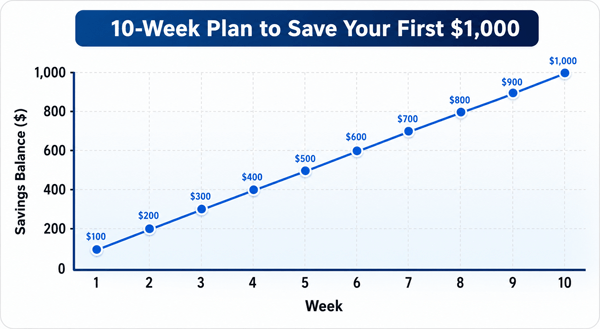
Figure: One example of a 10-week savings challenge, saving $100 per week until you reach $1,000.
Step 4: Find the Money Before You Try to Save It
Many people try to save whatever is left at the end of the month. The problem is that there is often nothing left. A better approach is to decide where the money will come from before the month begins.
Use this three-part method:
The best money-saving plan usually combines one small cut, one medium cut, and one income boost. That mix is more realistic than trying to remove every enjoyable expense at once.
- Cut or reduce one recurring expense.
- Pause or limit one flexible spending category.
- Add one temporary income boost until you reach $1,000.
For example, you might reduce takeout by $25 per week, cancel or pause a subscription worth $15 per month, and sell unused items for $150. These changes may not feel huge individually, but together they can build momentum quickly.
| Action | Possible Monthly Savings | Difficulty | Notes |
|---|---|---|---|
| Cook at home 3 more times per week | $80–$200 | Medium | Works best with a simple meal plan. |
| Cancel unused subscriptions | $10–$60 | Easy | Check app stores, bank statements, and streaming services. |
| Lower phone or internet plan | $10–$50 | Medium | Ask providers about cheaper plans or discounts. |
| Use public transport or carpool more often | $30–$150 | Medium | Depends on location and schedule. |
| No-spend weekends | $50–$200 | Medium | Plan free activities ahead of time. |
| Sell unused items | $50–$500 (one time) | Easy to medium | Good for jump-starting savings. |
| Pick up one extra shift or small side job | $50–$300+ | Medium to hard | Use as a temporary push, not a permanent burnout plan. |
Step 5: Pay Yourself First
Paying yourself first means moving money into savings as soon as you get paid, before spending on non-essentials. This works because it treats savings like a bill you owe your future self.
If you are paid every two weeks and want to save $1,000 in five months, set aside about $100 per paycheck. If you are paid weekly, set aside about $50 per week for 20 weeks. If you are paid irregularly, save a fixed percentage from each payment, such as 5%, 10%, or 15%, depending on what is realistic.
Step 6: Automate the Transfer
Automation removes the need to make the same decision again and again. Set an automatic transfer from checking to savings on payday or the day after payday. Even a small automatic transfer builds the habit.
If automation might cause overdraft fees because your income varies, use a calendar reminder instead. The key is to make saving a scheduled action, not a random hope.
Step 7: Track Progress Visibly
Tracking keeps you motivated. Use a notebook, spreadsheet, app, printable tracker, or simple note on your phone. Each time you save, update your balance. Watching the number grow makes the goal feel real.
| Milestone | Balance | What It Means |
|---|---|---|
| 10% | $100 | You have started and proved the habit is possible. |
| 25% | $250 | You can handle a small unexpected expense without panic. |
| 50% | $500 | You are halfway there and have real financial breathing room. |
| 75% | $750 | The goal is close; protect your progress. |
| 100% | $1,000 | Your starter emergency fund is complete. |
Step 8: Protect the Money from “Fake Emergencies”
A common mistake is treating every inconvenience as an emergency. Not everything urgent is truly important, and not everything important is unexpected. Before using the money, ask three questions:
- Is this necessary, not just wanted?
- Is it unexpected, not something I should have planned for?
- Will delaying it create a serious problem or extra cost?
If the answer is yes to all three, using the emergency fund may be reasonable. If not, look for another solution, delay the purchase, or create a separate sinking fund.
■ Beginner Budget Method for Saving $1,000
You do not need a complicated budget to save your first $1,000. Start with a simple four-category budget:
- Income: all money coming in.
- Needs: rent, utilities, groceries, basic transport, minimum debt payments.
- Wants: eating out, entertainment, shopping, upgrades, hobbies.
- Savings: your weekly or monthly $1,000 goal contribution.
Subtract needs from income first. Then choose a savings amount. Finally, limit wants to what remains. This order matters because if wants come before savings, your savings goal usually loses.
| Category | Example Amount |
|---|---|
| Monthly take-home income | $2,400 |
| Needs | -$1,850 |
| Debt minimums | -$150 |
| Savings goal | -$200 |
| Wants/flexible spending left | $200 |
In this example, saving $200 per month would reach $1,000 in five months. If $200 is too much, reduce the target or look for extra income. If $200 is easy, increase the target and finish sooner.
■ Practical Saving Strategies That Work
1. Use a 30-Day Spending Reset
For the next 30 days, pause non-essential purchases that are easy to restart later. This may include takeout, paid entertainment, clothing, gadgets, home decor, or premium subscriptions. A reset is not forever; it is a focused sprint to reach a specific goal.
2. Try the “Save the Difference” Method
When you choose a cheaper option, move the difference to savings. If you planned to spend $25 on lunch but spent $8, transfer $17. If you negotiate a bill down by $20, transfer the $20 each month. This turns smart spending decisions into visible savings progress.
3. Use Windfalls Wisely
Tax refunds, bonuses, cash gifts, rebates, overtime, and money from selling items can speed up your first $1,000. A practical rule is to save most of the windfall until the goal is complete. For example, save 80% and use 20% for something enjoyable or necessary.
4. Make Groceries Boring for a Short Time
Food is one of the most flexible budget categories. For a temporary savings push, repeat simple low-cost meals, shop with a list, use what you already have, and reduce food waste. You do not need extreme couponing. You need fewer unplanned trips and fewer unused groceries.
5. Negotiate or Shop Around for Bills
Call service providers and ask whether a lower plan, loyalty discount, or current promotion is available. Compare insurance, phone, internet, and banking fees. Even small monthly reductions matter because they repeat automatically.
What If You Live Paycheck to Paycheck?
Saving $1,000 while living paycheck to paycheck can feel impossible, but the first goal is not to save a huge amount immediately. The first goal is to create a small gap between income and spending. Start with $5, $10, or $20 per paycheck if that is all you can manage. The habit matters.
If your income truly does not cover basic needs, cutting small expenses may not be enough. In that case, focus on stabilizing the basics first: housing, food, utilities, transport, minimum debt payments, and income. Look for community resources, benefit programs, overtime opportunities, better-paying roles, or skill-based income improvements. Saving is easier when the budget has room to breathe.
If you are in this situation, treat shame-free support as part of the plan. Food assistance, utility hardship programs, nonprofit credit counseling, and local community programs can help create the first small gap needed to start saving.
■ Pros and Cons of a $1,000 Starter Emergency Fund
| Pros | Cons or Limits |
|---|---|
| Gives quick protection from small emergencies | May not cover large emergencies like job loss or major medical bills |
| Reduces reliance on high-interest debt | Can feel slow to build on a low income |
| Builds confidence and discipline | Requires saying no to some short-term wants |
| Creates a foundation for bigger financial goals | Needs to be rebuilt if used |
The key limitation is that $1,000 is a starting point, not a complete financial safety net. After reaching it, your next goal should be to keep it intact, pay down harmful high-interest debt if needed, and gradually build a larger emergency fund.
■ Common Mistakes to Avoid
1. Waiting Until You Earn More
More income can help, but saving is a habit. Start with the amount you can manage now, even if it is small.
A useful safeguard is to write down one rule before you start: “I will not use this $1,000 for wants, sales, upgrades, or predictable bills.” A clear rule reduces emotional spending later.
2. Saving Without Separating the Money
Money kept in your daily spending account is easy to spend. Move it somewhere separate.
3. Cutting Too Much Too Fast
An extreme budget can backfire. Choose a plan that is challenging but still realistic.
4. Using Savings for Predictable Expenses
Annual fees, school supplies, holiday gifts, and insurance premiums should have separate sinking funds when possible.
5. Ignoring Debt Completely
If you have very high-interest debt, you may need a balanced approach: build a small cushion, then attack debt aggressively.
6. Not Rebuilding After an Emergency
If you use the money for a real emergency, restart the plan immediately and rebuild the fund.
■ A 30-Day Starter Plan
| Time Period | Action Steps | Goal |
|---|---|---|
| Day 1 | Open or choose a separate savings account. Name it Emergency Fund. | Make the goal visible. |
| Days 2–3 | Review the last 30 days of spending. Find three expenses to reduce. | Identify quick savings. |
| Days 4–7 | Transfer your first amount, even if it is small. | Start momentum. |
| Week 2 | Cancel unused subscriptions and plan meals before grocery shopping. | Create recurring savings. |
| Week 3 | Sell unused items or pick one temporary income boost. | Add a larger one-time deposit. |
| Week 4 | Set an automatic transfer or payday reminder. | Make the habit repeat. |
■ Example: How Maya Saves Her First $1,000
Maya earns $2,600 per month after taxes and usually has little left over. She wants to save $1,000 in five months, so she needs $200 per month. She decides to reduce takeout by $90, cancel two subscriptions worth $25, lower her phone plan by $20, and sell unused items for $150 in the first month. Her first month savings total $285. After that, she saves around $135 from spending cuts and adds $65 from one extra shift each month. In five months, she reaches $1,000 without relying on a perfect budget.
The lesson is simple: most people reach the first $1,000 by combining several small changes, not by finding one magical solution.
■ What to Do After You Save Your First $1,000
Once you reach $1,000, do not rush to spend it. Keep it separate and use it only for real emergencies. Then decide your next financial step based on your situation:
A good next step is to review your risk level. A single person with stable income may need a different cushion than a parent, freelancer, student, caregiver, or household with one income. Your next target should match your real life, not someone else’s rule.
- If you have high-interest debt, consider focusing extra money on paying it down while keeping the $1,000 cushion.
- If you have no high-interest debt, build your emergency fund toward one month of essential expenses, then three to six months over time.
- If your income is unstable, prioritize a larger cash cushion before taking investment risk.
- If your emergency fund is solid, start learning about retirement accounts and long-term investing.
■ Quick Checklist: Save Your First $1,000
- Choose the purpose: starter emergency fund.
- Open or choose a separate savings account.
- Set a deadline and weekly or monthly target.
- Review spending and pick specific cuts.
- Add temporary income if needed.
- Transfer money on payday.
- Automate or set reminders.
- Track progress every week.
- Protect the money from non-emergencies.
- Rebuild the fund if you use it.
■ Frequently Asked Questions
1. How much should I save first: $500 or $1,000?
If $1,000 feels overwhelming, start with $500. A smaller first milestone is better than no savings. Once you reach $500, continue to $1,000.
2. Should I save $1,000 before paying off debt?
Many people benefit from saving a small emergency fund before aggressively paying off debt. Without any cushion, one surprise expense can push you back into debt. If your debt has very high interest, consider saving a starter cushion and then focusing strongly on repayment.
3. Where should I keep my first $1,000?
A separate savings account is usually best because it is safe, easy to access, and less tempting than checking. Avoid investing emergency money because investments can lose value when you need cash.
4. What if I can only save $10 per week?
Start there. Saving $10 per week reaches $1,000 in about 100 weeks, but you can speed it up with windfalls, selling unused items, temporary work, or occasional no-spend challenges.
5. Is $1,000 enough for an emergency fund?
$1,000 is a starter emergency fund. It can cover many small emergencies, but it may not cover job loss or major expenses. After reaching $1,000, work toward a larger fund over time.
6. Should I use a savings app?
A savings app can help if it makes tracking and transfers easier. Just watch for fees and make sure you understand how the app works before connecting accounts.
7. What counts as an emergency?
A true emergency is necessary, unexpected, and time-sensitive. Examples include urgent repairs, medical costs, or essential bills during a temporary income disruption.
8. How do I stay motivated?
Track your balance visually, celebrate milestones, and focus on the freedom the money gives you. Motivation grows when you see progress.
9. What is the fastest realistic way to save $1,000?
The fastest realistic way is to combine automatic transfers, a short spending reset, one or two bill reductions, and any one-time money such as selling unused items or extra work. Avoid plans that cause missed bills, overdraft fees, or new high-interest debt.
10. Should my first $1,000 be in cash or a bank account?
For most people, a separate savings account is safer and easier to track than keeping the full amount in cash. A small amount of cash may be useful for immediate needs, but a full cash emergency fund can be easier to lose, spend, or have stolen.
■ Final Thoughts
Saving your first $1,000 is not about being rich, perfect, or naturally good with money. It is about building a simple system: separate the money, choose a target, reduce a few expenses, add income when possible, and transfer money consistently. Once you prove to yourself that you can save $1,000, bigger goals become less intimidating.
Start with the next payday, the next $10, or the next small decision. The first deposit matters because it changes the story from “I cannot save” to “I have started.”