What Is Pay Yourself First? Simple Saving Strategy for Beginners
1. Introduction: Why Saving Feels Hard
Many people try to save whatever is left at the end of the month. The problem is that there is often nothing left. Rent, groceries, transport, subscriptions, small purchases, and unexpected costs quietly use up the money before saving even begins.
Pay yourself first is a simple saving strategy that reverses the order. Instead of spending first and saving later, you save first and spend what remains. This makes saving a planned priority rather than a hopeful afterthought.
This guide explains what pay yourself first means, how it works, how much beginners should save, where to keep the money, and how to avoid common mistakes. It is educational information, not personal financial advice. Your best choice depends on your income, expenses, debt, family needs, job stability, tax rules, account options, and local financial protections.
2. What Does Pay Yourself First Mean?
Pay yourself first means treating your savings like an important bill you owe to your future self. When your paycheck, business income, or allowance arrives, a portion is immediately moved into a savings, investment, or debt repayment account before you spend on non-essential items.
The phrase can sound strange because you are not literally paying yourself a salary from yourself. It means you give your future goals a first claim on your money. These goals may include building an emergency fund, paying off high-interest debt, saving for a home, investing for retirement, starting a business, or preparing for school fees.
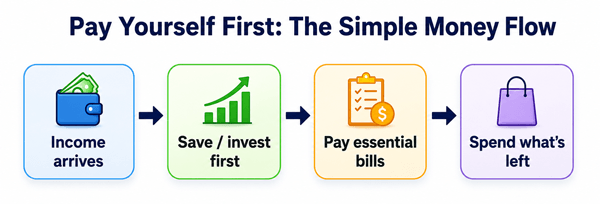
The Basic Rule Income comes in → savings or investment happens first → bills are paid → remaining money is used for everyday spending.
3. Pay Yourself First vs. Traditional Saving
| Traditional Saving | Pay Yourself First |
|---|---|
| Save whatever remains after spending. | Save a planned amount before discretionary spending. |
| Saving depends on willpower and leftover money. | Saving is automatic and built into your routine. |
| Easy to skip during busy or expensive months. | Harder to skip because it happens early. |
| Works best for people with strong tracking habits. | Works well for beginners who want a simple system. |
4. Why Pay Yourself First Works
The strategy works because it changes your default behavior. Most people adapt their spending to the money available in their checking account. If all your income stays in one account, it is easy to spend more than intended. If savings are moved away first, the remaining balance gives you a clearer spending limit.
- It removes the need to decide whether to save every day.
- It reduces temptation by separating savings from spending money.
- It creates consistency, which matters more than occasional large deposits.
- It helps beginners build financial confidence one payday at a time.
- It turns saving into a habit rather than a monthly struggle.
▪ How Pay Yourself First Works Step by Step
- Choose a savings goal. Start with one clear purpose, such as an emergency fund or high-interest debt payoff.
- Pick a realistic amount. Use a percentage of income or a fixed amount per payday.
- Move the money immediately. Set up an automatic transfer for payday or the day after payday.
- Keep savings separate. Use a separate savings account so daily spending does not mix with long-term money.
- Pay essential bills. Cover rent, utilities, food, transport, insurance, minimum debt payments, and other must-pay costs.
- Spend the remaining money intentionally. What remains is your limit for flexible spending until the next payday.
- Review and adjust monthly. Increase, pause, or redirect savings when your situation changes.
▪ How Much Should You Pay Yourself First?
There is no single correct amount for everyone. A common beginner target is 10% of take-home income, but the best amount is the one you can keep doing without missing essential bills. If 10% feels impossible, start smaller. Saving 1% to 5% consistently is better than setting a large goal and quitting after two weeks.
| Situation | Suggested Starting Point | Why It Makes Sense |
|---|---|---|
| Very tight budget | 1% to 3% of take-home pay or a small fixed amount | Builds the habit without risking missed bills. |
| Stable income, limited savings | 5% to 10% | Helps grow an emergency fund at a steady pace. |
| Comfortable cash flow | 10% to 20% | Supports faster savings, investing, or debt payoff. |
| High-interest debt | Small emergency buffer, then extra debt payments | Avoids new debt while attacking expensive balances. |
| Irregular income | Percentage of every payment received | Keeps savings flexible when income changes. |
▪ Simple Formula for Beginners
Pay Yourself First Amount = Take-home income x chosen savings percentage
Example: If your monthly take-home pay is $2,000 and you choose 10%, you save $200 first. You then plan bills and spending around the remaining $1,800.
5. Real-World Examples
Example 1: Beginner With a Tight Budget
Aisha earns $1,200 per month after tax. She wants to start saving but often ends the month with almost nothing. She begins with $25 per payday, twice a month. That is $50 per month. It may not sound large, but after one year she has $600 before any interest. More importantly, she has built a habit she can increase later.
Example 2: Salaried Worker Building an Emergency Fund
Omar takes home $3,000 per month and has no emergency fund. He sets up an automatic transfer of 10%, or $300, into a separate high-yield savings account each payday. In 12 months, he saves $3,600, enough to cover many common emergencies such as car repairs, medical costs, or a short income gap.
Example 3: Freelancer With Irregular Income
Maya is a freelancer. Some months she earns $1,500 and other months she earns $4,000. Instead of saving a fixed monthly amount, she saves 15% of every client payment. When she receives $800, she saves $120. When she receives $2,000, she saves $300. This keeps her system flexible.
6. Where Should You Put the Money?
The right place depends on the purpose of the money. Short-term savings should be safe and easy to access. Long-term money can usually take more investment risk, but only after you understand the risks, fees, tax treatment, and time horizon. Account names and protections differ by country, so use the closest safe local equivalent.
| Goal | Possible Place to Put Money | Key Point |
|---|---|---|
| Emergency fund | Separate savings account | Keep it safe, liquid, and easy to access. |
| Bills due soon | Checking account or bill account | Do not invest money needed in the next few months. |
| High-interest debt payoff | Extra payments to debt after minimums | Often a high-priority use of cash. |
| Retirement | Workplace retirement plan, IRA, pension, or local equivalent | Best for long-term goals, not short-term emergencies. |
| Home, education, or major purchase | Savings account, term deposit, or suitable low-risk option | Match the account to the deadline and risk level. |
7. What Should You Pay Yourself First For?
Beginners often ask whether they should save, invest, or pay off debt first. The answer depends on urgency and risk. A balanced order usually works best.
- Build a small starter emergency fund. Even a small buffer can prevent minor surprises from becoming debt.
- Pay minimums on all debts. Missing payments can lead to fees, credit damage, or service interruptions.
- Attack high-interest debt. Credit cards, payday loans, and expensive personal loans can grow quickly.
- Grow a full emergency fund. Many households aim for three to six months of essential expenses, adjusted for job stability and family needs.
- Invest for long-term goals. Once your foundation is stronger, long-term investing can help build wealth over time.
Important note: investment returns are never guaranteed, and cash needed soon should normally not be exposed to market risk.
8. Pay Yourself First and Budgeting: Do You Still Need a Budget?
Pay yourself first is not a full budget by itself. It is a savings system. You still need a basic plan for bills, food, debt, and everyday spending. The good news is that the budget can be simple. Once savings are moved first, your remaining money becomes the amount you can use for everything else.
| Method | Best For | Limitation |
|---|---|---|
| Pay yourself first | Making saving automatic | Does not show exactly where every dollar goes. |
| 50/30/20 budget | Simple spending structure | May not fit high-cost or low-income situations. |
| Zero-based budget | Detailed control | Takes more time and tracking. |
| Envelope method | Controlling variable spending | Can feel restrictive if too many categories are used. |
9. Benefits of the Pay Yourself First Strategy
- It is simple enough for beginners. You do not need complex spreadsheets to start.
- It builds savings automatically. Automation reduces forgotten transfers and emotional decisions.
- It helps control lifestyle creep. When income rises, you can raise savings before spending expands.
- It creates a financial safety net. Regular saving makes emergencies less disruptive.
- It supports long-term wealth building. Consistent investing over time can be powerful, especially when started early.
10. Risks and Limitations
Pay yourself first is useful, but it is not magic. If your income is too low to cover basic needs, saving first may need to be very small until income rises, expenses fall, or support is available. If you transfer too much, you may end up using credit cards or overdrafts, which can erase progress.
- Saving too aggressively can cause cash-flow problems.
- Ignoring high-interest debt can be expensive.
- Putting emergency money into risky investments can create losses when you need cash.
- Automation can fail if your payday changes or your balance is too low.
- The strategy still requires occasional review and adjustment.
11. Common Mistakes Beginners Should Avoid
| Mistake | Why It Hurts | Better Approach |
|---|---|---|
| Starting too big | You may run out of money and quit. | Start small and increase gradually. |
| Saving in the same account used for spending | The money is easy to spend accidentally. | Use a separate account. |
| Waiting for the perfect amount | Delays habit building. | Start with any amount you can repeat. |
| Ignoring debt interest rates | High-interest debt can grow faster than savings. | Balance emergency savings with debt payoff. |
| Not naming the goal | Savings feel vague and easier to raid. | Label accounts by purpose, such as Emergency Fund. |
| Never reviewing the plan | Old amounts may stop fitting your life. | Review at least monthly or after major changes. |
■ Practical Setup: A 30-Day Starter Plan
- Day 1: Write down your take-home income and essential monthly bills.
- Day 2: Choose one goal, preferably a starter emergency fund if you have no savings.
- Day 3: Open or choose a separate savings account.
- Day 4: Pick a small amount you can repeat, such as 2%, 5%, or a fixed amount per payday.
- Day 5: Schedule an automatic transfer for payday or the day after payday.
- Days 6-29: Spend only from the money left after the transfer and track any pressure points.
- Day 30: Review what worked, what felt tight, and whether to keep, reduce, or increase the amount.
■ Pay Yourself First for Different Life Situations
1. If You Live Paycheck to Paycheck
Start extremely small. The first goal is not to become wealthy overnight. The first goal is to prove to yourself that saving can become automatic. Even $5 or $10 per payday can build momentum. At the same time, look for ways to reduce recurring expenses, increase income, or get help with essential costs if needed.
2. If You Have Credit Card Debt
Consider building a small cash buffer first so you do not use the card for every surprise. Then direct extra money toward the highest-interest debt, while still keeping the habit of paying yourself first. In this case, paying yourself first may mean paying your future self by reducing debt.
3. If You Are a Student
Use small fixed amounts from part-time income, allowances, scholarships, or freelance work. Focus on emergency savings, textbooks, transport, and avoiding unnecessary debt. The habit matters more than the amount.
4. If You Are Self-Employed
Separate business money, tax money, personal spending money, and savings. A useful approach is to automatically set aside percentages for taxes, emergency savings, retirement, and operating expenses whenever income arrives.
■ How to Make the Strategy Easier
- Automate the transfer so you do not rely on memory.
- Use separate accounts for separate goals.
- Name your savings account after the goal, such as Emergency Fund or Home Deposit.
- Increase savings when you get a raise, bonus, or debt payoff frees up cash.
- Keep the first target small enough that success feels possible.
- Use a waiting period before taking money out for non-emergencies.
■ Simple Pay Yourself First Worksheet
| Question | Your Answer |
|---|---|
| What is my monthly take-home income? | |
| What are my essential monthly expenses? | |
| What is my first savings goal? | |
| What amount or percentage will I save first? | |
| What date will the transfer happen? | |
| Which account will receive the money? | |
| When will I review the plan? |
■ Quick Pros and Cons
| Pros | Cons |
|---|---|
| Simple and beginner-friendly | Can be difficult when income is very low |
| Works well with automation | Still requires a basic spending plan |
| Builds consistency | Saving too much can cause overdrafts or new debt |
| Helps reduce impulse spending | May need adjustment during irregular income months |
■ Frequently Asked Questions
1. Is pay yourself first the same as saving money?
It is a specific way to save money. Instead of saving whatever is left after spending, you save first and then spend from the remaining balance.
2. How much should a beginner pay themselves first?
A beginner can start with 1% to 10% of take-home income, or any fixed amount that can be repeated. The best starting amount is one that does not cause missed bills or new debt.
3. Should I pay myself first if I have debt?
Often yes, but the amount and purpose matter. Many people keep a small emergency buffer while directing extra money toward high-interest debt. Avoid building large low-interest savings while expensive debt grows unchecked.
4. What if I cannot afford to save anything?
Start by reviewing essentials, due dates, fees, and small leaks in spending. If there truly is no room, focus on stabilizing income, reducing urgent expenses, and saving a tiny amount when possible. The habit can begin very small.
5. Should emergency savings come before investing?
For most beginners, a basic emergency fund should come before serious investing because emergencies need safe, accessible cash. Long-term investing becomes more appropriate after short-term stability improves.
6. Can I use pay yourself first with irregular income?
Yes. Use a percentage of every payment instead of a fixed monthly amount. You can also save more in high-income months to prepare for slower months.
7. Where should I keep my pay yourself first money?
Use an account that matches the goal. Emergency funds usually belong in safe and accessible savings. Long-term retirement money may belong in retirement or investment accounts, depending on your country and risk tolerance.
8. What is the biggest mistake with this strategy?
The biggest mistake is choosing an amount that is too high, then relying on credit cards or overdrafts to survive the month. Start with a realistic amount and build gradually.
■ Final Takeaway
Pay yourself first is one of the simplest saving strategies for beginners because it changes the order of money decisions. You do not wait to see what is left. You decide that your future goals matter, move money toward them first, and live on the rest.
Start small, automate the transfer, keep savings separate, and review your plan regularly. The goal is not perfection. The goal is to build a repeatable system that makes saving easier, more consistent, and less dependent on willpower.
Reader Advice: This article is for educational and informational purposes only and should not be taken as personal financial, investment, tax, or legal advice. Please check the latest information from official sources or a qualified professional, as rules, products, fees, and policies can change over time.