How to Save Your First $10,000: A Step-by-Step Guide
Saving your first $10,000 can feel difficult when you are starting from zero, but it is one of the most powerful financial milestones you can reach. It gives you breathing room, protects you from surprise expenses, and proves that you can manage money with a plan. The goal is not to become rich overnight. The goal is to build a stable financial base, one practical step at a time.
For many beginners, the hardest part is not knowing where to start. Should you cut expenses first? Pay off debt? Open a savings account? Save weekly or monthly? This guide answers those questions in plain English and gives you a clear saving strategy you can adapt to your income, bills, family responsibilities, and lifestyle.
1. Quick Answer: How Do You Save Your First $10,000?
To save your first $10,000, choose a realistic deadline, divide the goal into monthly or weekly targets, separate your savings from daily spending money, reduce wasteful expenses, increase income where possible, automate transfers, and track progress every week. A good plan is simple, repeatable, and realistic enough to follow even when life gets busy.
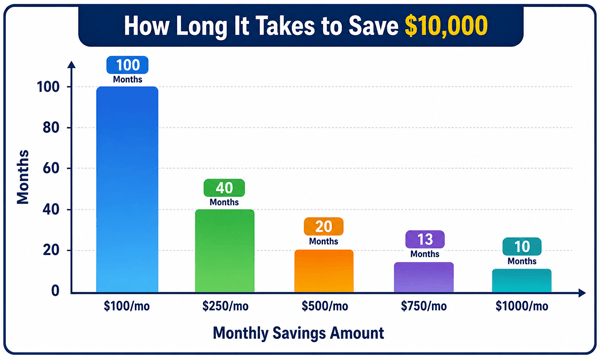
| Monthly Savings | Approximate Time to Reach $10,000 | Best For |
|---|---|---|
| $100 | 100 months / 8 years 4 months | Very tight budgets |
| $250 | 40 months / 3 years 4 months | Slow but steady savers |
| $500 | 20 months / 1 year 8 months | Moderate-income households |
| $750 | 14 months | Aggressive savers |
| $1,000 | 10 months | High savings rate or temporary sprint |
2. What Does Saving $10,000 Actually Mean?
Saving $10,000 means setting aside money that is not used for regular monthly spending. It can serve as an emergency fund, a down payment starter, a debt-payoff cushion, a career-change fund, or a first major financial milestone. The purpose matters because it affects where you keep the money and how quickly you should try to save it.
For most beginners, the first $10,000 should be kept safe and accessible, not invested in risky assets. If this money is your emergency fund, it should usually be in a bank savings account, money market account, or other low-risk cash account where the value does not swing up and down. Investments can be useful for long-term wealth, but emergency savings should be reliable.
A useful benchmark is to compare $10,000 with your essential monthly expenses. If your essentials are $2,000 per month, $10,000 covers about five months. If your essentials are $5,000 per month, it covers about two months. This makes the goal more personal and more accurate than treating $10,000 as the perfect number for everyone.
Step 1: Choose a Clear Reason for Saving $10,000
A specific reason makes saving easier because it gives every dollar a job. “I want to save more money” is vague. “I want $10,000 so I can handle emergencies without using a credit card” is clear and motivating.
Common reasons include:
- Building a starter emergency fund
- Preparing for job loss or irregular income
- Saving for a home, car, education, or relocation
- Creating a cushion before paying down debt aggressively
- Building confidence and discipline with money
Best practice: Write your reason in one sentence and put it somewhere visible, such as your budgeting app, phone notes, or a paper planner.
Step 2: Pick a Realistic Deadline
A deadline turns a dream into a plan. The right deadline depends on income, expenses, family size, debt payments, and how much flexibility you have. Saving $10,000 in 10 months requires $1,000 per month, which may be unrealistic for many beginners. Saving it over 24 to 36 months may be more sustainable.
| Goal Deadline | Monthly Target | Weekly Target | Difficulty Level |
|---|---|---|---|
| 10 months | $1,000 | About $231 | Very aggressive |
| 12 months | $834 | About $193 | Aggressive |
| 18 months | $556 | About $129 | Moderate |
| 24 months | $417 | About $97 | Manageable for many |
| 36 months | $278 | About $65 | Slow and steady |
If the target feels impossible, do not quit. Extend the timeline or start with a smaller milestone, such as $1,000, then $2,500, then $5,000, and finally $10,000.
Step 3: Find Your Current Savings Gap
Your savings gap is the amount of money left after income minus expenses. This tells you whether your $10,000 plan is realistic and what needs to change.
Use this simple formula:
Monthly income - monthly expenses = potential monthly savings
Optional check: potential monthly savings ÷ monthly take-home income = savings rate. A higher savings rate shortens the timeline, but consistency is more important than a perfect percentage.
| Example Budget Item | Amount |
|---|---|
| Monthly take-home income | $3,200 |
| Rent and utilities | $1,200 |
| Food and household items | $600 |
| Transportation | $350 |
| Debt payments | $300 |
| Insurance, phone, subscriptions, other bills | $450 |
| Total expenses | $2,900 |
| Potential monthly savings | $300 |
In this example, the person can naturally save about $300 per month. To reach $10,000 in two years, they would need about $417 per month, so they must find an extra $117 per month through spending cuts, income increases, or both.
Step 4: Build a Simple Budget That Supports the Goal
You do not need a complicated budget to save $10,000. You need a budget that clearly separates needs, wants, debt payments, and savings. Beginners often do well with a simple four-bucket budget:
| Budget Bucket | What It Includes | Goal |
|---|---|---|
| Needs | Rent, utilities, groceries, transport, insurance, and a basic phone plan | Keep necessary costs controlled |
| Debt payments | Credit cards, loans, and personal debt | Pay minimums and reduce costly debt |
| Savings | $10,000 fund, emergency savings, and short-term goals | Pay yourself first |
| Wants | Dining out, entertainment, shopping, upgrades, and subscriptions | Enjoy life within limits |
A practical beginner budget might look like this: cover essentials first, make required debt payments, transfer money to savings immediately after payday, and spend what remains carefully. This is often easier than saving whatever is left at the end of the month.
Visual Guide: $10,000 Savings Timeline
The chart below shows how your monthly savings amount affects the time needed to reach $10,000. Even small increases can shorten the timeline significantly.
Step 5: Open a Separate Savings Account
Keeping your $10,000 savings in the same account you use for daily spending makes it too easy to spend accidentally. A separate account creates a mental wall between money for today and money for your goal.
Look for an account that is:
- Safe and insured according to your country’s banking rules
- Easy enough to access during emergencies
- Separate from your debit card spending account
- Free or low-fee
- Simple to automate with recurring transfers
Avoid chasing risky returns with your first $10,000 if the money is meant for emergencies. The priority is safety, liquidity, and consistency.
Before choosing an account, compare fees, withdrawal limits, transfer speed, minimum balance rules, deposit protection, and whether the account is regulated in your country. Safety and access matter more than a slightly higher rate for emergency money.
Step 6: Automate Your Savings
Automation is one of the most effective saving habits because it removes the need to make the same decision every payday. Set up an automatic transfer from your checking account to your savings account right after income arrives.
Examples:
- $100 every Friday
- $250 on the 1st and 15th of each month
- 10% of every paycheck
- A fixed transfer on payday plus extra money from side income
Start with an amount you can keep. You can always increase it later. A small automatic transfer that actually happens is better than a large transfer you cancel every month.
Step 7: Cut Expenses Without Making Life Miserable
Saving $10,000 does not require cutting every enjoyable thing from your life. Extreme restriction often leads to burnout. The smarter approach is to reduce low-value spending first: purchases you barely notice, subscriptions you forgot about, and habits that do not improve your life much.
| Expense Area | Practical Action | Possible Monthly Savings |
|---|---|---|
| Subscriptions | Cancel unused apps, streaming services, and memberships | $10–$80 |
| Food delivery | Limit delivery to once a week or less | $50–$200 |
| Groceries | Plan meals, compare prices, and reduce waste | $50–$150 |
| Phone plan | Switch to a cheaper plan if coverage is similar | $20–$60 |
| Insurance/bills | Compare providers or ask for discounts | $20–$100 |
| Impulse shopping | Use a 24-hour rule before buying | $50–$300 |
The goal is not to be cheap. The goal is to redirect money from spending that does not matter much toward a goal that matters more.
Step 8: Increase Income to Speed Up Progress
There is a limit to how much you can cut, especially if your income is low or your essential costs are high. Increasing income can make the $10,000 goal faster and less stressful.
Beginner-friendly income ideas include:
- Ask for extra shifts or overtime if available
- Sell unused items and put all proceeds into savings
- Freelance a skill such as writing, tutoring, design, bookkeeping, or admin support
- Offer local services such as childcare, pet care, cleaning, delivery, or repairs
- Negotiate a raise after documenting your results
- Apply for better-paying roles while keeping your current job stable
Best practice: Treat extra income as goal money before it becomes lifestyle money. If you earn an extra $300 this month, transfer it to savings immediately instead of letting it disappear into normal spending.
Income ideas should be legal, safe, and realistic for your skills, schedule, and local rules. Avoid any side income opportunity that requires large upfront fees, unclear contracts, or promises of guaranteed profit.
Step 9: Use Milestones to Stay Motivated
A $10,000 target can feel far away, so break it into smaller wins. Each milestone builds confidence and helps you keep going.
| Milestone | What It Means | Reward Idea |
|---|---|---|
| $1,000 | Starter emergency cushion | Small affordable treat |
| $2,500 | Stronger protection from surprise bills | Celebrate with a low-cost activity |
| $5,000 | Halfway point | Review your plan and raise the target if possible |
| $7,500 | You are close | Share progress with an accountability partner |
| $10,000 | Major financial milestone reached | Decide the next money goal |
Choose rewards that do not undo your progress. A $20 celebration is fine. A $500 shopping spree after reaching $1,000 is not helpful.
Step 10: Protect Your Savings From Yourself
One of the biggest challenges is not saving money; it is keeping the money saved. You need rules for when the $10,000 can and cannot be used.
Good reasons to use the fund may include medical bills, urgent car repairs, temporary job loss, emergency travel, or essential home repairs. Poor reasons include impulse shopping, vacations you did not plan for, upgrading electronics, or covering overspending that keeps happening every month.
Create a simple rule: “I can use this money only for true emergencies or the specific goal I named.” If you withdraw money, rebuild it as soon as possible.
■ Should You Pay Off Debt or Save $10,000 First?
This depends on the type of debt and your risk level. Many beginners should save a small emergency fund first, then focus on high-interest debt, then continue building toward $10,000. Without any savings, even a small emergency can push you deeper into debt.
| Situation | Suggested Priority |
|---|---|
| No savings at all | Save a starter emergency fund first, such as $500–$1,000 |
| High-interest credit card debt | Build a small cushion, then aggressively pay down debt while saving a little |
| Low-interest manageable debt | Save toward $10,000 while making required payments |
| Unstable income or dependents | Prioritize a larger cash cushion sooner |
| Debt collectors or legal risk | Get professional guidance and address urgent obligations |
There is no single answer for everyone. The safest approach is usually balance: avoid having zero savings, but do not ignore expensive debt that grows quickly.
■ Best Places to Keep Your First $10,000
| Option | Pros | Cons | Best Use |
|---|---|---|---|
| Regular savings account | Simple, safe, easy access | May earn low interest | Emergency fund |
| High-yield savings account | Better interest, still accessible | Rates can change; availability varies by country | Cash savings goal |
| Money market account | May offer checks/debit access | May require a higher balance | Emergency savings with access |
| Short-term certificate/deposit | Predictable return | Money may be locked for a period | Known future expense |
| Investment account | Higher long-term growth potential | Can lose value in the short term | Not ideal for emergency savings |
For most beginners, cash savings should be safe and easy to access. Investing comes later, after you have emergency savings and a longer time horizon.
■ Common Mistakes to Avoid When Saving $10,000
1. Trying to save too much too fast
An unrealistic plan often fails. Choose a target that stretches you without breaking your budget.
2. Saving only what is left over
Pay yourself first. Transfer savings soon after income arrives.
3. Keeping savings in your spending account
Separate accounts reduce accidental spending.
4. Ignoring small leaks
Small recurring charges can quietly block progress.
5. Using savings for non-emergencies
Set clear rules for withdrawals before temptation appears.
6. Giving up after one bad month
A missed month is not failure. Adjust and continue.
■ Practical $10,000 Saving Strategies for Different Situations
1. If You Live Paycheck to Paycheck
Start small. Save $5, $10, or $25 at a time. First aim for $500 or $1,000. Review essential bills, look for assistance programs if needed, and focus on creating a small buffer before trying to hit the full $10,000.
2. If You Have Irregular Income
Use percentages instead of fixed amounts. For example, save 10% of every payment and 30% of any unusually large payment. Keep a separate tax or bill account if you are self-employed.
3. If You Have a Family
Make the goal visible and practical. Plan meals, reduce waste, shop with a list, and discuss spending choices as a household. The goal should protect the family, not create constant stress.
4. If You Are Single
Use flexibility to your advantage. Consider a roommate, side income, temporary spending freeze, or automatic transfers. Single-person households often have fewer shared costs, so planning matters.
■ A 12-Month Aggressive Plan to Save $10,000
A 12-month plan requires saving about $834 per month. This is aggressive and may not work for everyone, but it is useful as an example.
| Source of Monthly Savings | Example Amount |
|---|---|
| Automatic payday transfer | $400 |
| Food and delivery reduction | $150 |
| Subscription and bill cuts | $75 |
| Side income or overtime | $250 |
| Total monthly savings | $875 |
This plan reaches slightly more than $10,000 in 12 months. If $875 per month is not realistic, extend the timeline to 18, 24, or 36 months.
■ A 24-Month Realistic Plan to Save $10,000
A 24-month plan requires about $417 per month. This may be more practical for many households.
| Source of Monthly Savings | Example Amount |
|---|---|
| Automatic payday transfer | $250 |
| Grocery and meal planning savings | $75 |
| Reduced impulse spending | $50 |
| Small side income | $75 |
| Total monthly savings | $450 |
This approach is less intense and may be easier to maintain. Consistency matters more than speed.
■ Pros and Cons of Saving Your First $10,000
| Pros | Cons or Challenges |
|---|---|
| Creates financial security | May require lifestyle changes |
| Reduces dependence on debt | Can take months or years |
| Builds confidence and discipline | Requires saying no to some spending |
| Helps prepare for emergencies | May feel slow at first |
| Creates a base for future investing | Needs protection from impulse withdrawals |
■ What to Do After You Save $10,000
Once you reach $10,000, pause and decide what job that money should do next. Do not automatically spend it. Your next step depends on your financial situation.
Possible next steps include:
- Keep it as your emergency fund
- Pay down high-interest debt faster
- Start investing for long-term goals
- Save for a home, education, business, or relocation
- Increase retirement contributions if available
- Build separate sinking funds for predictable expenses
The first $10,000 is a foundation. The next goal is to use that foundation wisely.
■ Frequently Asked Questions
1. How long should it take to save $10,000?
It depends on how much you can save each month. At $250 per month, it takes about 40 months. At $500 per month, it takes about 20 months. At $1,000 per month, it takes 10 months.
2. Is saving $10,000 a good emergency fund?
For many beginners, $10,000 is a strong emergency fund. However, the right amount depends on your monthly expenses, job stability, family responsibilities, and health needs.
3. Can I save $10,000 on a low income?
Yes, but the timeline may be longer. Start with smaller milestones, reduce avoidable expenses, use automation, and look for safe ways to increase income.
4. Should I invest my first $10,000?
If the money is for emergencies or a short-term goal, keep it in a low-risk cash account. If you already have emergency savings and no urgent debt, investing part of future savings may make sense.
5. What is the fastest way to save $10,000?
The fastest realistic method is combining expense cuts with extra income. Cutting spending alone may not be enough. Extra shifts, side work, selling unused items, and automatic transfers can speed up progress.
6. What if I have to use the money before reaching $10,000?
That is not failure if it was a real emergency. Use the savings, avoid new debt if possible, then restart your plan and rebuild the balance.
7. How much should I save from each paycheck?
A good beginner target is 10% to 20% of take-home pay if possible. If that is too much, start with a fixed amount you can maintain and increase it over time.
■ Final Thoughts: The First $10,000 Is Built by Repetition
Saving your first $10,000 is not about perfection. It is about repeating simple actions long enough for them to work. Choose a clear reason, set a realistic timeline, automate your savings, reduce low-value spending, increase income when possible, and protect the money once you save it.
You may have slow months, surprise bills, or moments when progress feels small. Keep going. The habits you build while saving your first $10,000 are the same habits that can help you build long-term financial stability and wealth.
Reader Advice: This article is for educational and informational purposes only and should not be taken as personal financial, legal, tax, or investment advice. Please check the latest information from official sources or a qualified professional, as rules, policies, rates, and personal circumstances can change over time.