How Much Money Should You Save Each Month?
1. Quick Answer: How Much Should You Save Each Month?
A practical starting target is to save 20% of your take-home pay each month if you can. For many beginners, that may be too high at first. In that case, start with 5% to 10%, build the habit, and increase your savings rate over time. The “right” amount is not one fixed number for everyone. It is the amount that helps you make progress without causing missed bills, high-interest debt, or constant stress.
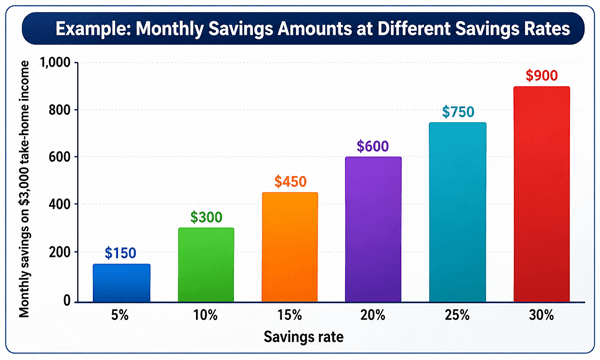
For searchers who want a direct answer: if your monthly take-home pay is $3,000, saving 10% means $300 per month, 15% means $450, and 20% means $600. The best target is the one you can repeat every month while still paying essential bills.
| Monthly Savings Target | Best For | Example on $3,000 Take-Home Pay |
|---|---|---|
| 5% | Tight budgets or those just getting started | $150 per month |
| 10% | Building a consistent savings habit and funding small goals | $300 per month |
| 15% | Stronger progress and a common retirement savings guideline | $450 per month |
| 20% | A balanced target for saving and investing | $600 per month |
| 25%+ | Aggressive goals such as a home down payment, career break, or financial independence | $750+ per month |
2. The Best Monthly Savings Rule for Beginners
For most beginners, the best rule is simple: save a percentage of your income, not a random leftover amount. A percentage adjusts automatically when your income changes and makes it easier to compare your progress from month to month.
A useful order of priority is: first protect yourself with a small emergency buffer, then pay down high-interest debt, then build a full emergency fund, then save and invest for long-term goals such as retirement, a home, education, or business plans.
A simple savings formula
Monthly savings amount = monthly take-home income x savings rate
Example: If you take home $3,000 per month and choose a 15% savings rate, your monthly savings target is $3,000 x 0.15 = $450.
3. Savings Rate vs. Savings Amount: Which Matters More?
Your savings rate is usually more useful than the dollar amount because $300 per month means very different things for different incomes. Someone earning $1,500 per month who saves $300 is saving 20%. Someone earning $6,000 per month who saves $300 is saving 5%.
| Take-Home Income | Savings Amount | Savings Rate | What It Means |
|---|---|---|---|
| $1,500/month | $150/month | 10% | A good starting savings habit on a modest income. |
| $3,000/month | $600/month | 20% | A strong general savings target for many people. |
| $6,000/month | $600/month | 10% | A solid start, but it may be low if you have ambitious financial goals. |
■ How Much to Save Each Month by Goal
You do not save for only one reason. A healthy savings plan usually includes short-term cash savings, medium-term goal savings, and long-term investing. The table below shows how to think about each category.
| Goal | Suggested Monthly Approach | Where to Keep It |
|---|---|---|
| Starter emergency fund | Save $25 to $200+ per month until you have a starter emergency cushion. | Separate savings account |
| Full emergency fund | Build toward 3 to 6 months of essential living expenses. | Easy-access savings account |
| Retirement | Aim to save about 15% of pre-tax income, including any employer match. | Retirement account or long-term investment account |
| Short-term goals | Divide your target amount by the number of months until you need the money. | Savings account, money market account, or another low-risk cash account |
| Debt payoff | Prioritize paying off high-interest debt before investing aggressively. | Extra debt payments rather than a savings account |
1. Emergency savings
Emergency savings is money set aside for unexpected expenses such as urgent car repairs, medical bills, temporary income loss, or essential home repairs. The Consumer Financial Protection Bureau explains that the right emergency fund depends on your situation and that even a small amount can provide financial security. Vanguard suggests thinking separately about spending shocks and income shocks: at least half a month of expenses for a spending shock, and 3 to 6 months of expenses for an income shock.
Note for readers: emergency fund money should usually be easy to access, not locked away in a risky investment, because the purpose is stability during a surprise expense.
2. Retirement savings
Retirement savings is money for your future self. If your employer offers a match, try to contribute enough to receive the full match before focusing on less urgent goals. A common long-term benchmark from Fidelity is to save at least 15% of pre-tax income annually for retirement, including employer contributions. This is a guideline, not a guarantee. People who start later, retire earlier, or expect higher expenses may need more.
3. Short-term goal savings
Short-term goals include a vacation, wedding, car purchase, annual insurance bill, school fee, laptop, home repair, or moving cost. The best method is to use a deadline-based calculation.
Example: You want $1,200 for a laptop in 8 months. $1,200 divided by 8 = $150 per month. If $150 is too much, extend the deadline, choose a lower-cost option, or combine savings with selling unused items.
■ How to Calculate Your Ideal Monthly Savings Amount
- Write down your monthly take-home income. Use the amount that actually reaches your bank account after taxes and payroll deductions.
- List your essential expenses: housing, food, utilities, transport, insurance, minimum debt payments, childcare, and basic medical costs.
- List flexible spending: restaurants, subscriptions, entertainment, upgrades, hobbies, shopping, and convenience spending.
- Choose a starting savings rate. Use 5% if money is tight, 10% if you need a realistic beginner target, 15% if you want stronger progress, or 20% if your budget can handle it.
- Split savings by priority: emergency fund first, then high-interest debt, then retirement and other goals.
- Automate the amount right after payday so saving happens before casual spending.
■ Monthly Savings Examples for Different Incomes
| Monthly Take-Home Pay | 5% | 10% | 15% | 20% | 25% |
|---|---|---|---|---|---|
| $1,500 | $75 | $150 | $225 | $300 | $375 |
| $2,500 | $125 | $250 | $375 | $500 | $625 |
| $3,500 | $175 | $350 | $525 | $700 | $875 |
| $5,000 | $250 | $500 | $750 | $1,000 | $1,250 |
| $8,000 | $400 | $800 | $1,200 | $1,600 | $2,000 |
Chart: Monthly savings on a $3,000 take-home income
■ A Simple Monthly Savings Diagram
Use this beginner-friendly flow when deciding where your next saved dollar should go:
| Step | Question | Action |
|---|---|---|
| 1 | Do you have at least a small emergency cushion? | Build starter emergency savings first. |
| 2 | Do you have high-interest debt? | Pay more than the minimum while keeping a basic emergency cushion. |
| 3 | Can you get an employer retirement match? | Contribute enough to capture the full employer match, if available. |
| 4 | Do you have 3 to 6 months of essential expenses saved? | Build your full emergency fund gradually. |
| 5 | Do you have specific future financial goals? | Save or invest based on your timeline and risk tolerance. |
4. Should You Save Before Paying Off Debt?
The best answer is usually both, but not in equal amounts. You need some cash savings so one surprise bill does not push you deeper into debt. After that, high-interest debt should usually receive aggressive attention because the interest cost can grow faster than most savings accounts can earn.
| Situation | Better Priority |
|---|---|
| No emergency savings at all | Build a small starter emergency fund. |
| Credit card or payday-style debt | Pay down high-interest debt aggressively after building a starter emergency fund. |
| Low-interest fixed debt | Balance debt payments with saving and investing. |
| Employer retirement match available | Try to capture the employer match while managing debt. |
5. What If You Cannot Save 20%?
Do not treat 20% as a pass-or-fail rule. A person saving 3% consistently is building a better habit than someone waiting for the perfect budget and saving nothing. Start with a number that is small enough to keep but meaningful enough to notice.
- Start with 1% to 5% if your budget is tight.
- Increase savings by 1 percentage point every 1 to 3 months.
- Save part of every raise, bonus, tax refund, gift, or side-income payment.
- Use separate savings accounts for emergencies, annual bills, and goals.
- Review subscriptions, food delivery, impulse shopping, and bank fees before cutting essentials.
6. What If You Can Save More Than 20%?
Saving more than 20% can be excellent, especially if you have a stable income and clear goals. But very high saving should still be balanced with health, family needs, basic insurance, skill development, and reasonable enjoyment. Extreme saving that causes burnout often does not last.
Good reasons to save more include preparing for a home down payment, rebuilding after job loss, starting a business, funding education, moving countries or cities, catching up on retirement savings, or planning a career break.
7. Where Should Monthly Savings Go?
The place you keep savings should match the purpose and timeline. Money needed soon should usually be safe and accessible. Money for long-term goals can usually accept more risk because it has more time to recover from market ups and downs.
| Timeline | Example goal | Common place to keep money |
|---|---|---|
| 0 to 12 months | Emergency fund, annual bills, short trip | High-yield savings or regular savings account |
| 1 to 3 years | Car, moving, wedding, school costs | Savings account, term deposit/CD, money market-style option |
| 3 to 7 years | Home deposit or major goal | Mix of cash and conservative investments, depending on risk tolerance |
| 7+ years | Retirement, long-term wealth | Diversified retirement or investment accounts |
8. Common Mistakes When Deciding How Much to Save
- Saving only what is left at the end of the month. Pay yourself first instead.
- Choosing a savings goal that is too aggressive and quitting after one month.
- Keeping emergency savings invested in risky assets that may fall when you need the money.
- Ignoring irregular expenses such as insurance, gifts, taxes, repairs, and school fees.
- Comparing your savings amount to someone with a very different income or family situation.
- Saving while carrying expensive debt without a payoff plan.
- Leaving all money in one account, which makes it easy to spend accidentally.
9. A Practical Monthly Savings Plan You Can Start Today
- Pick a realistic starting rate: 5%, 10%, 15%, or 20% of take-home pay.
- Open or label a separate savings account for emergencies.
- Set an automatic transfer for payday or the day after payday.
- Create one sinking fund for predictable irregular costs such as car repairs or annual insurance.
- Review progress after 30 days. If bills were comfortable, increase the transfer slightly.
- Repeat monthly. Consistency matters more than perfection.
10. Pros and Cons of Percentage-Based Monthly Saving
| Pros | Cons |
|---|---|
| Easy to understand and automate | May not match urgent goals with fixed deadlines |
| Adjusts as income rises or falls | Can feel hard on a very low income |
| Helps compare progress fairly | Does not automatically account for debt or family size |
| Works well with budgeting systems | Needs periodic review as life changes |
■ Frequently Asked Questions
1. Is saving 10% of income enough?
Saving 10% is a solid start, especially for beginners. It may be enough for basic goals if you start early and have low debt. For retirement or major goals, many people eventually need to move closer to 15% to 20% or more.
2. Is saving 20% every month realistic?
It is realistic for some people but not everyone. Housing costs, family responsibilities, income level, debt, and location matter. Use 20% as a strong target, not a reason to feel like a failure.
3. How much should I save from each paycheck?
Use the same percentage method. If you are paid twice a month and want to save $400 monthly, transfer $200 from each paycheck. If paid weekly, divide the monthly target by about four.
4. Should I save based on gross income or take-home income?
For everyday budgeting, take-home income is easier because it is the money you can actually spend. For retirement benchmarks, many institutions discuss savings as a percentage of pre-tax income, especially when employer retirement plans are involved.
5. How much emergency savings do I need?
A common target is 3 to 6 months of essential expenses, but start smaller if that feels impossible. A starter cushion of even a few hundred dollars can reduce reliance on credit cards during small emergencies.
6. Should savings include retirement contributions?
Yes, but separate your thinking. Retirement contributions count toward long-term saving, while emergency savings and short-term goals need accessible cash. A person saving 15% for retirement but nothing for emergencies may still be vulnerable to surprise expenses.
7. What percentage of income should a student save?
Students can start with a small percentage, such as 5% to 10%, or a fixed amount from part-time work. The goal is to build the habit and avoid unnecessary debt, not to match the savings rate of a full-time worker.
8. What if my income changes every month?
Base your essential budget on a conservative average or your lowest recent income month. Save more in high-income months to cover lower-income months. Freelancers and commission-based workers often need a larger emergency fund.
9. Is it better to save monthly or yearly?
Monthly saving is usually easier because it spreads the habit across the year and works well with paychecks. Yearly saving can also work if you receive annual bonuses, seasonal income, or irregular freelance payments.
10. What is the 50/30/20 rule?
The 50/30/20 rule is a simple budgeting framework: about 50% for needs, 30% for wants, and 20% for saving and debt repayment. It is helpful for many people, but it should be adjusted for income, debt, location, family size, and urgent goals.
■ Final Takeaway
The best monthly savings amount is the highest amount you can save consistently while still paying essential bills, managing debt, and living a sustainable life. A good beginner target is 10% of take-home pay. A strong general target is 20%. For retirement, many guidelines point toward 15% of pre-tax income, including employer match. Start where you are, automate it, and increase gradually. The habit matters more than hitting a perfect number immediately.
References and Source Notes
- Consumer Financial Protection Bureau (CFPB), “An essential guide to building an emergency fund” (updated Oct. 29, 2025): explains that emergency savings are for unplanned expenses and that the right amount depends on personal circumstances. https://www.consumerfinance.gov/an-essential-guide-to-building-an-emergency-fund/
- Vanguard, “Comprehensive Guide to Building an Emergency Fund”: suggests planning separately for spending shocks and income shocks, including a 3-to-6-month expense target for income shocks. https://investor.vanguard.com/investor-resources-education/emergency-fund
- Fidelity, “How much money should I save each year for retirement?”: suggests aiming to save at least 15% of pre-tax income annually for retirement, including employer match. https://www.fidelity.com/viewpoints/retirement/how-much-money-should-I-save
- Google Search Central, “Creating helpful, reliable, people-first content”: emphasizes helpful, reliable content created for people. https://developers.google.com/search/docs/fundamentals/creating-helpful-content
Reader Advice: This article is for educational and information purposes only and should not be taken as personalized financial, investment, tax, or legal advice. Please check the latest information from official sources or a qualified professional, as rules, policies, rates, and personal circumstances can change over time.