How Much Should You Have in an Emergency Fund?
An emergency fund is money set aside for real financial surprises: a job loss, urgent car repair, medical bill, home repair, emergency travel, or another expense you could not reasonably plan for. It is not an investment account, shopping fund, vacation fund, or “extra money” account. Its main job is to protect your life from being disrupted by one unexpected bill.
In everyday language, this may also be called emergency savings, a rainy day fund, or a cash buffer for unexpected expenses.
For many people, the best long-term target is three to six months of essential living expenses. That does not mean you must save that amount immediately. A practical beginner goal is to first save a small starter emergency fund, often $500 to $1,000 or one month of essential expenses, then build gradually. The right amount depends on your job stability, income type, household size, debt, insurance coverage, health, and comfort level.
This guide explains how emergency funds work, how much to save, where to keep the money, when to use it, and how to build one without feeling overwhelmed.
▪ Quick Answer: How Much Should You Save in an Emergency Fund?
| Situation | Suggested Emergency Fund Target | Why This Makes Sense |
|---|---|---|
| You are just starting | $500 to $1,000, or any amount you can build quickly | A small cushion can stop a minor emergency from becoming credit card debt. |
| You have stable income and few dependents | 3 months of essential expenses | This may cover short disruptions, repairs, or temporary income gaps. |
| You have a family, mortgage, or dependents | 4 to 6 months of essential expenses | More people and fixed bills usually mean more financial risk. |
| You are self-employed, freelance, commission-based, or have irregular income | 6 to 12 months of essential expenses | Income can fluctuate, and replacing lost income may take longer. |
| You are retired or near retirement | 6 to 24 months of planned cash needs, depending on income sources | A larger cash buffer may help avoid selling investments during market downturns. |
A common rule of thumb is three to six months of essential expenses in an easy-access savings account. In simple terms, if you are asking “how much emergency fund should I have?”, start with your monthly must-pay expenses, then multiply by the number of months you want covered. Government and consumer finance organizations commonly recommend using your own situation and essential costs to set the target, rather than copying someone else’s number. Sources used for this article include the Consumer Financial Protection Bureau, the Federal Reserve, MoneyHelper, the Financial Consumer Agency of Canada, Vanguard, the FDIC, and the NCUA.
1. What Is an Emergency Fund?
An emergency fund is a separate cash reserve that helps you pay for urgent, necessary, and unexpected expenses without relying on high-interest debt. It is one of the first foundations of personal finance because it gives you breathing room when life does not go according to plan.
Examples of real emergencies
- Your car breaks down and you need it to get to work.
- You lose your job or your work hours are reduced.
- A medical, dental, or veterinary bill appears unexpectedly.
- Your home needs an urgent repair, such as plumbing, heating, electrical, or roof work.
- You must travel unexpectedly for a family emergency.
- A major appliance stops working and needs repair or replacement.
What an emergency fund is not for
- Routine monthly bills that should already be in your budget.
- Planned purchases such as holidays, weddings, gadgets, or furniture.
- Sales, discounts, or “limited-time” shopping offers.
- Investing, crypto trading, or business speculation.
- Helping others when doing so would put your own household at risk.
A simple test is: Is it necessary, urgent, and unexpected? If the answer is yes, it may be a valid emergency fund use. If not, it probably belongs in another savings category.
2. Why an Emergency Fund Matters
An emergency fund is not exciting, but it can be life-changing. It helps you handle problems without turning every surprise into a crisis. It also protects your long-term goals because you are less likely to interrupt retirement savings, miss payments, or take expensive loans when something goes wrong.
The Federal Reserve’s Survey of Household Economics and Decisionmaking tracks whether adults could cover a hypothetical $400 emergency expense using cash or its equivalent. For survey year 2025, the Federal Reserve data show 63% of all adults could cover that expense with cash or a cash-like resource, meaning a large minority still could not. This shows why even a modest emergency fund can matter.
Benefits of having an emergency fund
- Less stress because you have a plan for surprise expenses.
- Lower need for credit cards, payday loans, personal loans, or borrowing from family.
- Better ability to keep bills current during income disruption.
- More freedom to make calm decisions after a job loss or emergency.
- Protection for your retirement savings and long-term investments.
- More confidence in your budget because one bad month does not ruin everything.
3. How Emergency Funds Work
An emergency fund works best when it is separate, easy to access, and used only for emergencies. You contribute money regularly, leave it alone during normal months, and withdraw from it only when a true emergency happens. After using it, you rebuild it.
The basic emergency fund cycle
- Set a target based on your essential monthly expenses.
- Open or choose a separate safe account for the money.
- Automate small transfers each payday or each month.
- Use the fund only for urgent, necessary, unexpected costs.
- Refill the fund after you use it.
This is simple, but it works because it creates a financial buffer between you and debt.
4. How Much Should You Save? The Practical Formula
The easiest formula is: Monthly essential expenses x number of months = emergency fund target.
Essential expenses are the costs you must keep paying to maintain your basic life. They are not your full lifestyle expenses. In an emergency, you may reduce restaurants, subscriptions, entertainment, shopping, and travel. Your emergency fund should focus on survival-level costs first.
Essential expenses usually include
- Rent or mortgage payment.
- Utilities such as electricity, gas, water, internet, and phone.
- Groceries and basic household supplies.
- Transportation, fuel, public transit, insurance, and essential repairs.
- Minimum debt payments, including credit cards, loans, or student loans.
- Insurance premiums and out-of-pocket medical needs.
- Childcare, school costs, or dependent care that cannot be paused.
- Basic pet care, if applicable.
Emergency fund calculation example
| Monthly Essential Expense | Amount |
|---|---|
| Rent or mortgage | $1,200 |
| Utilities and phone | $300 |
| Groceries | $500 |
| Transportation | $350 |
| Insurance and medical basics | $250 |
| Minimum debt payments | $200 |
| Other essential costs | $200 |
| Total essential monthly expenses | $3,000 |
If this person wants a three-month emergency fund, the target is $3,000 x 3 = $9,000. If they want a six-month emergency fund, the target is $3,000 x 6 = $18,000.
5. Emergency Fund Target Ladder
Many beginners feel discouraged when they hear “save six months of expenses.” A better approach is to build in stages. Each stage gives you more protection than the last.
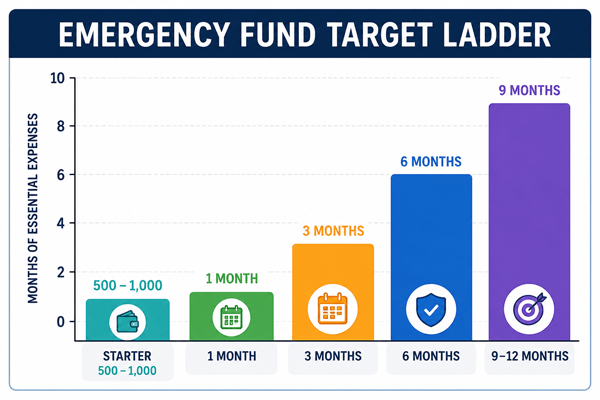
Chart: A practical emergency fund target ladder, moving from a starter cushion to a larger cash reserve for higher-risk situations.
| Stage | Target | Best For | Main Benefit |
|---|---|---|---|
| Stage 1 | $100 to $500 | Very tight budgets | Creates the habit and covers small surprises. |
| Stage 2 | $500 to $1,000 | Beginners | Can handle many common small emergencies. |
| Stage 3 | 1 month of essentials | Most households | Protects against a bad month or delayed income. |
| Stage 4 | 3 months of essentials | Stable income households | Covers many short-term disruptions. |
| Stage 5 | 6 months of essentials | Families, homeowners, higher fixed bills | Provides stronger protection. |
| Stage 6 | 9 to 12 months or more | Freelancers, business owners, unstable industries | Protects against longer income gaps. |
6. Should You Save 3 Months, 6 Months, or 12 Months?
There is no perfect number for everyone. The right emergency fund size depends on the risks in your life. The more stable your income and lower your obligations, the smaller your fund may need to be. The more uncertain your income and higher your responsibilities, the larger your fund should be.
| Factor | Smaller Fund May Be Okay If... | Larger Fund Is Wiser If... |
|---|---|---|
| Income stability | You have a steady salary in a stable field. | You freelance, run a business, earn commission, or work seasonally. |
| Household income | You have two reliable incomes. | Your household depends on one income. |
| Dependents | You support only yourself. | You support children, parents, a spouse, or other dependents. |
| Debt level | You have low debt and flexible expenses. | You have high fixed payments or high-interest debt. |
| Housing | You rent and have fewer repair responsibilities. | You own a home and may face major repairs. |
| Health and insurance | You have strong coverage and low expected costs. | You have high deductibles or ongoing health needs. |
| Job market | You could find similar work quickly. | Your job search could take several months. |
When 3 months may be enough
- You have a stable job and predictable income.
- Your monthly essential expenses are low.
- You have another reliable household income.
- You have good insurance and few dependents.
- You can quickly reduce spending if needed.
When 6 months is better
- You have children or dependents.
- You own a home or car that could need repairs.
- You work in a field where job searches can take time.
- You have a single-income household.
- You would struggle to cut expenses quickly.
When 9 to 12 months may be appropriate
- You are self-employed, freelance, or run a small business.
- Your income is irregular or seasonal.
- You work in an unstable industry.
- You have large fixed expenses.
- You are supporting several people.
- You simply sleep better with a larger cushion.
7. Starter Emergency Fund vs Full Emergency Fund
A starter emergency fund is a small first goal. A full emergency fund is your long-term protection target. Both are useful, but they serve different purposes.
| Type | Typical Amount | Purpose | Best Timing |
|---|---|---|---|
| Starter emergency fund | $500 to $1,000, or one small paycheck | Covers small urgent expenses and prevents new debt while you stabilize your budget. | Build this first, especially if you are new to budgeting or paying off debt. |
| Full emergency fund | 3 to 6+ months of essential expenses | Protects you during bigger setbacks such as job loss or major repairs. | Build after your starter fund, while also managing debt and other goals. |
If you have high-interest credit card debt, a starter emergency fund can help you avoid adding more debt. After that, many people split extra money between debt payoff and emergency savings, depending on interest rates, job risk, and personal stress level.
8. Where Should You Keep an Emergency Fund?
Keep your emergency fund somewhere safe, separate, and easy to access. The goal is not to earn the highest possible return. The goal is to have money available when life goes wrong.
| Account Type | Good for Emergency Fund? | Pros | Cons |
|---|---|---|---|
| High-yield savings account | Yes | Safe, separate, accessible, may earn interest. | Transfers may take time depending on the bank. |
| Regular savings account | Yes | Simple and easy to access. | May pay low interest. |
| Money market deposit account | Usually yes | May offer check or debit access plus interest. | May require a minimum balance. |
| Checking account | For a small buffer only | Immediate access. | Too easy to spend accidentally; usually lower interest. |
| Cash at home | Small amount only | Useful during outages or immediate needs. | Risk of theft, loss, or no interest. |
| Certificates of deposit | Partial use only | Can earn fixed interest. | Early withdrawal penalties may apply; not ideal for all emergency money. |
| Stocks, crypto, or long-term investments | No | Potential growth. | Can lose value right when you need cash. |
Best practice: use two layers
Safety note: When using a bank or credit union, check that the institution is properly insured in your country and keep balances within applicable coverage limits. In the United States, FDIC-insured banks and federally insured credit unions generally provide standard coverage of $250,000 per depositor, per insured institution, per ownership category.
- Keep a small amount in checking for immediate surprises, such as $100 to $500 depending on your budget.
- Keep the main emergency fund in a separate savings account so it is available but not too tempting to spend.
Your emergency fund should be liquid. Liquidity means you can access the money quickly without selling investments at a loss or paying major penalties.
A helpful rule is to keep at least part of the fund accessible within the same day or next business day, while the rest can sit in a separate savings account that is still easy to reach.
9. How to Build an Emergency Fund Step by Step
Step 1: Calculate your essential monthly expenses
Look at your last one to three months of spending. Add only the expenses you would still need to pay during an emergency. If your spending varies, use a realistic average.
Step 2: Choose your first target
Do not start with a goal that feels impossible. Choose a first milestone such as $250, $500, $1,000, or one month of essential expenses. After you reach it, move to the next stage.
Step 3: Open a separate savings account
A separate account helps prevent accidental spending. Use a safe bank or credit union account that allows access when needed.
Step 4: Automate your savings
Set up an automatic transfer on payday. Even a small amount builds momentum. Saving $25 per week becomes $1,300 in one year. Saving $50 per week becomes $2,600 in one year.
Step 5: Use quick wins to speed up progress
- Save part of tax refunds, bonuses, or cash gifts.
- Sell unused items and put the money directly into savings.
- Pause one subscription for three months.
- Use a temporary spending challenge, such as no takeout for two weeks.
- Round up purchases if your bank offers that feature.
- Move leftover grocery or fuel money at the end of each week.
Step 6: Refill the fund after using it
Using your emergency fund is not failure. That is what it is for. After the emergency passes, make rebuilding it your next priority.
10. How Fast Can You Build an Emergency Fund?
| Monthly Savings Amount | Time to Save $500 | Time to Save $1,000 | Time to Save $3,000 |
|---|---|---|---|
| $25/month | 20 months | 40 months | 120 months |
| $50/month | 10 months | 20 months | 60 months |
| $100/month | 5 months | 10 months | 30 months |
| $250/month | 2 months | 4 months | 12 months |
| $500/month | 1 month | 2 months | 6 months |
The point is not to build the full fund overnight. The point is to begin. Every dollar saved gives you more options than you had before.
11. Emergency Fund Examples for Different People
Example 1: Single person with stable job
Monthly essentials: $2,000. Suggested target: $6,000 to $12,000. If they have low debt and stable income, a three-month fund may be a reasonable starting long-term goal.
Example 2: Family with children and a mortgage
Monthly essentials: $4,500. Suggested target: $18,000 to $27,000. A larger fund can help cover family needs, home repairs, and income disruption.
Example 3: Freelancer with irregular income
Monthly essentials: $3,200. Suggested target: $19,200 to $38,400. Because income is less predictable, six to twelve months of essentials may be more appropriate.
Example 4: Student or young adult
Monthly essentials: $900. Suggested starter target: $500 to $1,000, then one to three months of essentials. The first goal is to avoid using debt for small emergencies.
Example 5: Retiree
Monthly essentials after predictable income: $2,500. Suggested cash reserve depends on pensions, Social Security or other income, health costs, and investment strategy. Some retirees keep a larger cash buffer so they are not forced to sell investments during downturns.
12. Should You Build an Emergency Fund Before Paying Off Debt?
In many cases, yes, you should build at least a small starter emergency fund before aggressively paying off debt. Without a small cushion, the next surprise expense may go straight back onto a credit card.
After that, the choice depends on the debt. High-interest debt can grow quickly, so it often makes sense to keep a starter fund and then prioritize aggressive debt repayment. For lower-interest debt, you may choose to build a larger emergency fund at the same time.
| Situation | Practical Approach |
|---|---|
| No savings and high-interest debt | Save a small starter fund first, then focus heavily on high-interest debt. |
| Some savings and high-interest debt | Keep a modest cushion and pay down debt aggressively. |
| Stable job and low-interest debt | Build emergency savings while making required debt payments. |
| Unstable income or dependents | Consider a larger emergency cushion even while paying debt. |
13. Common Emergency Fund Mistakes to Avoid
- Saving too much in checking, where it is easy to spend accidentally.
- Investing the emergency fund in risky assets that can fall in value.
- Waiting to start until you can save a large amount.
- Using the fund for non-emergencies and not rebuilding it.
- Copying someone else’s target without looking at your own expenses.
- Forgetting irregular essentials such as insurance deductibles, car repairs, or medical costs.
- Keeping all emergency money in a place that takes several days to access.
- Ignoring the emergency fund after major life changes such as marriage, children, home purchase, job change, or relocation.
14. When Should You Use Your Emergency Fund?
Use your emergency fund when the expense is necessary, urgent, and unexpected. If it meets all three conditions, using the fund is appropriate.
| Question | Yes Means... | No Means... |
|---|---|---|
| Is it necessary? | It protects health, income, housing, transportation, or basic safety. | It may be a want, not an emergency. |
| Is it urgent? | Waiting could make the problem worse or more expensive. | You may be able to save for it normally. |
| Is it unexpected? | It was not part of your regular or planned spending. | It should probably be in your budget or sinking fund. |
For planned but irregular expenses, use sinking funds instead. A sinking fund is money saved for a known future cost, such as car insurance, holiday gifts, school fees, or annual subscriptions. Emergency funds are for surprises. Sinking funds are for predictable expenses that do not happen every month.
15. Emergency Fund vs Sinking Fund vs Investment Account
| Money Bucket | Purpose | Example | Where to Keep It |
|---|---|---|---|
| Emergency fund | Unexpected urgent needs | Job loss, urgent repair, medical bill | Savings account or money market account |
| Sinking fund | Known future expenses | Car insurance, holidays, school fees | Separate savings buckets or accounts |
| Investment account | Long-term growth | Retirement, wealth building, future goals | Brokerage, retirement account, pension plan |
Mixing these accounts creates confusion. Keeping separate buckets makes it easier to know what money is safe to spend and what money should stay protected.
16. How to Build an Emergency Fund on a Low Income
Building savings on a low income is harder, but not impossible. The strategy is to start small, reduce pressure, and build consistency. A $100 emergency fund is better than no emergency fund. A $300 fund is better than $100. Progress matters.
- Start with a very small goal, such as $5 per week or $20 per month.
- Save immediately after getting paid, even if the amount is small.
- Use cash windfalls carefully: put a portion into savings before spending the rest.
- Reduce one recurring cost, even temporarily, and redirect the savings.
- Use community resources when available instead of draining savings for every hardship.
- Avoid comparing your progress to people with higher incomes.
If you cannot save right now, focus first on stabilizing cash flow: track spending, prioritize essentials, contact creditors before missing payments, and look for income supports or assistance programs in your area.
For readers outside the United States or United Kingdom, replace any dollar or pound examples with your own local currency and local essential costs. The calculation method stays the same.
17. How Often Should You Review Your Emergency Fund?
Review your emergency fund at least once or twice a year, and whenever your life changes. Your target should change when your expenses or risks change.
Review your target after
- A new job, job loss, or change in income.
- Marriage, divorce, or household change.
- Having a child or taking on dependent care.
- Buying a home or car.
- Moving to a higher-cost or lower-cost area.
- Taking on or paying off major debt.
- Changes in insurance deductibles or health needs.
18. Pros and Cons of Keeping a Large Emergency Fund
| Pros | Cons |
|---|---|
| More peace of mind and flexibility during a crisis. | Money may earn less than long-term investments. |
| Less dependence on debt. | A very large fund can slow other goals if overdone. |
| Helpful for freelancers, families, and single-income households. | Inflation can reduce purchasing power over time. |
| Can prevent forced investment sales during bad markets. | Requires discipline not to spend it unnecessarily. |
A larger fund is not automatically better. Once you have enough for your situation, extra money may be better used for debt payoff, retirement investing, insurance gaps, or other financial goals.
19. Simple Emergency Fund Checklist
- I know my monthly essential expenses.
- I have chosen my first target and long-term target.
- My emergency fund is separate from everyday spending money.
- The money is safe and easy to access.
- I have automated contributions or a regular savings habit.
- I know what counts as a real emergency.
- I have a plan to rebuild the fund after using it.
■ Frequently Asked Questions
1. How much should I have in an emergency fund?
A common target is three to six months of essential living expenses. Beginners can start with $500 to $1,000 or one month of essentials, then build gradually. People with irregular income, dependents, or higher risk may prefer six to twelve months.
2. Is $1,000 enough for an emergency fund?
$1,000 is a strong starter emergency fund, but it may not be enough for job loss or major repairs. Think of it as the first milestone, not necessarily the final goal.
3. Should an emergency fund be based on income or expenses?
Expenses are usually more practical because your emergency fund must cover what you need to pay. Some people use income as a rough shortcut, but essential expenses give a more accurate target.
4. Where should I keep my emergency fund?
Keep it in a safe, liquid account such as a savings account, high-yield savings account, or money market deposit account. Avoid risky investments for emergency money.
5. Can I invest my emergency fund?
Usually no. Emergency funds should be stable and accessible. Investments can lose value, and emergencies often happen at inconvenient times.
6. Should I keep cash at home?
A small amount of cash at home can help during power outages or immediate needs, but it should not replace a bank-based emergency fund. Cash can be stolen, lost, or damaged.
7. What if I use my emergency fund?
Use it without guilt for real emergencies. Then rebuild it as soon as you can by temporarily increasing savings or redirecting extra money.
8. Do I need an emergency fund if I have a credit card?
Yes. A credit card is borrowed money, not savings. It can help with payment timing, but relying on it can create interest charges and debt.
9. How much should freelancers save?
Freelancers and self-employed workers often need six to twelve months of essential expenses because income can be irregular and client payments can be delayed.
10. Can my emergency fund be too big?
Yes. After you have enough for your risk level, keeping too much cash may slow debt payoff or long-term investing. The goal is enough protection, not unlimited cash.
■ Final Thoughts
An emergency fund is one of the simplest and most powerful financial tools you can build. It does not require advanced investing knowledge or a high income. It requires a clear target, a separate safe account, regular contributions, and the discipline to use it only for real emergencies.
Start with what you can. A small emergency fund is not a failure. It is the beginning of financial stability. Over time, build toward one month, then three months, then the amount that fits your life. The best emergency fund is the one that protects your household and helps you stay calm when life becomes unpredictable.
Sources and Notes
This article uses official and consumer-finance sources to support general emergency fund guidance. It is not personalized financial, legal, tax, or investment advice.
- Consumer Financial Protection Bureau: emergency funds are cash reserves for unplanned expenses or financial emergencies such as car repairs, home repairs, medical bills, or loss of income.
- Federal Reserve, Survey of Household Economics and Decisionmaking: 2025 data show 63% of all adults could cover a $400 emergency expense using cash or its equivalent.
- MoneyHelper: a common rule of thumb is three to six months of essential outgoings in an instant-access savings account.
- Financial Consumer Agency of Canada: emergency funds help pay for unexpected expenses such as car repairs, urgent veterinary visits, job loss, or health problems that affect work.
- Vanguard: emergency savings can be planned around both spending shocks and income shocks; income shocks often call for a larger reserve.
- FDIC and NCUA: U.S. deposit and share insurance rules generally protect eligible accounts up to standard coverage limits, depending on institution and ownership category.
Reader Advice: This article is for educational and informational purposes only and should not be taken as personalized financial, legal, tax, or investment advice. Please check the latest information from official sources or a qualified professional, as rules, policies, rates, and financial guidance can change over time.