How to Save Money on Utility Bills
1. Introduction: Why Utility Bills Feel So Expensive
Utility bills can quietly take a large bite out of your monthly budget. Electricity, gas, heating, cooling, water, trash, sewer, internet, and phone services often feel like fixed costs, but many parts of these bills are more flexible than people realize. You may not be able to control the weather or your local utility rates, but you can control how much energy and water your home wastes, when you use power, which plans you choose, and how often you review your usage.
The goal is not to live uncomfortably, sit in the dark, or stop using modern conveniences. The goal is to reduce waste. A comfortable home can still be an efficient home. Small daily changes, low-cost fixes, and smarter service choices can add up over time.
This guide explains how utility bills work, where money is commonly wasted, and which practical steps usually give the best return. It is written for beginners, so you do not need technical knowledge to use it.
It also gives a clear 30-day action plan, renter-friendly ideas, bill-audit steps, and upgrade advice so readers can start with free and low-cost changes before spending money on larger improvements.
At a Glance: Best Ways to Lower Utility Bills
Start with the biggest sources of waste: thermostat settings, air leaks, old lighting, hot-water use, leaks, appliance habits, and unused internet, cable, or phone add-ons. For most households, the best results come from combining several small changes rather than depending on one large upgrade.
2. What Counts as a Utility Bill?
A utility bill is a regular charge for essential household services. Some are billed by usage, some are fixed monthly charges, and some include both.
| Utility type | What you usually pay for | Common ways to save |
|---|---|---|
| Electricity | Lights, appliances, air conditioning, electronics, electric water heating | Use less during peak times, switch to LEDs, improve cooling habits, unplug standby loads |
| Natural gas or heating fuel | Space heating, water heating, cooking, dryers in some homes | Adjust thermostat, maintain heating equipment, seal air leaks, lower water heater temperature |
| Water and sewer | Water used in showers, toilets, laundry, dishwashing, irrigation | Fix leaks, install efficient fixtures, shorten outdoor watering, run full loads |
| Trash/recycling | Collection service, bin size, municipal fees | Choose the right bin size if available, recycle correctly, avoid extra pickup fees |
| Internet, phone, cable | Service plans, equipment rental, taxes and fees | Negotiate, downgrade unused speed/channels, buy compatible equipment when sensible |
| Other service charges | Delivery fees, connection fees, local taxes, service fees | Review bills carefully and question errors or duplicate charges |
3. How Utility Bills Work: The Simple Version
Most utility bills include three parts:
- A usage charge: the amount you used, such as kilowatt-hours of electricity, therms of gas, or gallons of water.
- A fixed or service charge: a monthly fee for being connected to the service, even if you use very little.
- Taxes, delivery charges, and other fees: these vary by location and provider.
This matters because not every part of your bill can be reduced. If your electric bill is $120 and $25 is a fixed customer charge, your savings come mainly from the remaining usage-based portion. That is why the best strategy is to reduce waste where usage is highest: heating, cooling, water heating, lighting, laundry, appliances, and always-on electronics.
4. Start With a Utility Bill Audit
Before you buy gadgets or make big upgrades, spend 20 minutes reviewing your bills. A simple audit can show where your biggest opportunities are.
Step 1: Compare the last 12 months
Look at your monthly usage, not only the amount due. Rates can change, so usage tells a clearer story. For electricity, look for kilowatt-hours (kWh). For gas, look for therms or cubic meters. For water, look for gallons, cubic feet, or cubic meters.
Step 2: Identify seasonal spikes
If your electric bill jumps in summer, cooling is probably the main issue. If your gas bill jumps in winter, heating is likely the biggest target. If water bills rise in summer, outdoor watering or leaks may be responsible.
Step 3: Check for plan or fee problems
Look for equipment rental fees, late fees, estimated readings, service add-ons, duplicate charges, or a plan that no longer matches your household. For internet and phone bills, compare what you actually use with what you pay for.
Step 4: Set a realistic savings goal
A good beginner goal is to reduce usage-related costs by 5% to 15% over the next three months. That is enough to matter, but not so aggressive that it becomes frustrating. Track usage as well as the amount due, because rate changes, taxes, fixed fees, and seasonal weather can affect the final bill.
5. Quick Wins: Low-Cost Ways to Lower Utility Bills Fast
| Action | Estimated cost | Why it helps | Difficulty |
|---|---|---|---|
| Set thermostat back when asleep or away | $0 | Heating and cooling are major energy users; reducing unnecessary run time can cut costs | Easy |
| Replace frequently used bulbs with LEDs | Low | LED lighting uses far less energy than old incandescent bulbs | Easy |
| Wash clothes in cold water | $0 | Heating water for laundry uses energy; cold water works for many everyday loads | Easy |
| Run full dishwasher and laundry loads | $0 | Spreads energy and water use across more items | Easy |
| Fix dripping faucets and running toilets | Low to moderate | Leaks waste water around the clock | Easy to medium |
| Seal obvious air leaks with weatherstripping or caulk | Low | Keeps conditioned air inside and outdoor air outside | Medium |
| Unplug unused electronics or use smart power strips | Low | Reduces standby power from devices that draw energy while off | Easy |
| Review internet/cable plan | $0 | Many households pay for speed, channels, or add-ons they no longer use | Easy |
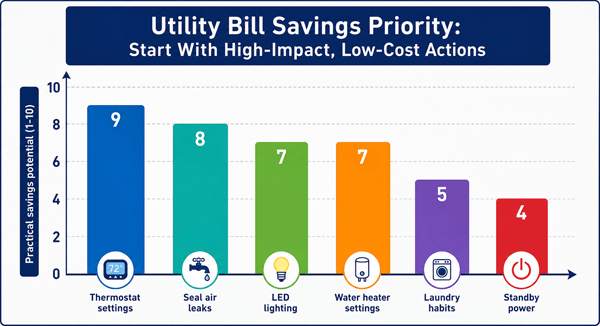
6. Chart: Best Places to Start
The chart below ranks common savings actions by practical impact for many households. Actual savings depend on your climate, home size, rates, equipment, and habits.
■ Save Money on Heating and Cooling
Heating and cooling are often the largest energy costs in a home. That makes them the best place to begin. You do not have to accept discomfort; the key is to avoid heating or cooling empty rooms, leaky spaces, or hours when nobody needs the same temperature.
1. Use thermostat setbacks wisely
The U.S. Department of Energy says you can save as much as 10% a year on heating and cooling by turning your thermostat back 7 to 10 degrees Fahrenheit for 8 hours a day from its normal setting. ENERGY STAR also reports that certified smart thermostats save about 8% of heating and cooling bills on average, or around $50 per year, though results vary by home and climate.
EEAT note: Treat savings percentages as estimates, not guarantees. Official energy-efficiency sources and utility providers usually present them as averages or potential savings because home size, insulation, climate, rates, equipment age, and daily habits all affect results.
| Situation | Practical setting idea | Important note |
|---|---|---|
| Winter while home | Choose the lowest comfortable setting | Wear layers before raising the heat |
| Winter while asleep or away | Lower the setting for several hours | Avoid unsafe indoor temperatures in very cold weather |
| Summer while home | Choose the highest comfortable setting | Use fans to feel cooler, but turn fans off when leaving |
| Summer while away | Raise the setting instead of cooling an empty home | Do not create unsafe conditions for pets, plants, or sensitive items |
| Heat pump homes | Use smaller setbacks unless your thermostat is designed for heat pumps | Large setbacks can trigger backup heat in some systems |
2. Seal drafts and air leaks
Air leaks make your heating and cooling system work harder. Common leak spots include door gaps, window frames, attic hatches, baseboards, outlets on exterior walls, and gaps around pipes. Weatherstripping, caulk, door sweeps, and foam gaskets are inexpensive fixes.
3. Change or clean HVAC filters
Dirty filters restrict airflow. That can reduce comfort, increase run time, and put extra strain on equipment. Check your filter monthly during heavy heating or cooling seasons and replace or clean it according to the manufacturer instructions.
4. Use curtains, blinds, and shade
In hot weather, block direct sun during the hottest part of the day. In cold weather, open curtains on sunny windows during the day and close them at night to reduce heat loss.
5. Do not close too many vents
A common misconception is that closing vents in unused rooms always saves money. In some forced-air systems, closing too many vents can increase pressure, reduce efficiency, and create comfort problems. It is usually better to seal leaks, improve insulation, and use zoning only if the system is designed for it.
■ Save Money on Electricity
1. Switch to LED lighting where lights are used most
LED bulbs are one of the simplest upgrades. The Department of Energy says residential LEDs, especially ENERGY STAR-rated products, use at least 75% less energy and last up to 25 times longer than incandescent lighting. ENERGY STAR lighting materials also note that certified LED bulbs are far more efficient than older incandescent bulbs.
Start with bulbs that are on the longest: kitchen, living room, porch, hallway, bathroom, and work areas. You do not have to replace every bulb in one day. Replace the most-used bulbs first.
2. Reduce standby power
Many devices draw small amounts of electricity even when they appear off. Examples include game consoles, chargers, smart speakers, old cable boxes, printers, and extra monitors. Use power strips for entertainment centers and home offices so you can shut down several devices at once.
3. Use appliances efficiently
- Run full dishwasher loads instead of many small loads.
- Air-dry dishes when practical.
- Keep refrigerator coils clean and door seals tight.
- Let hot food cool before placing it in the refrigerator.
- Avoid placing a refrigerator near heat sources such as ovens or direct sun.
- Use microwave, toaster oven, or pressure cooker for small meals when they fit the job.
4. Be careful with space heaters
A space heater can help if you heat one small room for a short time instead of the whole home. But using several electric space heaters for long periods can quickly raise your electric bill and may create safety risks. Always follow safety instructions and never use damaged cords or unattended heaters.
■ Save Money on Water and Sewer Bills
Water savings often reduce two bills at once: the water bill and the sewer bill. If your water is heated, lower hot-water use also reduces electricity or gas costs.
1. Fix leaks first
A dripping faucet, leaking toilet, or hidden irrigation leak can waste a surprising amount of water. A simple test is to check your water meter before and after a two-hour period when no water is used. If the meter changes, you may have a leak.
The EPA WaterSense program notes that average household leaks can waste thousands of gallons of water each year, so leak checks are one of the most practical first steps for lowering water and sewer costs.
2. Install low-flow fixtures
Low-flow showerheads and faucet aerators are usually inexpensive and easy to install. They reduce water flow while keeping usable pressure. If your shower uses a lot of hot water, this can reduce both water and water-heating costs.
3. Use smarter laundry and dishwashing habits
- Run full loads when possible.
- Use the eco setting if it cleans well for your household.
- Wash clothes in cold water for normal loads.
- Pre-treat stains instead of using hotter water for every load.
- Scrape dishes instead of rinsing them under running water for a long time.
4. Control outdoor water use
Outdoor watering can dominate a summer water bill. Water early in the morning, avoid watering on windy days, fix broken sprinkler heads, and adjust irrigation so it does not spray sidewalks or driveways. Consider native or drought-tolerant landscaping if water costs are high in your area.
■ Save Money on Water Heating
Water heating is a major utility cost because it affects showers, laundry, dishwashing, and faucets. The Department of Energy highlights lowering water heater temperature as an easy, no-cost project that can save energy. Many households can set a tank water heater to 120 degrees Fahrenheit, but always consider health, manufacturer guidance, household needs, and local advice.
Practical ways to reduce water-heating costs
- Take shorter showers, even by two or three minutes.
- Fix hot-water leaks quickly.
- Wash most clothes in cold water.
- Use efficient showerheads and faucet aerators.
- Insulate accessible hot-water pipes if appropriate.
- Consider a water heater blanket only if your model and manufacturer instructions allow it.
Safety note: Water that is too hot can scald, while water that is too cool may create health concerns in some systems or households. When in doubt, check the water heater manual or ask a qualified professional.
■ Save Money on Internet, Cable, and Phone Bills
Utility savings are not only about electricity and water. Internet, cable, and phone plans can become expensive because providers add fees, promotions expire, and households keep paying for services they no longer use.
■ Review what you actually use
| Service | Common waste | Money-saving move |
|---|---|---|
| Internet | Paying for very high speed that your household does not need | Compare plan speeds and downgrade if daily use is basic browsing, streaming, and video calls |
| Cable/TV | Paying for channels or sports packages you rarely watch | Cancel add-ons or switch to a smaller package |
| Mobile phone | Unlimited plans for users with low data use | Check actual data use and compare lower-cost plans |
| Equipment rental | Monthly modem/router or cable box rental fees | Ask whether buying compatible equipment would be cheaper over time |
| Promotional pricing | Bill jumps after promo period ends | Call before the promotion expires and ask for current offers |
■ How to negotiate without stress
- Check your current bill and know the exact amount you pay.
- Look up competitor prices or new-customer offers in your area.
- Call or chat with customer service and say you are reviewing your budget.
- Ask whether there is a lower-cost plan, loyalty discount, or fee waiver available.
- Be polite, but be ready to cancel add-ons you do not use.
Do not accept a discount that locks you into a worse long-term deal unless you understand the contract, early termination fees, and price after the promotion ends.
■ Use Time-of-Use Rates and Peak Hours Carefully
Some electric utilities charge more during peak hours and less during off-peak hours. If you are on a time-of-use plan, shifting flexible tasks can help. Examples include running the dishwasher, laundry, electric vehicle charging, or pool pumps during cheaper hours.
However, do not assume time-of-use pricing is always cheaper. If your household must use a lot of power during peak hours, a flat-rate plan may be better where available. Compare plans using your actual usage pattern before switching.
Before changing plans, check whether your utility provides a usage chart by hour or a plan-comparison tool. If it does, compare your last 12 months of actual use instead of guessing from one unusually hot or cold month.
■ Renters vs. Homeowners: What You Can Do
| Savings action | Good for renters? | Good for homeowners? | Notes |
|---|---|---|---|
| Adjust thermostat habits | Yes | Yes | No ownership needed |
| Use LED bulbs | Yes | Yes | Keep old bulbs if you need to reinstall them when moving |
| Weatherstrip doors/windows | Often | Yes | Use removable options if lease limits changes |
| Fix leaks | Report to landlord | Yes | Renters should document and report leaks promptly |
| Upgrade appliances | Usually no | Yes | Renters can ask landlord; homeowners can compare payback |
| Add insulation | Usually no | Yes | Bigger project, often best during renovation |
| Negotiate internet/mobile plans | Yes | Yes | Often one of the easiest wins |
■ Check Rebates, Assistance, and Free Energy Audits
Before paying full price for upgrades, check your utility provider, local government, and official energy-efficiency programs for rebates, bill assistance, weatherization help, or free/discounted home energy audits. Rebates can change often and may require specific product ratings, approved contractors, receipts, or pre-approval.
This is especially useful for insulation, air sealing, efficient HVAC equipment, smart thermostats, water heaters, low-flow fixtures, and energy-efficient appliances. Always confirm current rules before buying, because eligibility, funding, and deadlines can change.
■ When Bigger Upgrades Make Sense
Some upgrades cost more upfront but can reduce bills for years. The key is to compare the cost, expected savings, lifespan, rebates, and whether you plan to stay in the home long enough to benefit.
| Upgrade | Best when | Watch out for |
|---|---|---|
| Smart thermostat | You have central heating/cooling and a regular schedule or forget to adjust settings | Some systems need compatible wiring; savings vary |
| Insulation and air sealing | Home is drafty, rooms are uneven, attic insulation is poor | Quality installation matters; consider professional audit |
| Efficient appliances | Old appliance is failing or used heavily | Do not replace a working appliance only for small savings unless payback is clear |
| Heat pump or high-efficiency HVAC | Current system is old, costly, or near replacement | Requires proper sizing and installation |
| Efficient water heater | Old water heater is near end of life | Compare fuel type, installation cost, household hot-water demand |
| Solar panels | High electric rates, good roof exposure, long-term home ownership | Understand net metering, financing, warranties, and maintenance |
■ Comfort and Safety Limits
Saving money should not create unsafe indoor temperatures, poor air quality, frozen pipes, mold risk, electrical hazards, or problems for children, older adults, pets, medical needs, or sensitive equipment. If a change affects safety, health, warranty coverage, or building rules, choose the safer option and ask a qualified professional or your utility provider for guidance.
■ Common Mistakes That Keep Utility Bills High
- Only looking at the amount due instead of actual usage.
- Ignoring small leaks because they seem harmless.
- Leaving old incandescent bulbs in high-use fixtures.
- Cooling or heating empty rooms for long periods.
- Using space heaters as a whole-home heating strategy.
- Forgetting to replace HVAC filters.
- Keeping internet, cable, or phone add-ons after you stop using them.
- Buying expensive upgrades before trying free or low-cost fixes.
- Assuming every energy-saving product will pay for itself quickly.
- Not checking whether rebates or assistance programs are available.
■ A 30-Day Utility Bill Savings Plan
| Week | What to do | Goal |
|---|---|---|
| Week 1 | Collect 12 months of bills, check usage trends, list fixed fees and add-ons | Understand where your money goes |
| Week 2 | Adjust thermostat schedule, replace top-used bulbs with LEDs, wash clothes in cold water | Get quick savings without major spending |
| Week 3 | Check for leaks, install aerators or efficient showerhead, seal obvious drafts | Reduce waste around the clock |
| Week 4 | Call internet/phone/cable providers, compare utility plans, review rebates for upgrades | Lower service costs and plan bigger improvements |
■ Example: How Small Changes Add Up
Imagine a household pays $250 per month across electricity, gas, water, and internet. They make five changes: adjust the thermostat, replace high-use bulbs with LEDs, wash laundry in cold water, fix a running toilet, and downgrade an unused cable add-on. None of these changes requires a major renovation.
If the household reduces total utility and service costs by only 8%, that is $20 per month or $240 per year. If they save 15%, that is $37.50 per month or $450 per year. The exact result depends on local rates and usage, but the point is simple: utility savings are often a collection of small wins rather than one magic trick.
■ Pros and Cons of Cutting Utility Costs
| Pros | Cons or limits |
|---|---|
| Can free up money every month for savings, debt payoff, or emergencies | Some savings require habit changes that take time to become automatic |
| Many improvements are low-cost or free | Renters may have limited control over appliances, insulation, and HVAC |
| Reduces waste and can improve home comfort | Savings vary by climate, home condition, local rates, and household size |
| Can extend the life of some equipment by reducing unnecessary use | Major upgrades need careful payback analysis |
| May make your home more resilient during high-rate seasons | Too much cutting can affect comfort, safety, or convenience |
■ Frequently Asked Questions
1. What is the fastest way to save money on utility bills?
The fastest ways are to adjust thermostat settings, turn off unused lights and electronics, wash clothes in cold water, run full loads, fix obvious leaks, and review internet or cable add-ons. These actions can usually be done immediately with little or no cost.
2. What uses the most electricity in a home?
In many homes, heating, cooling, water heating, refrigeration, laundry, lighting, and major appliances are among the biggest energy users. The exact ranking depends on your climate, fuel type, home size, equipment, and habits.
3. Does unplugging appliances really save money?
It can, especially for devices that draw standby power all day. The savings from one charger may be tiny, but entertainment centers, home office equipment, old cable boxes, and multiple always-on devices can add up.
4. Is a smart thermostat worth it?
A smart thermostat can be worth it if your heating and cooling system is compatible and you often forget to adjust temperatures. ENERGY STAR reports average savings of about 8% on heating and cooling bills for certified smart thermostats. The payback depends on the purchase price, rebates, climate, and how you use it.
5. Should I turn my heating or air conditioning off completely when I leave?
Usually, it is better to set the temperature back rather than turn the system off completely, especially in very hot, cold, or humid weather. Extreme indoor temperatures can affect comfort, pets, pipes, humidity, and belongings. Heat pump users should be especially careful with large setbacks.
6. Do LED bulbs really make a difference?
Yes, especially in fixtures used for several hours a day. LEDs use far less energy than old incandescent bulbs and last much longer. Replace the highest-use bulbs first for the fastest payback.
7. How can renters reduce utility bills?
Renters can adjust thermostat habits, use LEDs, install removable weatherstripping, report leaks quickly, use efficient showerheads where allowed, reduce standby power, and negotiate internet or phone plans. For larger fixes, ask the landlord in writing and explain how the repair may protect the property.
8. How much should I expect to save?
There is no universal number. A realistic beginner target is 5% to 15% of usage-related costs after a few months of consistent changes. Larger savings may be possible in inefficient homes, homes with high heating or cooling use, or households paying for unused services.
9. Are budget billing plans a good idea?
Budget billing can make monthly payments more predictable by spreading seasonal costs across the year. It does not necessarily reduce total usage or total cost. You still need to monitor usage and understand any settlement balance at the end of the billing period.
10. What should I do if my bill suddenly jumps?
Check whether the bill is estimated or actual, compare usage with the same month last year, look for rate changes, inspect for leaks or equipment problems, and ask the utility to explain unusual charges. A sudden water bill increase may indicate a leak, while a sudden electric or gas increase may point to weather, HVAC issues, or a faulty appliance.
11. How do I lower my electric bill without spending money?
Start with no-cost habits: raise or lower the thermostat only when needed, turn off unused lights, unplug idle electronics, run full laundry and dishwasher loads, wash clothes in cold water, use natural shade, clean HVAC filters if reusable, and avoid using high-energy appliances during peak-rate hours if your plan charges more at those times.
■ Final Thoughts: Save Money Without Making Life Miserable
The best way to save money on utility bills is to focus on waste, not comfort. Start with your bills, find the biggest usage patterns, and make the easiest changes first. Adjust your thermostat, switch high-use bulbs to LEDs, fix leaks, reduce hot-water waste, use appliances efficiently, and review service plans. Then consider bigger upgrades only when the numbers make sense.
Utility bill savings are not about one perfect trick. They are about building a more efficient home and becoming a more aware customer. When you repeat small smart actions every month, the savings can become part of your normal budget instead of a one-time effort.
Reader Advice: This article is for educational and informational purposes only and should not be taken as professional financial, legal, safety, engineering, or utility advice. Please check the latest information from your official utility provider, local authority, product manual, or qualified professional, as rates, rules, programs, and policies can change over time.